A Polish man has been identified as the main suspect of a vandalization and desecration of the Medjugorje shrine in Bosnia on July 28.
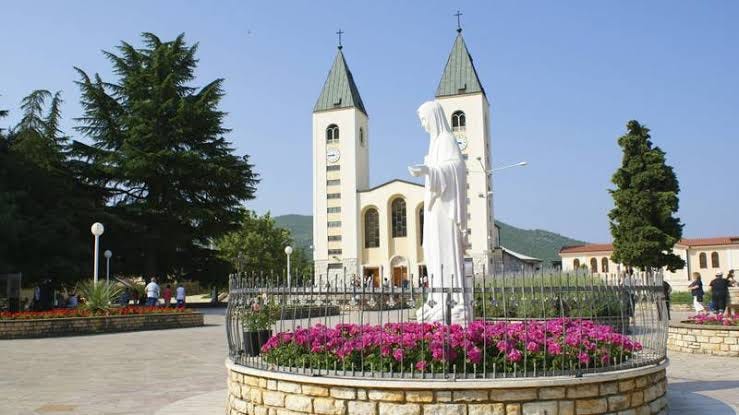
Security camera footage showed a man dousing the altar of Saint James Parish in the Bosnian town of Medjugorje with a flammable liquid and setting it on fire during the early hours of Tuesday morning. The same day, several pictures circulated on social media showing statues of Our Lady vandalized with blasphemous graffiti.
Bosnian police identified and arrested Bartłomiej Włodzimierz Krakowiak, a Polish national, as the main suspect in the vandalism the same day as the attack. According to Bosnian media, Krakowiak went on a pilgrimage to Medjugorje in 2017 after being diagnosed with depression.
According to local media, police in the nearby town of Citluk received reports in the early morning of July 28 that several statues of Our Lady had been vandalized, covering her face with black graffiti and with messages such as “Medjugorje is a deception,” “Only Jesus,” and blasphemous phrases.
Police also found a banner with the first names of the six alleged visionaries of Medjugorje with a message in Polish saying “they are fraudsters, I have evidence.”
The local parish put out a statement the same day saying: “it is with great sadness that we received the news of the act of vandalism that damaged the prayer areas in our parish. We immediately began cleaning and repairing the damage so that all areas would be properly prepared for the prayer again.”
“We thank all those who, with their work and selfless help, participate in ensuring that the sanctuary remains a place of encounter with God, a place of peace, and a place where the Blessed Virgin Mary, Queen of Peace, is honored,” it adds.
The parish invited Catholics to pray, fast, and forgive after the blasphemous attack.
“In a special way, we invite all faithful to respond to this event in the way that Our Lady has been teaching us for over forty years in Medjugorje: with prayer, fasting, and forgiveness. We pray for the conversion of the hearts of those who committed this act, that the Lord may touch them with His grace and lead them on the path of goodness.”
“We also pray for peace in the hearts of all people. Our Lady constantly invites us to be carriers of peace. May this event encourage us to take her invitation even more seriously: not to return evil for evil, but to witness love, forgiveness, and hope with our lives,” the statement says.
The statement emphasized that ordinary devotional activities at the shrine would not stop.
“The shrine remains open to all pilgrims. The prayer program is taking place regularly, and all the spaces are being rapidly cleaned and prepared so that they can once again be a place of prayer and encounter with the Lord through the intercession of the Queen of Peace.”
Thousands of young people are expected to attend the Medjugorje’s International Youth Festival on Aug. 1-6. Local media reported that the Franciscan community in charge of the shrine said that they’re not expecting any changes to the schedule and that the parish will be ready to receive the pilgrims by then.
—
An estimated 50 million people have visited the village of Medjugorje, in Bosnia and Herzegovina, since June 24, 1981, when six youngsters reported seeing an apparition of a woman bathed in brilliant light.
The six — Ivan Dragičević, Ivanka Ivanković, Jakov Čolo, Marija Pavlović, Mirjana Dragičević, and Vicka Ivanković — identified the figure as the Gospa (“Lady” in Croatian).
They said the Gospa referred to herself as the “Queen of Peace” and shared messages calling for prayer, conversion, and fasting, which are reported to continue to this day.
After decades of investigation and assessment of the visionaries’ claims, in 2024 the Vatican doctrine office offered a cautiously positive assessment of the alleged Marian messages emanating from Medjugorje, authorizing the local bishop to issue a declaration of “nihil obstat” (“nothing stands in the way”).
According to the DDF’s note, “the nihil obstat indicates that the faithful can receive a positive encouragement for their Christian life through this spiritual proposal, and it authorizes public acts of devotion.”
The DDF was careful, though, to distinguish between the positive acts of popular piety which had developed around the site, which the Vatican affirmed, and the supernatural claims of the visionaries, on which it returned no endorsement: “Evaluating the abundant and widespread fruits, which are so beautiful and positive, does not imply that the alleged supernatural events are declared authentic.”
“Instead, it only highlights that the Holy Spirit is acting fruitfully for the good of the faithful ‘in the midst’ of this spiritual phenomenon of Medjugorje. For this reason, all are invited to appreciate and share the pastoral value of this spiritual proposal.”
“Moreover, the positive assessment that most of the messages of Medjugorje are edifying does not imply a declaration that they have a direct supernatural origin. Consequently, when referring to ‘messages’ from Our Lady, one should always bear in mind that they are ‘alleged messages.’”
The dicastery’s note said “the time has come to conclude a long and complex history that has surrounded the spiritual phenomena of Medjugorje,” acknowledging that “bishops, theologians, commissions, and analysts” had expressed contrasting opinions.
The DDF also “strongly advised” that “pilgrimages are not made to meet with alleged visionaries but to have an encounter with Mary, the Queen of Peace.”
Among the fruits associated with the shrine, the dicastery highlighted vocations to the priesthood and religious life, and “genuine conversions of people who had been far from God and the Church.”
The note said the “central aspects” of the Medjugorje messages included an emphasis on peace, Christocentrism (the centrality of Jesus), the call to conversion, prayer, fasting, the Mass, and sacramental confession.
“However, a few messages stray from these positive and edifying contents and even seem to go so far as to contradict them. As a result, one should be attentive lest these few confused elements overshadow the beauty of the whole.”
In conclusion, the note said its observations created the conditions “to proceed with the determination of a nihil obstat.”
“Through the nihil obstat about a spiritual event, the faithful ‘are authorized to give it their adherence in a prudent manner,’” it explained.
“While this does not imply a declaration of the supernatural character of the phenomenon in question — and recalling that the faithful are not obliged to believe in it — the nihil obstat indicates that the faithful can receive a positive encouragement for their Christian life through this spiritual proposal, and it authorizes public acts of devotion.”
“Such a determination is possible insofar as many positive fruits have been noted in the midst of a spiritual experience, while negative and dangerous effects have not spread among the People of God.”
