
Pope Leo XVI invited participants at a global gathering to consider how the Church can proclaim the fullness of the Church’s teaching about marriage and family to people in fragile circumstances.
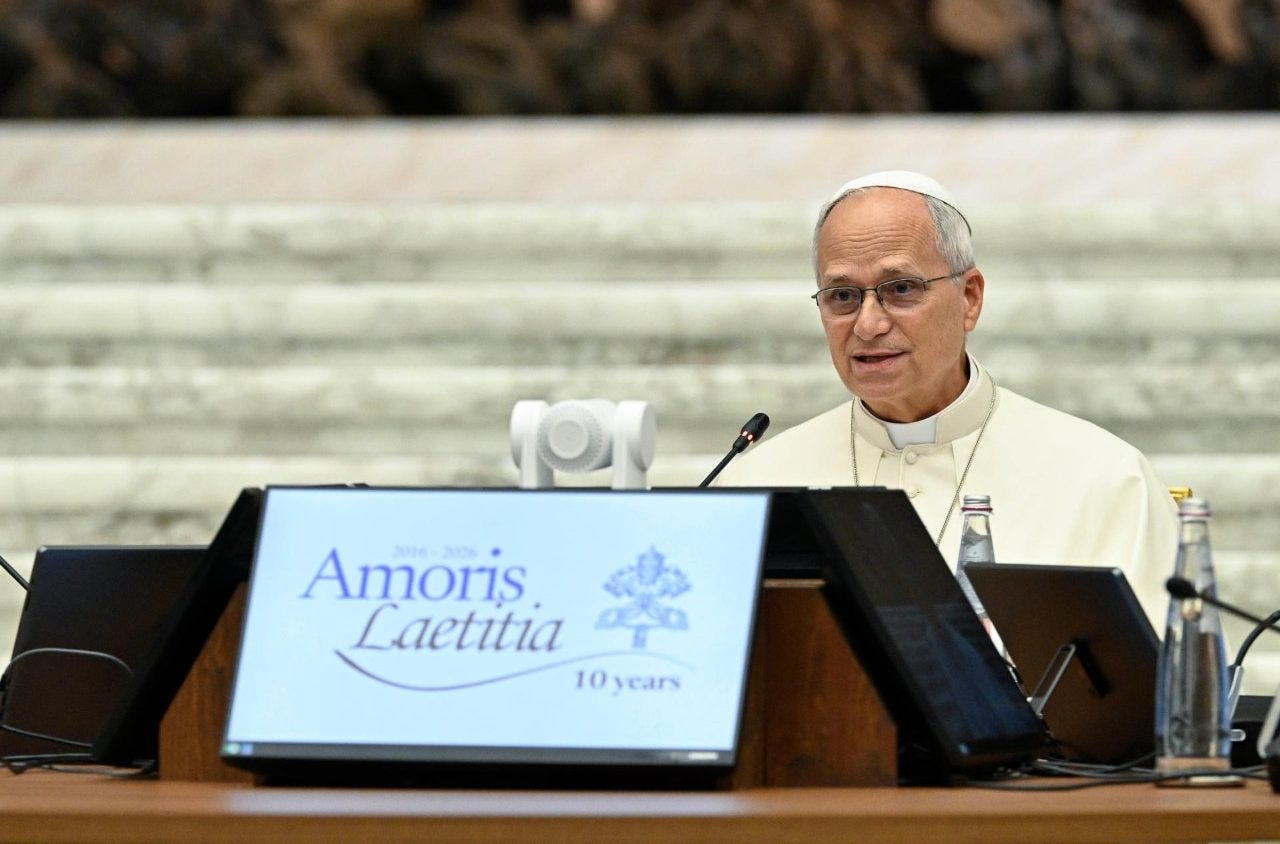
“Fragility deserves special attention, for it can profoundly shape the way people see themselves, their future, and even their relationship with God and with the Church,” the pope said in his opening remarks Wednesday.
“The experience of fragility raises the question of whether we are able to remain close to one another when life no longer corresponds to what had been hoped for, and whether we can recognize the work of grace even in situations marked by limits, wounds and apparent failure.”
The pope delivered an Oct. 7 address at the start of a weeklong gathering of bishops from around the world, convened to reflect on the 2016 apostolic exhortation Amoris laetitia.
Released by Pope Francis, Amoris laetitia was a lengthy and wide-ranging document on family life, covering topics including marriage preparation, child rearing, and the spirituality of marriage.
But the apostolic exhortation generated the most attention – and controversy – over a footnote that touched on the reception of sacraments by divorced and remarried Catholics.
The apostolic exhortation says in paragraph 305 that “a pastor cannot feel that it is enough simply to apply moral laws to those living in ‘irregular’ situations, as if they were stones to throw at people’s lives.”
The paragraph adds that “because of forms of conditioning and mitigating factors, it is possible that in an objective situation of sin – which may not be subjectively culpable, or fully such – a person can be living in God’s grace, can love and can also grow in the life of grace and charity, while receiving the Church’s help to this end.”
A footnote to the paragraph says that such help “can include the help of the sacraments” and adds that the Eucharist “is not a prize for the perfect, but a powerful medicine and nourishment for the weak.”
Later, the bishops of the Buenos Aires region in Argentina published an instruction for their priests in which they called for mutual discernment of a couple in an irregular union on whether they can receive communion and go to confession if “it is acknowledged, in a concrete case, that there are limitations that diminish responsibility and culpability.”
“Amoris laetitia opens the door to access to the sacraments of reconciliation and the Eucharist,” the bishops of Buenos Aires said.
Pope Francis later said that there was no alternative interpretation of the document, and the Dicastery for the Doctrine of the Faith said in 2023 that the pope had included the Buenos Aires bishops’ instruction in the Acta Apostolicae Sedis and it therefore was considered “authentic magisterium.”
Critics of the Buenos Aires text, and of the formulation of the footnote, argued that it appeared to run directly contrary to the Church’s sacramental discipline and teaching on marriage.
In March 2026, Pope Leo called for a global gathering of bishops to reflect on the tenth anniversary of Amoris laetitia.
The gathering, being held Oct. 7-14 at the Vatican, is entitled “Ten years after Amoris laetitia: proclaiming the Gospel with families today.”
All 115 episcopal conferences worldwide are being represented at the event, as are all 15 sui iuris (self-governing) Eastern Catholic Churches. They are joined by 11 couples or families, as well as 26 “experts” and 16 “facilitators.”
Questions had arisen ahead of the gathering about whether it would focus on the controversies in Amoris Laetitia.
Pope Leo’s opening remarks did not discuss the controversial topics in the document directly.
But the pope spoke about the need to offer “the fullness of the Gospel’s teaching about the family” to people in fragile situations.
“What kind of Church, then, do people encounter precisely when they are most fragile? Do our communities help them discover that they still have a place, a responsibility and gifts to offer?” he reflected.
He called for “renewed ways of proclaiming the Gospel, offering sacramental graces, accompanying families, and making visible the tenderness with which Christ continues to walk among his people.”
“As pastors, we have received the responsibility, in season and out of season, of proclaiming the beauty of God’s plan for marriage and the family and his call for love and tenderness,” he said. “This challenges us to accompany people as they seek to live their vocation in the concrete circumstances of their lives.”
The pope compared the meeting to Scriptural accounts of the Apostles gathering periodically to “report all that God had done with them.” He encouraged those present to share their experiences from the past decade since Amoris laetitia was released, and to face difficult questions with courage.
“In many contexts, a growing distance has emerged between the ways in which sex and intimacy are lived and the Christian vision of marriage. Young people continue to long for love, fidelity and belonging, yet many find it difficult to embrace how such a vision of love can take shape in their own lives or to believe that a lifelong commitment is the condition for reaching what they desire. Economic insecurity, migration, violence, loneliness and other forms of emotional fragility also shape the choices people make and the possibilities they can imagine for their future,” he said.
He also asked participants to listen to the lived experiences of families, and from the wisdom that they have to share.
“The Holy Spirit often speaks through the very situations that challenge us, and enlightens us that we may discover how God’s mercy and the salvific grace of Christ can reach our families today, particularly in their weakness and resilience, in their hopes and disappointments, in their longing for communion and their search for meaning,” he said.
In his welcome message to participants, Cardinal Kevin Farrell, prefect of the Dicastery for the Laity, Family, and Life, cited Pope Leo’s March 19 message announcing the October meeting, in which the pope said that John Paul II’s Familiaris consortio and Amoris laetitia “have both strengthened the Church’s doctrinal and pastoral commitment to the service of young people, married couples and families.”
“Now it is the time to reflect on the journey we have undertaken in our Churches, to look ahead to the challenges that await us and to ask ourselves what might make the proclamation of the Gospel more relevant to families, so that they might rediscover and live out their Christian vocation with greater awareness,” he said.
“We are living in a time of rapid cultural and social transformations, which have profoundly shaped the reality of the family over the past 10 years,” Farrell said, pointing to secularization, individualism, and technology as among the driving forces of this social change.
At the same time, people are experiencing “new questions about the meaning of life, and…a desire for authentic, lasting, and fruitful relationships,” he continued.
“Catechesis, essential to the Christian formation, remains indispensable, but in many contexts, it cannot on its own sustain the transmission of the faith and the development of a personal relationship with God among the younger generations. Indeed, we cannot take for granted the family and the social environment that in the past contributed almost naturally to preserving Christian life within the family.”
In an opening meditation offered to participants, Sr. Helen Alford, OP, dean of social sciences at the Pontifical University of St Thomas in Rome, also highlighted what she described as continuity between Familiaris consortio and Amoris laetitia.
Both documents, she said, “are concerned to maintain the ideal, ‘law [which] is a gift of God which points out the way,’ as well as to recognize that many are not able to fully ‘understand, appreciate or…carry out the objective demands of the law’.”
“Thirty-five years separate the two documents, during which the lived situation of Christian family life has been through many new developments. As in other cases, such as in the social teaching of the Church, when social situations are turbulent and changing quickly, it can be necessary to find new ways of putting together both the ‘objective demands of the law’ (AL 295) and the ‘law of gradualness’ (FC 34) that many experience in trying to enter into it,” she said.
“Both Familiaris consortio and Amoris laetitia try to do this in their different historical contexts.”
Alford also reflected on families as being both evangelizers and in need of evangelization. Families are often the initial place where people receive the proclamation of the Gospel, she observed.
“At the same time, many families in situations of suffering and need could derive great help in facing their trials from hearing the Good News proclaimed to them, receiving the new perspective the Gospel gives us on life and, thereby, the grace of the sacraments,” she said.
“The very stresses, tensions and brokenness in family life can be borne with more fortitude and with the hope that they can be worked through by uniting them to the sufferings of Christ.”
Reiterating Pope Leo’s emphasis on the need to accompany families in moments of fragility, Alford stressed that “The beauty of the vocation to marriage is to be found through and with and in its fragility, not least because weakness can reawaken trust in God, and trust in God awakens the desire for holiness.”
She pointed to the story of the Samaritan woman in the Gospel of John as an example of “proclaiming the Gospel to and through a person in a fragile family situation.”
Evangelization must begin with an encounter that awakens a desire in the other person, she said.
“Then comes the phase that we would like to avoid: facing the brokenness and weakness of our interlocutor, since we, too, know how much we need God’s mercy,” she continued. “Yet, according to this model, it is necessary to do that, not in order to condemn, but in order to make the encounter more real and the desire for help more insistent.”
“Only then are we called, in this model, to share what we have to teach,” she said, noting that the process leads the person who has been evangelized to then become an evangelizer to others.
Following Alford’s reflection, participants in the meeting began small group discussions, which will continue for several days, considering the themes laid out for discussion: Families today: reality, beauty and challenges; Young people and the discovery of the vocation to marriage; The first years of marriage: a decisive time; In the difficulties of life: accompanying and supporting; and Christian families as subjects of the Church’s mission.
Each group will offer a brief report back to the assembly, followed by a time for further interventions in a plenary setting.
The discussions during the five thematic days will be boiled down into a summary report. A commission including representatives of the assembly will check that the report faithfully reflects what emerged.
On the final day, Wednesday, Oct. 14, Pope Leo XIV will celebrate a Mass in St. Peter’s Square. The assembly will then discuss the summary report before entrusting it to the pope, who will offer a concluding address. The summary will be made public as a working document, rather than a text that is intended to replace Amoris laetitia.
Whatever happens out of all this, it's gonna be a grand week in the Catholic news world.
Michelle, would you cite the source of the quotes from Sr. Alford, specifically what "model" to which she is referring?
For example,
“Then comes the phase that we would like to avoid: facing the brokenness and weakness of our interlocutor, since we, too, know how much we need God’s mercy,” she continued. “Yet, according to this model, it is necessary to do that, not in order to condemn, but in order to make the encounter more real and the desire for help more insistent.”