Portuguese bishops cut payment recommendation for abuse victims
The bishops’ conference voted to significantly cut the amounts recommended by an independent commission.
After an independent body of specialists recommended financial compensation packages to victims of clerical sexual abuse, the Portuguese bishops’ conference has voted to significantly cut the recommended amounts before offering the packages to victims.
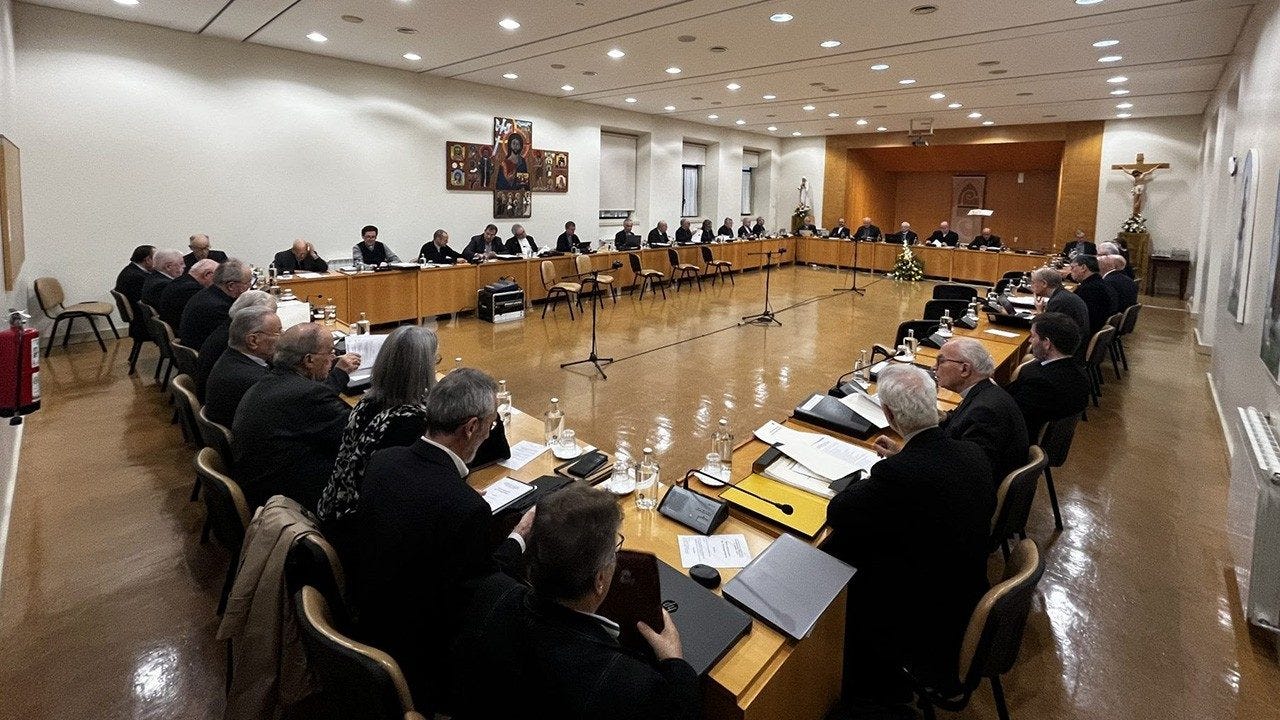
While compensation offers to victim-survivors are individually approved by the local diocesan bishops, the Portuguese bishops voted as a conference in February to apply a uniform percentage cut to compensation packages recommended by an independent panel — with the cuts believed to be as high as 50 percent.
After an independent commission’s 2023 report on clerical sexual abuse, Portuguese victims of clerical sexual abuse were in 2024 invited to present their cases to a panel of abuse experts, and to apply for financial compensation. The process applied to cases which could no longer be prosecuted in civil courts because of the statute of limitations.
Victims first relayed their situations to a pair of experts, who determined the credibility of their stories and assessed the extent of the damage suffered. The case files were then passed on to a Compensation Determination Commission (CDC) made up of seven legal experts, including two judges, lawyers and university professors of law, all working pro bono. That commission suggested compensations for each case, with the final decision on amount left to the bishop of the affected diocese, or the superior of the relevant religious institute.
The compensation proposals were analyzed by the bishops during a Feb. 27 extraordinary plenary meeting in Fatima, with several bishops expressing shock at the suggested compensation amounts, which they considered high in the context of legal precedent in Portugal, and in comparison with voluntary financial compensations paid by the Catholic Church in other European countries with higher living standards.
The bishops therefore decided to apply a uniform proportional cut to all the recommended compensations. According to one participant in the meeting, who spoke to The Pillar on condition of anonymity, the decision to apply the cut was approved by a majority of the bishops, but only after heated discussion, with some dissenting voices.
In a statement published after the meeting, the bishops said that the compensation awards ranged from 9,000 to 45,000 euros [around $10,500 to $52,000] but did not disclose the decision to cut the initially suggested amounts.
In a written response to questions posed by The Pillar, the bishops’ conference did not confirm a uniform policy of cuts, but did say that “the final amounts attributed were defined in accordance with the procedural regulation, which allowed for a distinction between the technical report and the final decision.”
“The Inquiry and Compensation Determination Commissions produced reports based on the individual analysis of each situation, and generally applicable criteria, with the final decision falling to the competent authority: the Portuguese bishops’ conference, in the case of diocesan situations, and the respective superiors of the institutes of consecrated life, in the other situations.”
The bishops’ conference added that “the determined amounts are not arbitrary. A solution was sought that was inspired in similar European experiences [5,000 euros minimum and a maximum of 60,000 euros in France, and 50,000 in Germany — around 5,700, 57 thousand and 69 thousand USD respectively], but adjusted to the reality of life in Portugal and the equitable criteria applied by our case law regarding non-pecuniary damages in crimes of this nature.”
“This is a process that cannot be reduced to a mere financial issue, foremost because no compensation can truly make up for the gravity of what happened, nor repair all that was destroyed in somebody’s life. What the Church has attempted is to make a concrete gesture of accountability and possible reparation. There is always an inevitable imperfection in such an exercise, and to recognize that is part of the honesty and humility that the topic demands,” the statement said.
The bishops’ conference e said that “the work carried out by the professionals in both commissions was extremely important” because, “without it, it would not have been possible to reach as fair and equitable an outcome as possible.”
But some members of the compensation commission told The Pillar that the decision to cut recommended amounts suggests that the group’s work and expertise was disregarded by the country’s episcopal conference.
The Pillar has also found that the nine cases which have not yet been finalized will not be assessed by the CDC, which has now ceased its work. The Pillar asked how those evaluations would be conducted, but the bishops’ conference communication department did not reply before time of publication.
Still, one member of the outgoing CDC stressed that “our work has finished. I do not know who will be evaluating the new cases, but they will have to follow the criteria applied [by the bishops’ conference] to the final compensations,” which means that any new panel of experts, if one is named, would not have the freedom that was accorded the first one, since several of its members confirmed to The Pillar that the bishops did not impose any limits to the recommendations they could make.
Exceptions for religious orders
The cuts agreed upon by bishops only apply to cases of historical abuse brought against dioceses, with the superiors of religious orders being free to follow the same criteria, or to accept the initial amounts proposed by the CDC.
At the February meeting, those religious orders or institutes were represented by the Portuguese Conference of Religious Institutes (CIRP), whose chairman and vice-chairman sit in on bishops’ conference meetings, albeit without a vote.
The Pillar asked Fr. Adelino Ascenso, chairman of CIRP, if his group agreed with or had adopted the cuts made by the bishops, but received no response.
But in a recent interview with Portuguese website Observador, the superior of the Jesuits in Portugal claimed that he had decided to pay the amount proposed by the compensation committee..
Contacted by The Pillar the Jesuit superior reaffirmed this, adding that he had the final say in the case involving his institute. But he did not comment on the cuts agreed upon by the bishops’ conference.
Differing criteria
The discrepancy between the independently recommended compensation amounts and those adopted by bishops’ conference appear to rest on a different reading of the relevant criteria for compensation.
The bishops considered that the values proposed by the CDC were much higher than what Portuguese civil courts regularly apply in cases of sexual abuse. But one member of the CDC told The Pillar that the commission abided strictly by regulations proposed by the bishops’ conference, which say that: “The amount of compensation shall take into account the values established within the scope of civil liability as compensation for non-pecuniary damages in the case law of Portuguese courts. Consideration will also be given to indemnities already awarded in civil jurisdiction, as well as other amounts already agreed upon and received out-of-court.”
The regulation also states that “financial compensation shall constitute a significant benefit that is proportionate to the assessed gravity of the harm.”
The bishops’ conference regulation does not specify that the criteria for determining compensation amounts should be singularly the compensation awarded by civil courts in cases of sexual abuse.
Instead, the document gives the CDC full freedom in its assessment: “The choice of methodology for determining the amount to be awarded is the responsibility of the Compensation Determination Commission. The Commission shall take into account the type of abuse committed and an overall assessment of the case, including other relevant criteria, on a scale ranging from the least serious to the most serious situations brought before the Commission, ultimately selecting the final amount to be awarded.”
A member of the CDC told The Pillar that “Portuguese courts tend to award low damages in cases of sexual abuse, but there is a reason for that. Often the culprit does not have financial means to pay more, and besides that there will often be a prison sentence.”
“It’s true that the prison sentence has a punitive nature,” the conference member said, “and the damages have a reparatory nature, but all things considered, and taking into account the prison sentence, the damages awarded tend to be lower. That is the context that has to be taken into consideration, one of insufficient economic means and, generally, prison time.”
On the other hand, he explained, “damages awarded by courts to people whose lives are wrecked in a traffic accident can be as high as 200 thousand or 300 thousand euros [230 thousand and 346 thousand USD]. And in the cases we considered, people did have their lives destroyed by these barbarous acts.”
The Pillar spoke to several people who were familiar with the compensation process, CDC members, members of diocesan commissions, bishops and others, but none would confirm individual compensation amounts proposed by the CDC, citing the confidentiality to which they are obliged under bishops’ conference regulations.
However, The Pillar has managed to ascertain that the maximum criteria adopted is closer to the standard damages applied by civil courts to cases of death, which is around 100,000 euros [$115,000].
Even allowing for the possibility that none of the compensations actually met that bar, but supposing an amount closer to 90,000 euros, which more than one source cited as credible, that would still imply a 50% cut, considering the bishops indicated that the highest compensation is 45,000 euros.
Lack of transparency
While the bishops had reserved from the start of the commission’s work the right to determine final compensation amounts, some CDC members told The Pillar that process and decisions of the conference reflected a lack of transparency, not only towards survivors of abuse, but to society at large.
CDC members stress that the final amounts are nowhere near what they suggested, and say they would like the bishops to make that clear — CEP statements have only said that the final amounts were reached “taking into consideration” the CDC reports.
The Pillar has also confirmed that victims who received compensation were not informed of the discrepancy between the value proposed by the CDC and the final figure approved by the bishops.
None of the public statements made by the bishops have mentioned a policy of discounting the amount either.
“We keep doing this. We take one good step, and screw it up with the second. When the Church created the Independent Commission, that was a good thing, but then the way we treated the findings was terrible. Now we created this mechanism to provide victims with compensations, which was a good initiative, but we messed it up with the confusion and lack of transparency” said one senior cleric involved in the compensation process.
Another individual involved with the investigative process said that “you could even justify the bishops’ final decision, but they should have been clear about it, and they weren’t. They should have said that these are the values, and explained how they reached them.”
According to the bishops’ conference, 95 people applied for financial compensation, of whom 78 were considered initially eligible. Eleven of those claims were later rejected, and 66 cases approved for compensation. Fifty-seven have had compensation already awarded, and nine others are pending analysis. One case was still awaiting a judicial decision by the Holy See when the bishops issued their statement.
The total amount of the compensations already awarded in this process is slightly more than 1.6 million euros, not taking into account the nine cases still under review.

