Post-Maduro, is the Vatican a diplomatic player again?
Reports that the Holy See was involved in last-minute negotiations over the fate of Maduro might signal renewed influence for Vatican diplomacy.
The global diplomatic landscape remains unsettled, following the abduction of former Venezuelan leader Nicolas Maduro by U.S. forces on Jan. 3.
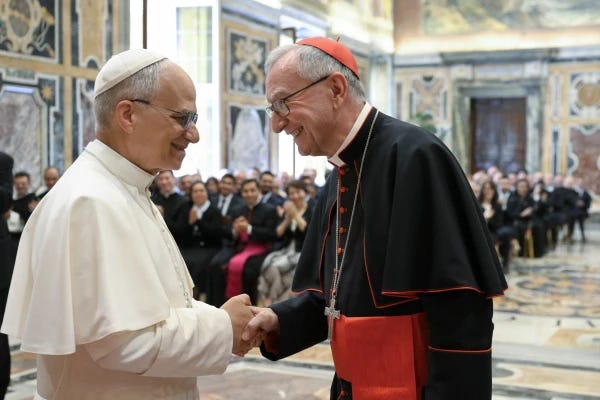
Pope Leo XIV and Cardinal Pietro Parolin. Credit: Vatican Media.
The future of Venezuela, its economic and political health, and basic questions of who runs the country have no immediate answers. Meanwhile, the prospect of new U.S. interventions in nations like Greenland and Cuba have triggered a global rethink about effective diplomacy and the prospect of other previously unthinkable developments.
But amid reports that the Holy See was involved in last-minute negotiations over the fate of Maduro, might the emerging new normal bring with it renewed influence for Vatican diplomacy?
Could the Holy See, led by an American pope, emerge as a newly credible player, especially in the geopolitics of the Western hemisphere — and if so, what might that mean for local Churches?
—
The pre-dawn mission to capture Nicolas Maduro and bring him to the United States to stand trial on charges of narco trafficking and other crimes caught the world by surprise, both for its boldness in removing the dictator from office and the country, and for the speed and efficiency of the military intervention.
But, as has since emerged, the suddenness of Maduro’s removal did not mean it was a complete surprise to everyone.
According to the Post’s report, Parolin told the ambassador that Russia was willing to host Maduro in exile, and asked for time to persuade him to step aside and leave Venezuela voluntarily, thereby avoiding bloodshed and instability.
Maduro did not – despite reportedly urgent recommendations to the contrary – choose to step down, and was instead captured in a military raid, leading to several dozen casualties among his protection force.
While the lessons of the past month have been learned too late by Maduro, there are some instructive points to draw from his fate, and the weeks and months leading up to his capture.
The Holy See has, for years, sought to leverage the credibility of the Church in Venezuela to act as a kind of honest broker in the country, while striving to keep Vatican diplomacy separate from the local episcopal hierarchy. At one point, the Holy See has even stepped in to chair post-election talks between Maduro and the opposition, even if these ultimately did not result in the regime agreeing to any relaxation of its grip on power.
Maduro’s government, in turn, appeared happy to attempt to use the Church when it could — spinning the Vatican’s diplomatic wheels, attempting to turn the canonization of the first Venezuelan saints into a patriotic celebration of the regime — while exerting pressure over domestic episcopal appointments and cracking down on local priests critical of the regime.
The now former dictator’s decision to, by all appearances, not take the Vatican very seriously looks like a serious miscalculation, with the benefit of hindsight.
Meanwhile, the Vatican has seemingly proven itself to be more alert to the urgency of Maduro’s position than was the man himself. And the Holy See was diplomatically influential enough to have apparently confirmed a place in exile for Maduro in Russia, and have known about the U.S. plans for direct intervention in time to bring the case for delay to U.S. diplomats.
This lesson seems to have been noted already by the putative winner of Venezuela’s last election, Maria Marchado, who has not featured much in the conversation or calculus for the post-Maduro government of the country. She started this week with an audience with Pope Leo, perhaps understanding that this may be a savvy prelude to a meeting with Trump on Thursday.
Others in the region may now reconsider before making Maduro’s mistake, and perhaps start paying closer attention to the Holy See’s diplomatic overtures. That, in turn, could bring with it the possibility of more elbow room in countries where the Church has found itself squeezed badly by authoritarian governments.
Shortly after Maduro’s removal from power (and the country), the Trump administration started overtly discussing the possibility of similarly robust interventions in Cuba, a country where the Vatican has invested significant diplomatic effort with little obvious return, while the domestic Church has labored under deteriorating circumstances.
The Cuban government might consider that the Vatican could become a suddenly influential partner to court, if not for the power to stave off U.S. action at least for the possibility of the Holy See acting as a temperature-lowering intermediary and potential source of timely warnings ahead of an intervention.
Similarly, the Ortega regime in Nicaragua has reacted immediately to post-Maduro pressure from the United States, signaling it will release dozens of political prisoners in response to public criticisms from the American State Department, including condemnation for the imprisonment by the regime there of “pastors, religious workers, the sick, and the elderly.”
Of course, many of those pastors and religious workers are Catholics, including priests, as a result of a years-long systematic crackdown on the Church in the country.
In addition to seizing Church property and assets, arresting and imprisoning clerics — including bishops — and forcing dozens more into exile, local sources have suggested that the country’s Cardinal Leopoldo Brenes was prevented from travelling to Rome last week for the consistory of the College of Cardinals out of concern he might not be let back into the country if he left.
Indeed, of all regimes which might now rethink their relations with the Vatican, Ortega’s would seem to have the most ground to make up, with virtually no formal diplomatic ties left to strengthen — the last papal nuncio to the country was expelled in 2022.
Ortega, more than most authoritarian leaders, will, or ought to have been, aware of the real possibility of American intervention against him, having seen his previous regime systematically undermined by U.S. aid to the contras movement in the late 1980s.
Ortego, too, will likely remember well the fate of Manuel Noriega of Panama, who was similarly subject to direct military removal by American forces in 1988 to face drugs charges in the U.S. — but he might also consider that while attempting unsuccessfully to negotiate a departure into exile after the American invasion of Panama, the only place the dictator could take refuge was the apostolic nunciature.
The Nicaraguan dictator might choose to learn the lessons of history, past and recent, and find it expedient to reapproach the Holy See and restart diplomatic links.
—
Of course, the Vatican’s sudden diplomatic relevance is amplified by the fact of Leo being elected the first American pope at a moment when American foreign policy is at its most unpredictable. But it would be a mistake to credit it entirely to circumstance.
For years, the Holy See has engaged in patient diplomatic overtures to various authoritarian governments in Latin America — often in the face of outright hostility in response, and criticism from observers, who faulted Rome with not speaking forcefully enough in defence of local Catholics.
At the same time, the Vatican has pushed itself to the center of negotiations in the epicenters of global conflict, military and diplomatic, like the invasion of Ukraine. This was most especially visible with Pope Francis’ appointment of the Italian Cardinal Matteo Zuppi to serve as his personal papal peace envoy.
While tangible diplomatic “wins” have been thin on the ground for the Vatican’s efforts to serve as negotiator and honest broker amid the war in Europe, one result of the Holy See forcing itself into the middle of the diplomatic conversation is that the Vatican is now, clearly, accepted as a voice and actor in that conversation — it is neither unusual, nor even especially remarkable for an ecclesiastical figure like Zuppi to visit Washington, Moscow, or Beijing and be received with senior status.
Parolin’s apparent foreknowledge of impeding U.S. action in Venezuela and his ability to communicate Russia’s willingness to offer a place in exile for Maduro, had he chosen to go, seems like proof the Vatican’s efforts to be in the conversation at the highest levels have not been totally in vain.
The question now would seem to be: will countries like Cuba and Nicaragua recognize this, and see the benefit of real renewed engagement with Rome?
If they do, the Vatican will have to decide if it is willing to spend some of its newfound diplomatic capital on behalf of the Church in those countries, and how best to do it.

