Priest reassignments spark ‘syncretism crisis’
South Africa parishioners plan to appeal the reassignment of their pastor, who reportedly engages in traditional African healing practices.
Parishioners in South Africa plan to appeal Wednesday against a decision to reassign their pastor, which they believe was taken because the priest reportedly engages in traditional African healing practices.
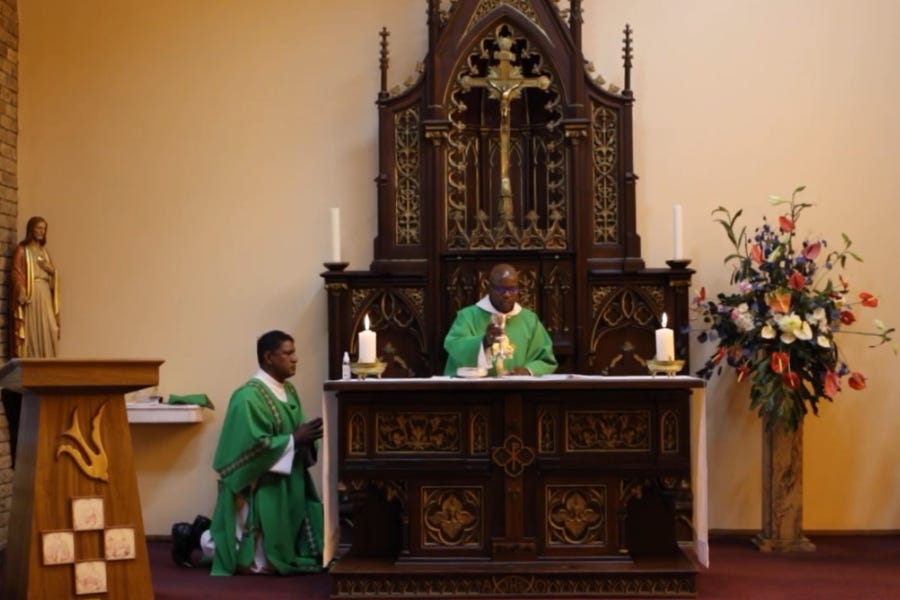
Members of the Church of the Immaculate Conception in Pinetown, KwaZulu-Natal, hope to meet March 11 with Archbishop Mandla Jwara of Durban, to discuss why their priest was placed on an involuntary sabbatical.
Fr. Sifiso Ndlovu, who has served as pastor of the Pinetown church since 2021, is one of two clerics in the Durban archdiocese who have been dubbed “the poster priests for syncretism” by the Sunday Tribune newspaper.
The other priest, Fr. Thembelani Ngcobo of Sacred Heart Parish in Montclair, who has a large social media following, has also been placed on an involuntary sabbatical, the Durban-based paper reported March 8.
Neither priest appears to have publicly acknowledged any engagement with traditional healing practices. But their reassignments have generated a controversy that the Sunday Tribune has called a “syncretism crisis.”
The personnel moves in the Durban archdiocese follow a joint pastoral letter issued in September 2025 by eight KwaZulu-Natal bishops that cautioned priests against syncretism, which they defined as “the blending of Catholic beliefs and practices with traditional African practices (esp. ubungoma) in ways that contradict the Gospel.”
Ubungoma is a Zulu term referring to traditional healing and divination practices of the Nguni people, a cultural group native to Southern Africa. Ubungoma is practiced by a traditional healer or diviner known as a Sangoma, who is seen as a conduit between the visible and invisible world.
The joint letter, whose signatories included Archbishop Jwara, expressly prohibited priests, deacons, religious, and lay people from participating in any syncretic religious practices, “including but not limited to slaughter of chickens, use of colored water, colored candles, blessing of non-liturgical wild dancing, and healing ritual services outside of Catholic liturgical practice.”
It said: “Any priest or religious found to be promoting or participating in such practices will be subject to immediate correction, including ultimately suspension from ministry. If unrepentant, he or she will be removed from ministry, in accordance with canon law.”
Jwara has not commented publicly on the two priests’ reassignments. The Sunday Tribune said it became aware of the moves after it received a leaked letter listing upcoming clergy changes in the Durban archdiocese. The paper published the full list of moves that will come into effect in April, which included the names of new pastors for the parishes in Pinetown and Montclair.
The bishops’ September 2025 intervention reportedly provoked a backlash among Catholics in KwaZulu-Natal. Jwara clarified in October 2025 that the episcopal joint letter sought to discourage priests from performing traditional healing practices, rather than serve as a blanket condemnation of ancestral veneration, a deep-rooted custom in South Africa.
“The main thrust of our recent joint statement was to address priests who engage in the practice of ubungoma in the Church/in parishes, and by doing so generate confusion among the faithful, as well as commit liturgical or pastoral abuses,” he said.
There are said to be 69,000 registered Sangomas in South Africa, including white South Africans. Sangomas are believed to communicate with ancestral spirits through rituals such as throwing bones for divination, burning sacred herbs, or entering a trance state.
The Catechism of the Catholic Church teaches that “all forms of divination are to be rejected.” Nevertheless, some South African priests, religious, and lay people are reported to engage in ubungoma.
In 2019, the Southern African Catholic Bishops’ Conference asked its theological advisory committee to research ubungoma in its member countries of Botswana, Eswatini, and South Africa, in response to growth in the practice, especially among young people.
The bishops’ conference discussed the committee’s research at a January 2025 plenary meeting. The research was aimed at helping the bishops of Southern Africa to adopt a common stance on the topic.
Thokozani Zulu, a member of the Immaculate Conception parish in Pinetown, told the Sunday Tribune that some parishioners wept when they were told there was little chance of successfully challenging the decision to reassign Fr. Sifiso Ndlovu.
“We are saddened because we have come a long way with Fr. Ndlovu. When he arrived here five years ago, the congregation was a handful of faithful who’d fill only two rows of benches. Today, the church is fully packed because of him,” said Zulu, a well-known South African musician.
He explained that a group of parishioners planned to meet with Archbishop Jwara and ask for Fr. Ndlovu’s term at the church to be extended, if the decision to move him cannot be reversed.
Zulu noted that some church members had threatened to withhold their monthly offerings or leave the parish as a result of the decision. Some were even considering exiting the Church, he said.
Zulu said that Fr. Ndlovu had never engaged in traditional healing practices on parish premises or at church events.
“When we are at the house of worship, there is no telling that he dabbles in traditional practices. He delivers his homilies in the manner familiar to Catholics. That is why we are saying we have no problem with his traditional practices,” he said.
Zulu suggested that Church authorities only became aware of the priest’s involvement in traditional rituals when a parishioner invited him to assist in a ceremony, took a photo, and shared it with the pastor’s superiors.
In his October 2025 clarification, Archbishop Jwara underlined that priests are representatives of Christ and therefore “cannot serve two masters.”
“His very life must be a witness and testament to the person and message of Christ, admitting of no duality that would diminish or displace Christ or the Gospel, or lead to scandal among the faithful,” he wrote.
He added: “As bishops, we have no control over what people do privately in their homes, rather our concern is that whatever ancestral rituals are practiced privately at each family should not be brought into our liturgical celebrations.”
“Let us pray that, just as the vine is pruned by the vinedresser, our cultures may be pruned by Christ of any practice incompatible with our faith.”

Aw shucks. I guess I'll have to rescind my application to witch-doctor medical school after all...
"“When we are at the house of worship, there is no telling that he dabbles in traditional practices. He delivers his homilies in the manner familiar to Catholics. That is why we are saying we have no problem with his traditional practices,” he said."
This quote--really all of Mr. Zulu's quotes, if they are accurate--is a massive indictment of whatever catechesis Catholics in Durban received