‘Providential’: Bishop Hansen on Oslo’s new shrine for persecuted Christians
Hansen received a proposal to establish the shrine in 2025, months after being consecrated Bishop of Oslo, following a Vatican diplomatic career.
A priest was killed in Sudan’s Nuba Mountains the day before Bishop Fredrik Hansen inaugurated a new shrine dedicated to persecuted Christians in Oslo, Norway.
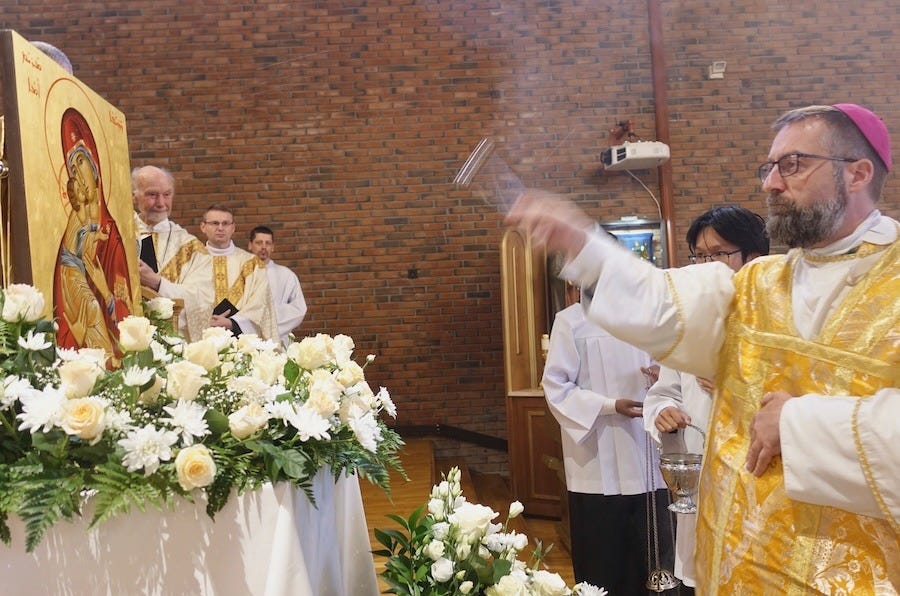
At first glance, these two events thousands of miles apart might seem unrelated. Fr. Youhanna Al-Amin was killed June 19, reportedly in retaliation for denouncing the theft of medicine intended for the local population. Hansen inaugurated the shrine to Mary, Mother of Persecuted Christians, June 20 at the Church of St. John in Oslo’s Bredtvet neighborhood.
Yet in the communion of the Church, everything is connected. The new shrine’s purpose is to give Catholics a place where they can pray together for priests and laity confronting dangers similar to those faced by Fr. Youhanna.
Hansen received a proposal to establish the shrine in August 2025, seven months after he was consecrated as Bishop of Oslo, following a Vatican diplomatic career. The idea came from Fr. Benedict Kiely, an English priest of the Personal Ordinariate of Our Lady of Walsingham who runs Nasarean.org, a charity supporting persecuted Christians.
As part of his mission, Kiely invites bishops around the world to install shrines with an icon of Mary, Mother of Persecuted Christians. The image is an Eleusa icon, with an inscription in the top-left corner that reads “Mary, Mother of Persecuted Christians” in Aramaic, the language spoken by Jesus. Shrine locations include New York, London, and Stockholm, as well as Astana in Kazakhstan and Qaraqosh in Iraq.
The shrines draw attention to — and encourage prayer for — the estimated 338 million Christians facing some form of persecution worldwide.
Norway might seem like a surprising place for a Catholic shrine devoted to persecuted Christians. But the nation’s growing Catholic community includes people from more than 180 countries, some with firsthand knowledge of persecution in their homelands.
In an email interview on the eve of the inauguration, Bishop Hansen discussed his own awakening to the scope of anti-Christian persecution, why he decided to establish the new shrine, and his hopes for its future.
When did you first become aware of the scale of the persecution of Christians worldwide?
Ten years ago, I was stationed as a papal diplomat in Vienna, Austria, at the Holy See’s mission to several international organizations. In one organization, the human rights portfolio included work on intolerance and discrimination against Christians in the Northern Hemisphere.
In the United Nations and beyond, the horrific atrocities committed by ISIS, also against Christians, were coming to light. It was not difficult to conclude that the anger and hatred directed against the followers of Jesus Christ are a global reality.
Why did you accept the invitation to establish a shrine to Mary, Mother of Persecuted Christians, in the Diocese of Oslo?
I believe that much greater focus needs to be directed both toward the plight of persecuted Christians and toward our shared obligation to pray for and support them.
I consider it providential that just as I began my episcopal ministry and started looking at priorities for our diocese, the offer of the icon and the idea of a shrine was presented to me.

Why did you choose the Church of St. John in Bredtvet, Oslo, as the new shrine’s location?
For two reasons. First, it is the largest Catholic church in the city of Oslo and will, therefore, ensure the shrine’s prominence.
Second, a significant number of faithful in the parish are themselves from countries where the memory of intolerance or persecution is strong, such as Poland, Lithuania, and Vietnam, or from countries where Christians today suffer violence and persecution, including Nigeria, Myanmar, and India.
Why do you think that — in addition to material support and advocacy — prayer for persecuted Christians is important?
Our Lord said: “Ask, and it will be given you” (Mt 7:7). Placing our suffering brothers and sisters before God and calling for His aid is therefore an expression of our faith and a specific act of assistance for them. It also reminds us of our need to do more, including material support and public advocacy.

Have you had any encounters with persecuted Christians? If so, what struck you about them?
In my visits to our parishes, I have met many people who have been affected by persecution in various ways. Either themselves, or their families and communities. My priests tell of similar experiences.
What I find striking is the joy and hope they all seem to share. Despite the horror they have seen or that has hit so close to home, these two so fundamental Christian characteristics — joy and hope — are dominant. What a witness they are for us.
What role do you hope the shrine will play within the Oslo diocese?
It is my hope that the shrine will strengthen the collective work of our local Church for Christians who suffer for their faith.
With its inauguration this weekend, we have arranged talks and presentations, as well as held planning meetings — including with partner organizations — to map out future efforts. And all of this will be supported by the prayers at the shrine — for years to come.
