‘Reality grounded in faith’ - Daly on Spokane wildfires
"This is a very difficult time. It’s devastating. But Christ is with us."
Firefighters are racing to fight a trio of fires in Spokane County that are currently threatening thousands of homes.
Three fires just north of downtown Spokane ignited on Saturday, and are continuing to burn a span of more than 10,000 acres, with no containment so far.
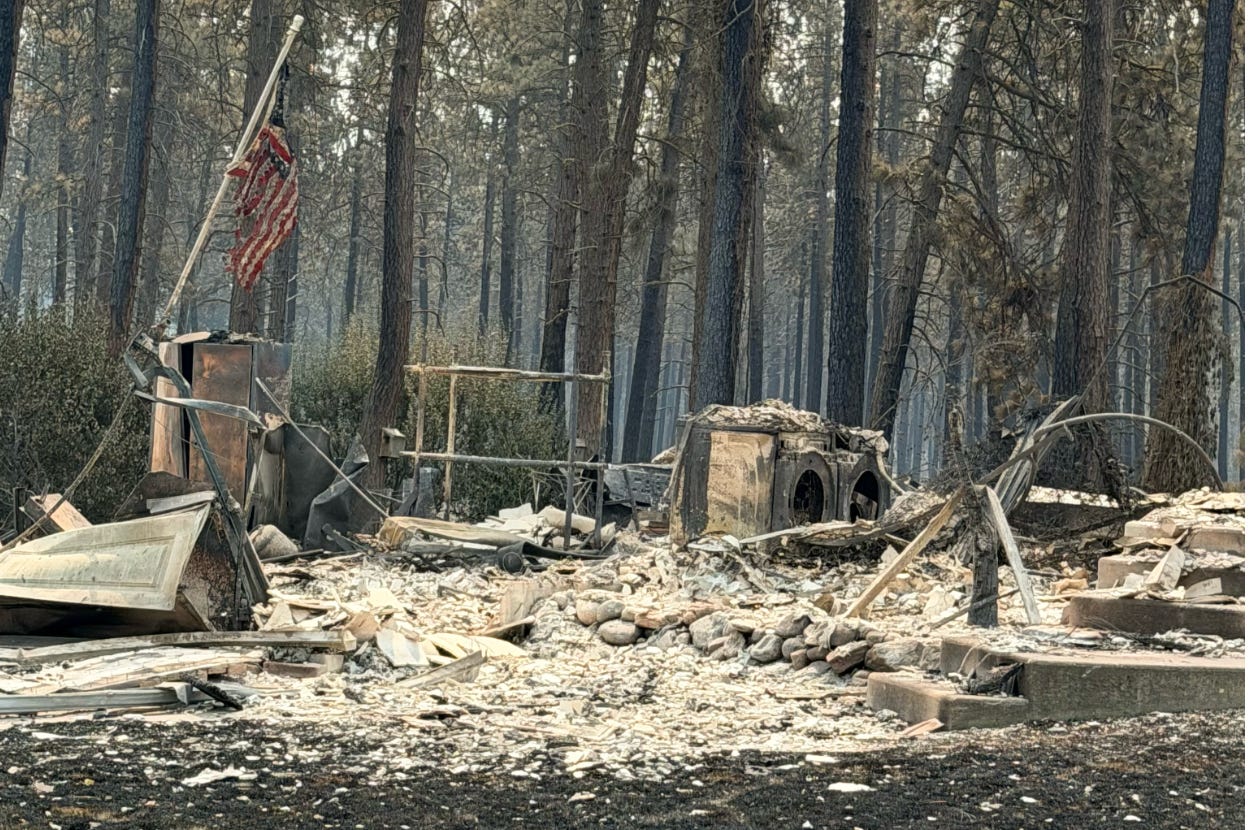
Officials have said it is the most destructive wildfire situation in the state’s history, largely because of the fires’ vicinity to residential neighborhoods.
As of Monday night, there had been no fatalities reported in the fires, but some 65,000 people had been evacuated.
With hundreds of homes destroyed, and many more threatened by the urban blaze, Bishop Thomas Daly of Spokane knows that his people need hope amid the devastation all around them.
The Pillar spoke with Bishop Daly about his pastoral response to the fires, what he expects to see in the rebuilding process, and the message of hope he wants to offer those who are being affected by the tragedy.
That interview is below. It has been edited for length and clarity.
Bishop, tell me about what you’ve seen in the areas affected by the wildfires in your diocese.
We toured on Monday — myself, our vicar general, and our director of communications, with one of the police officers — the areas impacted by the fire.
The fire’s devastation is on the north side of Spokane, primarily in two parishes, where residential areas have been evacuated.
More than 600 structures have been destroyed, and you just see the neighborhoods of homes that were built in the 1970s and 1980s which have been completely destroyed — just devastated.
I visited with one family that I know very well; they come to our cathedral for Mass. It’s a husband and wife with grown kids, who just remodeled their home — and that home was completely destroyed.
But their response was encouraging: “At least we’re all safe.”
One police officer said to me that he expects that people who were evacuated will soon feel the panic of what they’ve experienced. “It’s going to hit them about the panic,” he said, “when they had to evacuate, when cars were backed up as the fires were coming up the hill, and over through the trees and the forest.”
People had to leave immediately, which meant they left pets, and they left stuff that was really valuable. So there’s going to be a lot of post-traumatic stress over this, that we ought to be attentive to as the Church.
There has been a great outreach of concern. A friend of mine in California asked me today: “Why do your people seem calm?”
And I think it’s because, basically, they realize that their first priority was: “At least we’re still alive.”
It wasn’t about what they’re owed, or anything else.
Some of the politicians are bound to use this, not as a tragedy to care for people, but to make it a political issue right away.
But right now, I think there’s a level of calm, because there haven’t been so far any deaths reported. Still, it’s just devastating to see just the destruction.
Can you talk to me about the pastoral response you make to a tragedy like this? And then the humanitarian response you’ll make with Catholic Charities. How do you approach each of those things?
Well, I think the pastoral response is, first, to know where your people are.
People are evacuated. Some are with relatives. And our Immaculate Heart retreat house has opened up.
Rick McLean, the director of the retreat house, said “we can take people in.” And that’s a part of our pastoral approach.
Our two parishes in the area — Assumption and St. Thomas More — are on site finding out what the needs of the parishioners are. Right now, those are immediate needs — housing, foods, things like that.
On the immediate needs, Catholic Charities, the Society of St. Vincent de Paul, and the Red Cross are all working together.
St. Vincent de Paul is very much on the grassroots level, and the Red Cross and Catholic Charities are working at a bigger footprint — and the Archdiocese of Seattle has offered to assist as needed.
The secondary response will be about the [long term] impact. School’s going to start in a few weeks. And the chance of homes being put together, even somewhat, before winter comes is going to be very, very slim.
We have to be prepared for the long haul on the impact on parishioners and family life, when it’s going to take them a lot longer than they imagined to get back into some normalcy of life with housing.
Where are people going to live when they’re dealing with insurance companies? Are there sufficient contractors?
Because you know, when you don’t have a place to live, being displaced is very unsettling, and it becomes even more so with school-aged kids. So we have to be prepared for that.
In fact, that’s probably going to be the greatest need, the long-term impact on families as they try to get some normalcy of life in the months ahead, after they answer the immediate questions: Where am I going to sleep tonight? Where am I going to get my next meal? Have I gotten everything out of my house that I need, if my house has anything left?
I’ve been struck by the images we’ve seen over the past year of Pope Leo, as Bishop of Chiclayo, Peru, being present to his people when they face disaster. And it seems like that’s a template for bishops to be reminded to be with their people in these kinds of disasters when they come.
It is, as much as we can.
And thank God, Father Connall, who is our vicar general, was able to talk with a police officer whose son is entering the seminary in a few weeks. He took us through the blockade, letting us see the sites where people have been impacted.
It was there that we talked with people — Catholics who we know from the cathedral — who had lost their home, but who told us they were ok, because “we’re safe and our children are safe.”
Normally when we think of these wildfires, they’re out in the fields, in farming or wooded areas. To see residential areas destroyed is very different.
It sounds like visiting these homes was really affecting for you.
It was. I was doing the wedding of [a friend] in Lake Tahoe, and as I was getting ready to fly home, a neighbor said, “you might not be able to make it home, because of the smoke.”
I did make it home. But … I’m not used to residential fires burning like these are burning.
As a boy, our own house caught fire, and we moved.
But this, in Spokane, is just devastating, as you see it. And it’s hard to understand — in one area you’ll see one house burned while the fire left the others, but then you’ll see entire blocks that are burned.
As a kid — it took just a few months to rebuild the house, and that was 50 years ago. Now, I mean, people will have to find the contractors, and they’re going to be fighting with insurance companies, and it could be a couple years, I think.
You mentioned concern about the way wildfires might be politicized. On the other hand, the Church is called to care for the earth, our “common home,” as Francis called it. How do you approach the discussion around a growing frequency of wildfires in proximity to residential areas, and the questions those raise?
I think in the midst of this fire, the key is to stay focused on the immediate needs of the people.
People have been displaced. Their whole livelihood has just been ripped from them. So let’s deal with that first, and let’s not use someone’s tragedy to further a cause — whether you’re going to use it for fundraising or you’re going to use it to talk about climate change.
It was great working with the police officers and the firemen.
We talked with the officers who have to make sure that the neighborhoods remain safe and that people eventually will be let in if their houses are still around.
So as you’re taking in a tragedy like this, where do you see the Lord?
These are the moments when you need someone to be with you who says, “I’m with you to the end of the age.”
And then, look at the Church’s rich tradition of responding in quiet ways to the needs of people — “what you’ve done for the least of these, you did for me.”
This is not a time to be calling press conferences. A friend mentioned that since the fires began I haven’t issued a statement.
I said, “I’m going to go visit the site first and see what the devastation is before issuing a statement on what’s happening.”
Look at Scripture: When there’s been famine, when there’s been destruction, when there’s been pestilence, you can’t lose hope that the Lord is there.
The best definition of hope is this: “reality grounded in faith.”
The reality is that this is a very difficult time. It’s devastating. But Christ is with us, and he’s calling us to reach out of ourselves for people.
And people are doing that — There’s a generous spirit here. And thank God for that.


Thank you for sharing this interview; excellent insights and outreach on the part of Bishop Daly and the diocese. Continuing prayers for all those affected by these wildfires...
Solid pastoral response. Substantive. Great stuff. Praying for those suffering.