
The current bishop of Rochester encouraged Catholics to remain close to the Eucharist as the source of their efforts to evangelize, following the example of Blessed Archbishop Fulton Sheen.
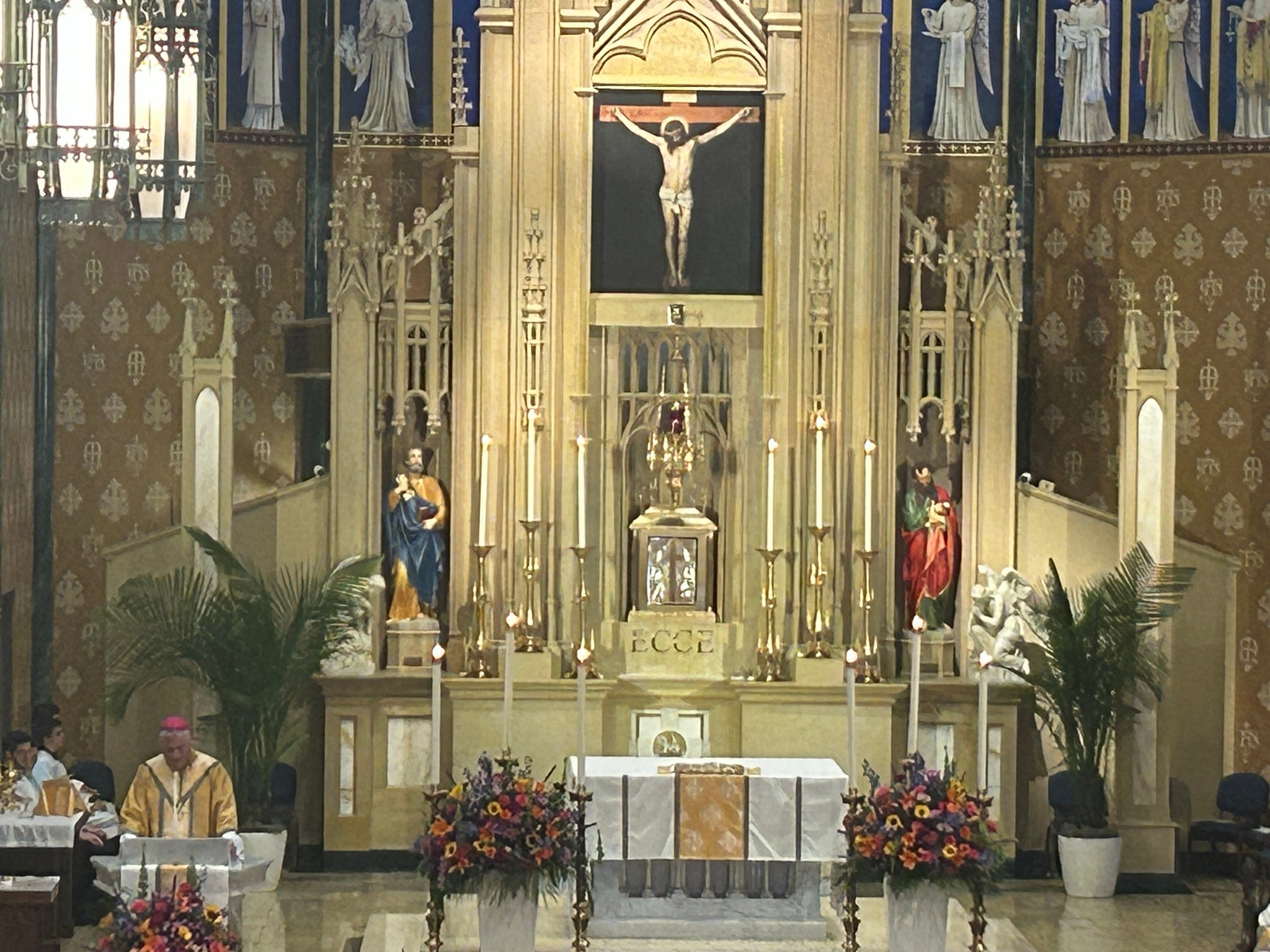
“Long before television cameras and national fame, Sheen was a priest convinced that fruitfulness begins on one’s knees,” said Bishop John Bonnici of Rochester at a Sept. 25 Mass of Thanksgiving for the beatification of Archbishop Sheen.
Bonnici celebrated Mass at the cathedral of Peoria one day after Sheen was officially declared blessed at a Sept. 24 Mass at The Dome at America’s Center in Saint Louis.
Ordained a priest in 1919, Sheen became a professor at The Catholic University of America and was appointed an auxiliary bishop of New York in 1951.
He was most well-known for his radio and television programs. He hosted the popular prime time show “Life is Worth Living” as well as “The Fulton Sheen Program” in the 1950s and ‘60s, winning an Emmy award for his television work.
Sheen became Bishop of Rochester in 1966 and remained in that office until his retirement in 1969.
In his homily, Bonnici emphasized that Sheen never lost sight of his priestly ministry, despite his fame.
He recalled the impact that Sheen had, not only through his nationally renowned radio and television shows, but through his ministry as a priest and bishop.
In particular, Sheen left his mark on the Diocese of Rochester, despite only serving as bishop there for two years and 10 months, Bonnici said. He recalled the archbishop’s commitment to pastoral visits, implementing Catholic social teaching, fostering devotion to the Blessed Mother, and encouraging prayers for vocations.
In reflecting on the life of the archbishop, Bonnici warned against the temptation to merely admire Sheen without allowing his life to prompt action.
“The Church does not raise up blesseds and saints to create a museum of remarkable Catholics,” Bonnici said. “She holds them before us so that their lives may ask something of ours.”
He invited Catholics to allow Archbishop Sheen’s life to challenge them to grow in holiness.
“Let us not be afraid to use every wordly means to proclaim the Gospel,” the bishop said, adding that while Sheen used radio and television to evangelize, contemporary Catholics should see the media of their own day – including podcasts, phones, and social media – as venues to share the Gospel.
“Every generation must find faithful ways to have the unchanging Gospel into the places where people are actually listening,” Bonnici said.
In working to evangelize, he advised Catholics to remain rooted in the Eucharist as the source of their work.
“Sheen repeatedly spoke to the daily Eucharistic Holy Hour as the source of his priestly perseverance,” the bishop said. “Before he spoke about Christ, he sought to remain with Christ. Before he addressed the world, he placed himself before the Lord.”
“Let us always, always return to the Eucharist. If we want to speak convincingly about Jesus, we must spend time with Jesus. Our activity, our ministry, our work must grow from adoration,” he continued.
Evangelization flows from the Eucharist, the bishop said. But sharing the Gospel cannot be limited only to words, he continued, encouraging acts of mercy and generosity to live out the Gospel in action.
Bonnici also emphasized that Sheen’s faith allowed him to carry the various crosses that he bore during his life, pointing to this witness as an example in times of suffering.
“Sheen knew that Christian proclamation without the cross becomes merely inspirational speech,” the bishop said. “The Gospel is good news because Christ has entered human suffering, carried our sins, conquered death and opened for us the way to eternal life.”
Here is what stood out to me: “To preach the gospel from a posture of self-righteousness that prevents you from empathizing with other people‘s brokenness is not mission. It is not blessedness.” Pope Leo by way of Cardinal Tagle respond to +Barron and his recent comments on empathy.