Rome’s cardinal denies involvement in brother’s corruption probe
Cardinal Reina said he is 'completely uninvolved' in an alleged scheme to curry favor with the Catholic vote by awarding lucrative contracts to his brother.
Cardinal Baldassare Reina, vicar of the Diocese of Rome, denied Jun. 8 being part of a criminal investigation against his brother involving several Sicilian politicians and businessmen.
The denial came as media reports in Italy questioned whether the cardinal had knowledge on his brother’s alleged dealings.
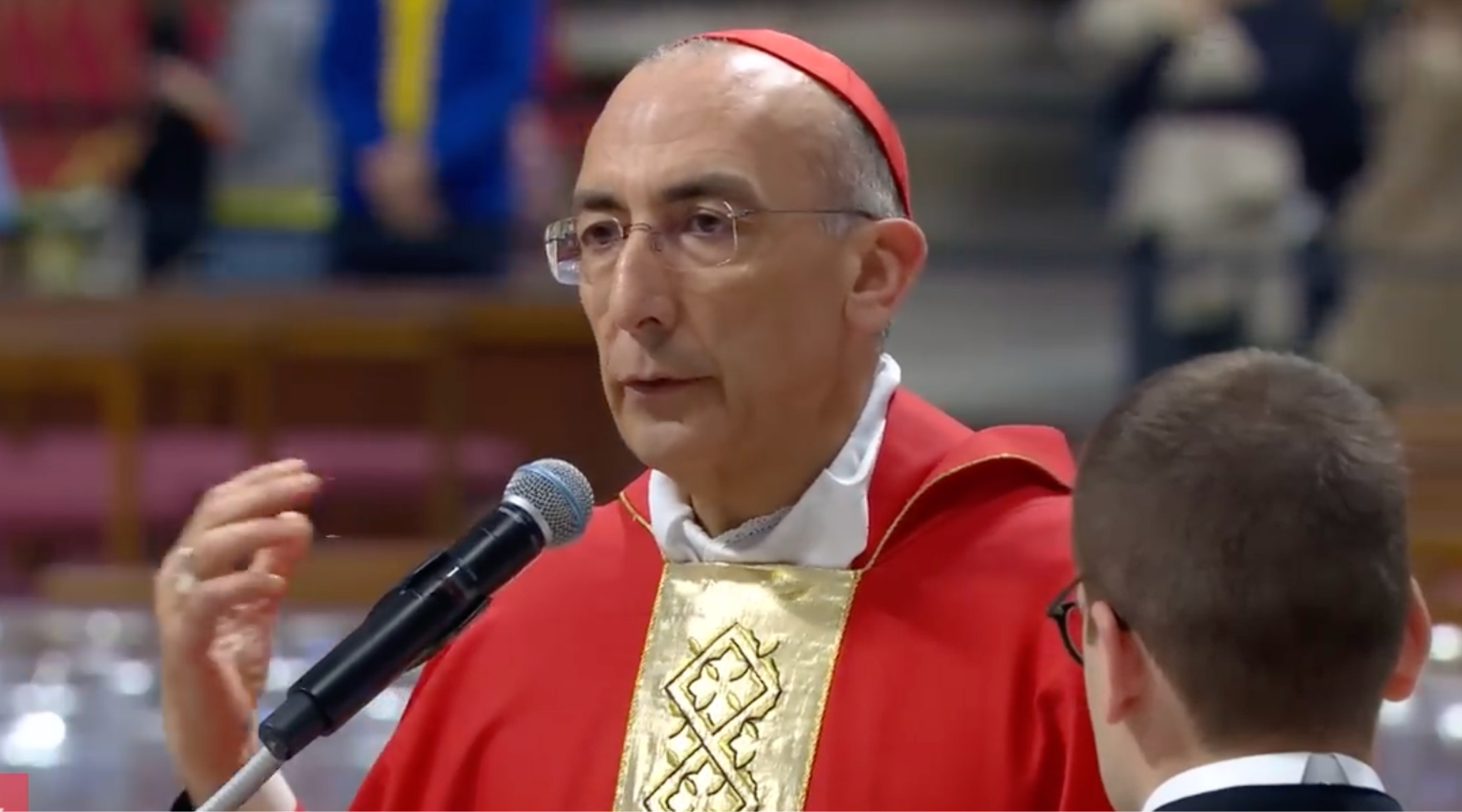
Domenico Reina, the cardinal’s brother, was accused by the Caltanissetta prosecutor’s office of receiving a public contract worth 128,000 euros, which was allegedly arranged by operatives linked to the Forza Italia political party, in an effort to curry favor with the cardinal and shore up support among Catholic voters in Sicily’s regional elections.
While the cardinal denied all knowledge of his brother’s dealings, Italian newspaper La Repubblica published an article June 9 citing alleged transcripts of phone conversations between the cardinal and his brother, in which the cardinal discussed and encouraged his brother to accept the contract and appeared aware of political links to the job.
—
A statement issued to the Italian news agency ANSA on Jun. 8 by Cardinal Reina’s attorney stressed that the cardinal “is not under investigation nor formally involved in the criminal proceedings in question,” after prosecutors in Caltanissetta announced an investigation into Domenico Reina, the cardinal’s brother, and 11 others over an alleged scheme involving corrupt hiring and contract-award practices at a Sicilian public healthcare agency aimed at securing political favors.
The statement said that the cardinal is “completely uninvolved in the facts being investigated and, according to the prosecution’s own hypothesis, is completely unaware of his brother’s actions and the intentions of his interlocutors.”
“Any reference to the cardinal in the investigation documents pertains exclusively to the assessments or intentions of third parties, not supported by any agreement or pact with the same, and does not imply any responsibility, not even moral, on the part of the cardinal himself,” the statement concluded.
Cardinal Baldassare Reina served as auxiliary bishop of Rome between 2022 and 2024. He was in October 2024 appointed cardinal vicar of Rome – the day-to-day leader of the Diocese of Rome, acting on behalf of the pope. He was made a cardinal by Pope Francis in December 2024.
The Caltanissetta’s prosecutor office alleges that Reina’s brother was approached as a way to curry favor with the cardinal, and to secure influence with the Catholic vote in the south.
However, La Repubblica published a report on Tuesday that raised questions abouts about the extent to which Cardinal Reina knew of his brother’s dealings.
The article cited a partial transcription – without explaining its source – of a November 2023 phone call between then-Bishop Reina and his brother, in which his brother expressed was deciding between taking job offers in a private clinic and or a 15-month project at Cefpas, the Center for Continuing Education and Professional Development of Health Service Personnel, a public agency for training healthcare personnel in Sicily — the role under investigation.
According to La Repubblica, Cardinal Reina reportedly insisted on the call that his brother should choose Cefpas because “it’s a well established organization” and that “Margherita [La Rocca Ruvolo] might be upset” if he didn’t choose the role at Cefpas, making reference to a local Forza Italia Member of Parliament.
While the prosecutor did not open an investigation against La Rocca Ruvolo, the prosecutor’s office said that “”the sole purpose pursued by the suspects was to curry favor with Reina’s brother, Cardinal Baldassarre, known as Baldo, in order to channel Catholic voters to Margherita La Rocca Ruvolo.”
During the call, according to La Repubblica, then-Bishop Reina pushed his brother to accept the Cefpas offer, because of its prestige: “Anyone who has been fortunate enough to get in there has never had their job put in question. That’s the point.”
The reported sections of the transcripts do not mention the amount or nature of the contract, nor do they refer to the prosecution’s allegation that the arrangement was intended to curry favor with Cardinal Reina and influence Catholic voters in Sicily.
Domenico Reina eventually accepted the Cefpas offer in January 2024. According to La Repubblica, he then sent a text message to La Rocca Ruvolo, saying “I’m forwarding the contract I received. I’ll read it carefully, but I hope there aren’t any clauses that could get me into trouble.”
According to La Repubblica, Roberto Sanfilippo, former director of Cefpas and one of the 12 men being investigated, publicly boasted because of helping “the pope’s deputy’s brother” because “Margherita La Rocca asked me to give this young man a hand.”
According to the prosecutor, the group managed hiring and the awarding of consulting contracts at Cefpas by implementing a system of cronyism, partially to gain electoral support, including among Catholics through the awarding of contracts to figures such as Domenico Reina.
“The use of Cefpas for purely personal purposes… also came to light in the corruption case involving the direct negotiation of the contract for the creation of a digital library for Cefpas, for which a sum of €128,000 was contemplated for Domenico Reina, an individual with no previous experience in multimedia documentation networks or in general.”
Riccardo Gallo Afflito, a politician described as La Rocca Ruvolo’s “political ally” in the proceedings, is one of three people for whom prosecutors have requested pre-trial detention. Prosecutors requested house arrest for five others, but did not seek any precautionary measure against Domenico Reina.
The investigation also alleges that Cefpas was used to award 75 temporary contracts to the wives, children, sons-in-law, and political associates of members of the same party, for “no show” or “no work” roles for which they lacked the necessary qualifications. The contracts were mostly awarded in February this year, just three months before local elections, which were held on May 24 and 25.
According to Il Fatto Quotidiano, Gallo Afflito was accused in the past by Daniele Sciabica, a mafia informant, of being involved in several mafia-related murders between 1985 and 1988 but the Palermo prosecutor’s office later closed the investigation without pressing charges against him.


No-show jobs should be a really easy political fraud to uncover--but they still exist. In Sicily, the amount of bogus jobs people show up for is staggering, and the amount of workers working under the tablet Is much higher. The people want to work and aid money from the federal government actually makes their finances worse by funneling money into useless and unproductive make work jobs. I remember walking into a museum in San Giuseppe Iato at 10 am in the morning, and the workers were like scared as I walked through and interrupted their games of solitaire. They told me to tour the outside first, then tour the inside. Outside, I met 11 forestieri who shared one weed Wacker and shared with me their outstanding bread, olive oil and peperoncini. I playfully asked why they hadn't restored any of the archeological grounds' collapsing barriers, and they said they lacked authority to do so from the something or other agency. Beautiful Greek archeology, but watch kids around the numerous pits without railings.