Rupnik rumors - and what might come next
What happens when the disgraced priest’s trial comes to an end?
Rumors began circulating in Rome Monday that the canonical trial of former Jesuit Fr. Marko Rupnik had come to a conclusion, without a conviction on the unspecified canonical crimes now being litigated through the Vatican’s Dicastery for the Doctrine of the Faith.
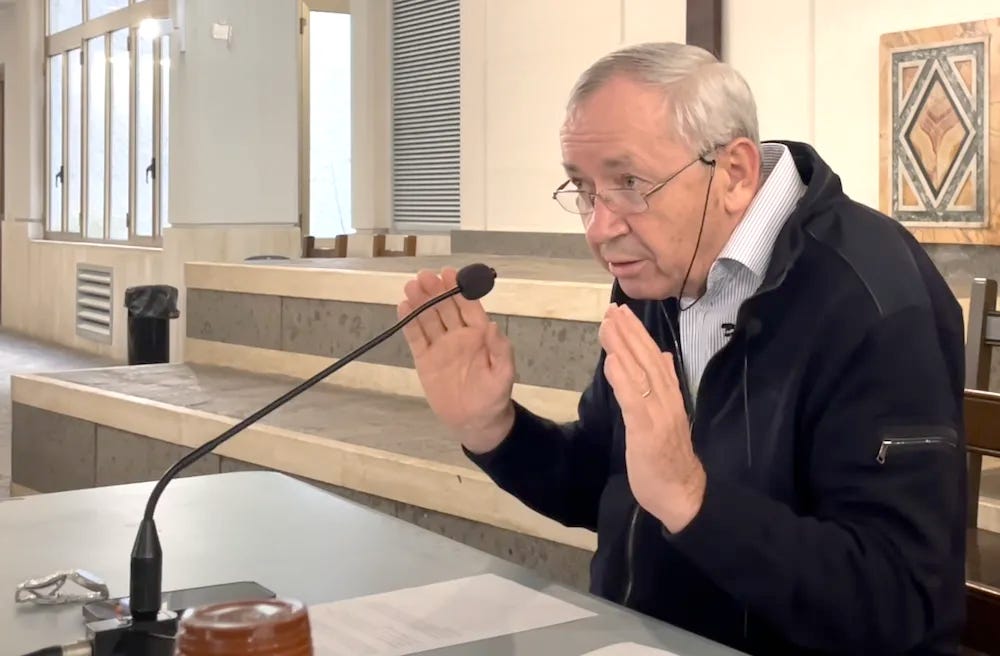
Those rumors are exactly that — unconfirmed and not specific, laden with ambiguity about what precisely has happened in Rupnik’s canonical trial, and how much is known about the details.
The rumors have not been confirmed by The Pillar. But they have garnered a great deal of attention, in line with the fierce global interest among Catholics in the Rupnik story, and foreshadowing the magnitude of attention that will come with his eventual verdict.
And whatever comes of the rumored resolution in the Rupnik case, the case will inevitably close. When it does, the Apostolic See will have to be prepared for the unique double helix of a case like Rupnik’s — with institutional attention focused on both ensuring a just legal outcome, and managing the wave of expectations attached to a high-profile case with a turbulent history.
—
The rumors about a resolution to the Rupnik case center around reports and postings published July 20 on an Italian traditionalist-adjacent blog, and a relatively unknown English-language website seeming to cover the Vatican.
Neither provided much detail about the nature of the purported verdict — whether the outcome was a deliberative acquittal for Rupnik of the allegations of sexual abuse against him, or – more likely – a determination that the available evidence could not provide a definitive resolution in the case.
Rupnik is accused of abusing multiple religious sisters over a period of years, intermixing spiritual manipulation with the creation of his now infamous mosaics of biblical scenes, and of coercing consecrated women into spiritualized sexual practices as he created his art.
The case is being heard by a tribunal organized by the Dicastery for the Doctrine of the Faith, after Pope Francis waived in 2023 the canonical statute of limitations that previously prevented the priest from being tried on the charges of sexual abuse themselves.
But the pope did not at the time cite the specific canonical crimes Rupnik would be tried for. Rupnik had been previously convicted and punished for attempting to absolve a sexual partner, a crime against the sacrament of confession, through a tribunal of the DDF. Because of that, the dicastery was the competent forum to oversee prosecution of all connected crimes, seemingly including those stemming from the allegations of sexual manipulation and coercion of religious sisters.
The crimes he was charged with would have taken place under the original penal code of the 1983 Code of Canon Law — which was significantly revised in 2021 — and thus the priest would have been tried under the law in force at the time of those crimes. Generally, canonists presume Rupnik is on trial for an alleged violation of canon 1395, which directs that:
“A cleric who continues in some … external sin against the sixth commandment of the Decalogue is to be punished with suspension. To this, other penalties can progressively be added if after a warning he persists in the offense, and eventually he can be dismissed from the clerical state.”
The canon continues:
“A cleric who has offended … against the sixth commandment of the Decalogue, if the crime was committed by force, or by threats, or in public, or with a minor … is to be punished with just penalties, not excluding dismissal from the clerical state if the case warrants.”
In 2021, the canon was revised to include the criminality of offenses against the sixth commandment committed by “abuse of his authority” — but at the time Rupnik allegedly committed his crime that was not the law in force, and thus it is not the law under which he is tried.
Canonists with experience in penal trials generally agree that, for better or worse, proving to the legal standard of conviction the existence of legal elements like “force,” “threats,” and even “persistence” can be difficult in many cases. And in Rupnik’s case — when the statute of limitations had already expired on the alleged crime — garnering proofs might well have been even more difficult. Indeed, one reason why statutes of limitation exist is the simple reality that with the passage of time, legally sufficient proofs become all the more difficult to obtain.
Further, The Pillar has heard for months complaints from Vatican sources about procedural elements in the Rupnik criminal trial — with some raising questions about whether procedural failures could eventually impede the priest’s prosecution.
For better or worse, such things happen in criminal cases — and perhaps all the more so in cases which have had the long and complicated history of Rupnik’s various legal and investigatory proceedings at the Vatican and in his former religious order, the Society of Jesus.
In short, canon lawyers have recognized that there are numerous reasons why Rupnik’s case might end without a conviction, and not all of those reasons hinge directly on the actual guilt or innocence of the disgraced priest. Such is the case with legal proceedings, which are merely the best human effort available for establishing facts in a manner that respects the rights of those involved in the questions at hand.
It is possible to believe both that the evidence available to the public indicates Rupnik’s likely commission of serious abuse, and to believe that a trial might not convict him.
But legal experts are not the only ones watching the Rupnik case. Victims and their advocates are watching it. Safeguarding experts are watching it. Catholics concerned with the integrity of the Church are watching it, including a large number for whom the case has become a litmus test for the Vatican’s seriousness about prosecuting abusers — a litmus test which many believe has heretofore implicated the Apostolic See, especially during the papacy of Francis.
To date, searching questions have been raised about the handling of the Rupnik affair — by the Jesuit order, the DDF, and Pope Francis.
Amid the case’s complex twists and turns, the Slovenian priest was briefly excommunicated for attempting to absolve an accomplice in a sin against the sixth commandment, which effectively means having illicit sexual relations with a partner, and then hearing their confession about it.
The Jesuit order has said that in October 2022, the DDF decided not to pursue canonical charges against Rupnik over the allegations from women religious dating to the 1990s, because the relevant statute of limitations had run out and they chose not to waive it.
And when Francis chose to lift the statute of limitations in 2023, it was widely believed to be only because of overwhelming public pressure, and the emerging narrative in the media that Francis had in some way protected Rupnik, or put his thumb on the scale in favor of the priest.
That narrative was compounded by the fact that Rupnik, despite facing a rising number of allegations of spiritual and sexual abuse, continued to maintain a public profile, concelebrating Mass at a basilica in Rome in March that year. He also remained an official adviser to several Vatican departments. And in 2024, the priest’s artwork — and its public display in churches — was defended by a ranking Vatican official, the communications prefect, who seemed to suggest that journalists pressing for accountability in the case had failed to adopt a Christian attitude toward the priest and his artwork.
In light of all of that, if Rupnik is not convicted, there will be a fierce outcry suggesting that the priest is still being protected because of the number of senior Vatican officials who seem to defend his art, and by extension, the man himself. And there will be a number of people who suggest — regardless of the facts — that Leo XIV is somehow protecting Rupnik, as Francis was accused of doing.
This means that if a non-convicting outcome in the case is merely released in the daily Vatican bulletin, it will be the beginning of a major credibility crisis for the Vatican. No matter the outcome, it seems clear that to demonstrate Rupnik received a fair trial, the DDF will need to be more forthcoming about the process than is its custom. That may well include the need to release a sanitized version of the case’s sentence, which would be far outside the standard operating procedure at the Vatican — and to release information about what would come next for Rupnik, conviction or not.
In short, the DDF’s best hope to demonstrate the integrity of its legal process — and its commitment to victims — is likely transparency. And despite the popularity of transparency as a Vatican buzzword, actually implementing it will be uncomfortable, and require a novel way of thinking about the communications issues involved in the case, including the conveyance of the kind of information generally kept close under wraps.
After years of talking about transparency, the Rupnik affair, at every stage, is the situation in which actual commitment to reform is put to the test — and that will be especially true at its conclusion.
In addition to ensuring the legal integrity of the case, the Vatican will have to ensure at the trial’s conclusion that Rupnik’s future prospects for ministry are assessed in light of his prior conviction for absolution of an accomplice, and the infamy which has come from public testimony about his alleged conduct. It will also have to ensure that the outcome of the case can be understood by Catholics suspicious of its adjudication.
Earlier this month, the Vatican — and the DDF specifically — demonstrated novel and strategic thinking about communications, as it addressed the fallout from the excommunications of bishops illicitly consecrated by the Society of St. Pius X. Sources close to the process told The Pillar that Leo personally ensured that communications experts were involved in the conversations about how information would be conveyed — and not only, The Pillar was told, “the usual suspects” inside the Vatican bureaucracy.
Despite that, there remain unanswered questions in that situation, and especially ambiguities about technical canonical elements of the Vatican’s announcements regarding the SSPX. Those are precisely the sort of ambiguities which would likely become problematic in communications about any eventual Rupnik outcome — where precise, clear, specific information about the canonical elements of the outcome, and plans for the future of the priest, will be essential for allaying scandal. In other words, the steps taken on communication strategy during the SSPX affair will need to be first steps, with more taken, in communication about Rupnik.
Leo seems keen on defusing scandal regarding the Church’s process wherever he can, and he seems to evince an understanding of the importance to that end of transparent communications in Vatican affairs, whenever possible.
And while the Rupnik affair is something he inherited, rather than initiated, overseeing it is now his responsibility. Communicating news about the case in a transparent and candid manner — especially incendiary news — will likely require all the savvy, resolve, and commitment that the pontiff can muster.


Given the number of women he is alledged to have attacked, I presume he is guilty even if he gets off in court. Here in the US it used to be virtually impossible to convict a man of rape. DNA helped fix that.
The deeper problem is what to do about all the churches he desecrated with his artwork. I certainly don't need a reminder of how the Church has covered up abuse and supported abusers. As far as I am concerned, that puts most of the Church's major shrines on my never go there list. The garbage needs to be removed.
Thanks very much for the explanations of the Vatican processes. The possible verdict looks like the old Scottish verdict of "Not Proven". Or the classic Irish verdict: "It was an accidental death under very suspicious circumstances".
I am reminded of the mass crackdown in the 1970s on the industrial scale corruption within the London police.
https://en.wikipedia.org/wiki/Operation_Countryman
8 prosecuted, none convicted. 250 forced to resign. And there have long been other stories of probably bent cops taking medical retirement under very suspicious circumstances, to the rage of one senior honest cop.
All very unsatisfactory, even if loads of corrupt officers were no longer in power on the streets.
But life is unsatisfactory. Rupnik is 71, so retirement and firm exclusion from any position of spiritual power is about the best we can hope for.
And the Internet has eyes everywhere. So if he volunteers as spiritual director at any convent he will never have a moment's peace.