Russian Orthodox bishop released after 'drug possession' arrest
The former ‘foreign minister’ of the Russian Church was arrested over a white powder found in his possession.
A formerly high-ranking Russian Orthodox bishop was released without charge Tuesday, two days after he was arrested by Czech police on suspicion of drug possession.
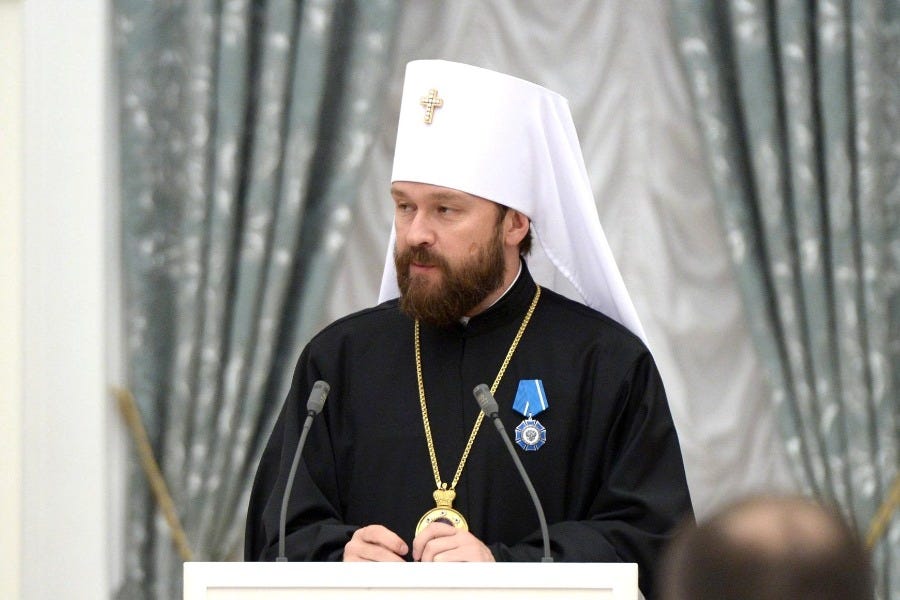
Czech authorities released Metropolitan Hilarion (Alfeyev) and an unnamed driver and camera operator May 26, as investigators await the results of laboratory tests on white substances seized from his car May 24 during a vehicle inspection near the town of Unhošť in the Central Bohemian Region.
Czech police confirmed the search took place following an anonymous tip but declined to provide further information while the investigation was ongoing.
Hilarion, once seen as a potential successor to Russian Orthodox Patriarch Kirill, has denied possessing or transporting illegal drugs.
The Moscow Patriarchate expressed support for the bishop, saying the arrest raised questions “regarding legality and observance of procedural norms.”
Russia’s foreign ministry, which is closely allied to the Russian Orthodox Church, strongly criticized the arrest.
On the day Hilarion was released, the foreign ministry summoned the Czech Republic’s chargé d’affaires, Jan Ondrejka, to protest against Hilarion’s detention.
The arrest marks the latest setback for the bishop, a noted theologian, Church historian, and composer who served as the Russian Orthodox Church’s chief ecumenical official from 2009 to 2022.
When Hilarion was appointed chairman of the Moscow Patriarchate’s Department for External Church Relations in 2009, at the age of 42, he was seen as a rising star of the Russian Orthodoxy, because the post was previously held by Kirill before he was elected Patriarch of Moscow.
The role is sometimes described as that of “foreign minister” for the Russian Orthodox Church. Its holder is an ex officio member of the Holy Synod, Russian Orthodoxy’s governing body.
The ecumenical leadership role brought Hilarion into frequent contact with popes Benedict XVI and Francis. He was present at the historic meeting of Pope Francis and Patriarch Kirill at Havana airport in 2016, the first encounter between a pope and the head of the Russian Orthodox Church.
Weeks before Russia’s full-scale invasion of Ukraine in February 2022, Hilarion said that war was “not a method to solve accumulated political problems” and every armed conflict “brings untold calamities.”
He was removed from his post in June 2022 and named head of the Russian Orthodox Diocese of Budapest and Hungary. It was rumored that he was sidelined because his reservations about war contrasted with Patriarch Kirill’s unequivocal support for the occupation of Ukraine.
The Russian Orthodox Church did not publicly clarify the reasons for the transfer. But Hilarion said he was dismissed because of “changes in the socio-political situation.”
The bishop encountered further controversy in Budapest after a former aide accused him of sexual misconduct and working for Russia’s intelligence services. He denied the claims made in June 2024 by the 23-year-old Japanese citizen George Suzuki.
Suzuki released videos that appeared to show Hilarion riding a motorized scooter around a 14-room residence on the outskirts of Budapest and shooting a pistol at an underground firing range in Moscow belonging to the Federal Security Service, the successor to the KGB. Hilarion suggested the videos were doctored.
Suzuki worked as an aide to Hilarion from 2022 to January 2024, when he returned to Japan. The BBC reported that the bishop offered to send Suzuki 2,000 euros (around $2,300) a month. But Suzuki’s grandmother allegedly demanded 384,000 euros (roughly $446,000) for destroying materials collected by her grandson.
Hilarion reported the grandmother for extortion. After the bishop discovered missing items and money, police issued an international warrant for the grandson’s arrest.
George Suzuki has denied theft and remains resident in Japan, where he periodically posts videos on a YouTube channel focused on “the truth about power and religion.”
The Russian Orthodox Church launched an investigation following Suzuki’s accusations. Hilarion was subsequently transferred from Hungary to the Czech Republic, where he was given oversight of the Church of Sts. Peter and Paul in the spa town of Karlovy Vary, the country’s most prominent Orthodox church.
According to a post on Hilarion’s Telegram channel, police stopped the bishop’s car on the road from Karlovy Vary to Prague May 24 without giving a clear reason and immediately searched the vehicle.
“During a search of the trunk, four small containers containing a white substance were discovered. The composition, origin, and nature of the substance can only be determined through a competent forensic analysis,” it said.
Michal Pacovský, the bishop’s lawyer, said he was concerned by reports that Hilarion was not allowed to observe the search because he had been taken to a convenience store at a gas station.
“There must be witnesses or video footage. As far as we know at this point, neither of these existed. At this preliminary stage, we see clear signs of a procedural violation,” he commented.
The Telegram post claimed that the incident followed “a prolonged period of pressure on Metropolitan Hilarion and the Orthodox community in Karlovy Vary.”
“According to the metropolitan, in recent months he has repeatedly received anonymous threats, including threats of physical violence, demanding that he leave his place of ministry,” it said, suggesting the opposition was politically motivated.
The full-scale invasion of Ukraine deeply strained relations between Russia and the Czech Republic, which emerged as one of Ukraine’s strongest supporters, sending large quantities of arms and cutting energy ties to Russia.
Czech authorities placed sanctions on Patriarch Kirill in 2023 and revoked the permanent residency of a Russian Orthodox cleric based in Karlovy Vary.
In 2024, the then-Czech foreign minister Jan Lipavský said: “I do not consider the Russian Orthodox Church of the Moscow Patriarchate to be a church and its representatives to be clergymen.”
“It is part of the Kremlin’s repressive machine that is involved in Russia’s influence operations.”
Igor Vyzhanov, the deputy chairman of the Department for External Church Relations, alleged that Hilarion’s detention was “a blatant provocation.”
“Despite these attempts, Russia and the Russian Orthodox Church still undoubtedly appear to be the most robust force, especially against the backdrop of the total moral decay currently prevailing in Europe,” he told the Russian state news agency TASS.

