Russian prelate sent to Brazil as police confirm cocaine in car
Metropolitan Hilarion was once considered a front runner to become Russian Orthodox patriarch.
Patriarch Kirill of Moscow issued a decree transferring Metropolitan Hilarion from the Czech Republic to Brazil Wednesday, the same day Czech media reported that a white substance found in Hilarion’s car was confirmed to be cocaine.
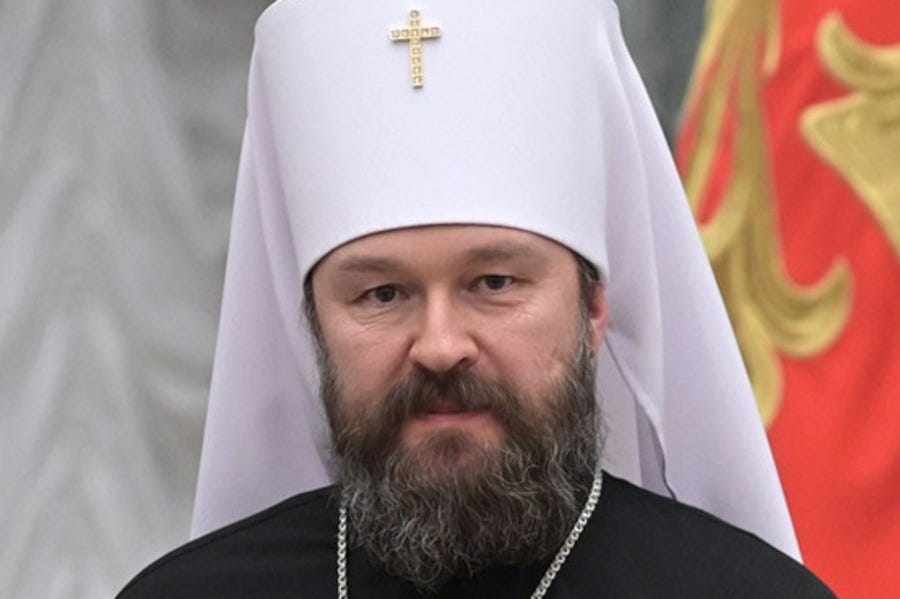
Patriarch Kirill decreed June 3 that Hilarion would serve in the Russian Orthodox Eparchy of Argentina and South America, while residing in southern Brazil.
Russian Orthodox media reported that the transfer was arranged because it was impossible for Hilarion — once seen as a potential successor to Patriarch Kirill — to continue overseeing a church in Karlovy Vary, Czech Republic, “due to objective circumstances.”
This was a reference to the bishop’s brief detention on suspicion of drug possession, after Czech police discovered a white substance in his car during a May 24 search.
Hilarion was released without charge May 26 amid an ongoing investigation. The bishop alleged that a third party planted the substance in the car.
The Czech news outlet Deník N said June 3 that police had confirmed the substance to be cocaine.
The confirmation is likely to place further pressure on Hilarion, a 59-year-old theologian, Church historian, and composer who served as the Russian Orthodox Church’s chief ecumenical official from 2009 to 2022.
When Hilarion was appointed chairman of the Moscow Patriarchate’s Department for External Church Relations in 2009, he was seen as a possible future leader of the Russian Orthodox Church, because the post was previously held by Kirill before he was elected Patriarch of Moscow.
In the role, often described as that of “foreign minister” for the Russian Orthodox Church, Hilarion frequently met with popes Benedict XVI and Francis. He was present at the historic meeting of the Argentine pope and Patriarch Kirill at Havana airport in 2016.
But Hilarion’s fortunes waned dramatically in 2022, the year that Russia launched a full-scale invasion of Ukraine.
Weeks before the invasion, Hilarion said that war was “not a method to solve accumulated political problems” and every armed conflict “brings untold calamities.”
He was removed from his post in June 2022 and named head of the Russian Orthodox Diocese of Budapest and Hungary. It was rumored that he was demoted because of his reservations about the invasion, which contrasted with Patriarch Kirill’s backing for the military operation.
Hilarion ran into further controversy in Budapest, when a former aide accused him of sexual misconduct and working for Russia’s intelligence services. He denied the claims made in June 2024 by the 23-year-old Japanese citizen George Suzuki, saying he was the victim of an extortion attempt.
Hilarion reported the theft of three watches and cash worth 90,000 euros (around $105,000) after Suzuki returned to Japan. Hungarian police issued an international warrant for Suzuki, but concluded in May this year that an intent to misappropriate the items could not be proven.
Following a Church investigation, Hilarion was transferred in December 2024 from Hungary to the Czech Republic, where he oversaw the Church of Sts. Peter and Paul in the spa town of Karlovy Vary.
According to a May 25 post on Hilarion’s Telegram channel, police stopped the bishop’s car on the road from Karlovy Vary to Prague May 24 without giving a clear reason and immediately searched the vehicle. The police took away four small containers containing a white substance for forensic analysis.
Hilarion’s lawyer Michal Pacovský said he was concerned by reports that his client was not allowed to observe the search because he had been taken to a convenience store at a gas station.
The Moscow Patriarchate expressed support for the bishop, saying the incident raised questions “regarding legality and observance of procedural norms.”
Russia’s foreign ministry, which is closely allied to the Russian Orthodox Church, strongly criticized the detention.
Following his May 26 release without charges or restrictions, Hilarion returned to Russia. His Telegram channel announced his arrival in his homeland May 29.
On May 31, the channel posted a photograph of Hilarion assisting at a Divine Liturgy celebrated by Patriarch Kirill at the Trinity Lavra of St. Sergius, a monastery outside of Moscow described as the spiritual heart of Russian Orthodoxy.
Patriarch Kirill’s June 3 decree appointing Hilarion to the Eparchy of Argentina and South America said the bishop would serve the Church of the Holy Apostles Peter and Paul in Santa Rosa, while living at the Church of the Holy Apostle and Evangelist John the Theologian in Campina das Missões.
Both churches are located in Rio Grande do Sul, Brazil’s southernmost state, which borders Argentina and Uruguay.
In a May 27 Telegram post, Hilarion reflected on his detention in the Czech Republic.
“To slip substances like these into someone’s pocket, or bag, or suitcase, or car, or apartment, and then call and say where they are — in general, it doesn’t cost anything. This could happen to anyone,” he wrote.
He added: “Sometimes it is important simply for us to appreciate our situation, to appreciate what is happening around us, and to thank God for how He takes care of us and brings us out of the most difficult situations.”

