
The Diocese of Pittsburgh released on Tuesday a statement to Catholics about an apparently illicit celebration of the Extraordinary Form of the liturgy being celebrated in the diocese.
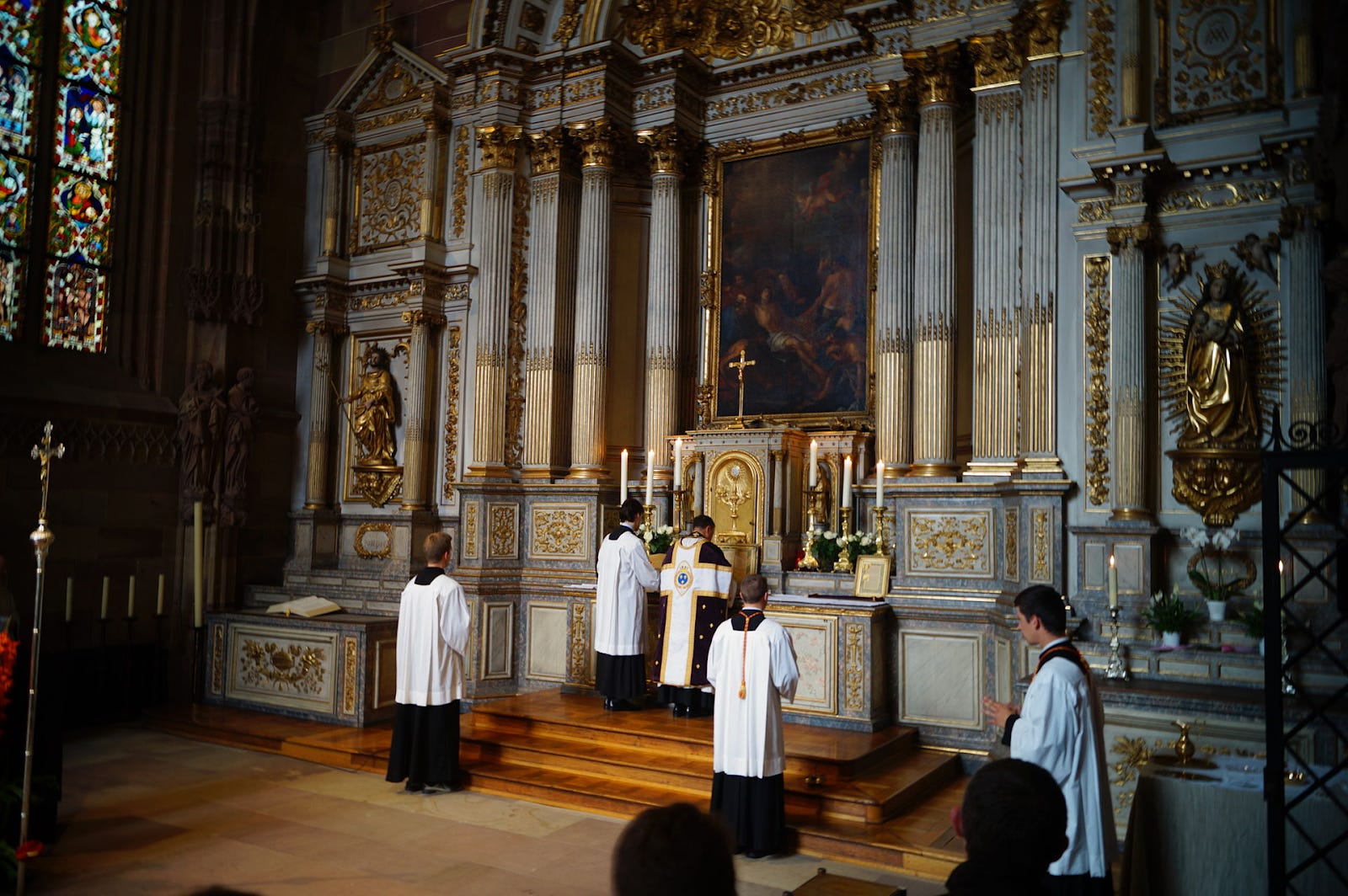
According to the statement, the diocese has become aware “of announcements concerning the celebration of the Traditional Latin Mass at a privately owned property identifying itself as Immaculate Heart of Mary Chapel in Conway, Pennsylvania.”
While directing Catholics to the time and place of TLM celebrations in the diocese which have been approved by the bishop, in line with the norms of Traditionis custodes, the statement advised local Catholics that the scheduled Mass in Conway, at the “chapel” there, “has not been presented to Bishop Mark Eckman for his review or approval.”
“Neither the chapel nor the announced liturgical celebrations have received authorization from the Diocese of Pittsburgh. The faithful are therefore advised not to attend these celebrations, which do not fulfill the Sunday obligation,” said the statement.
As you might expect, this got Pillar editors talking, since the Pittsburgh statement raises some interesting canonical questions. But rather than JD and Ed arguing back and forth over the phone as they work out what they think, we thought it would be interesting for readers to see how the canonical-analytical sausage gets made around here.
So, as an experiment, we bring you the first — and maybe last, we’ll see — Pillar Explainer Sic et non. JD and Ed will trade off writing back and forth, in an unvarnished, unresearched, authentic dialogue, as they work out what they think about the statement — and you can read along until they agree, or agree to disagree.
For your clarity, JD will be writing in bold, as befits his confident and go-getting mindset. Ed will take italics to reflect his nuanced and questioning approach. Enjoy.
JD:
It is not a surprise to me that the bishop intervened in this situation, as it seems to have taken on a life of its own on social media. But I am surprised by the announcement that the Masses do not fulfill the Sunday obligation. From my point of view, that comes as a surprise in two ways:
That this is not a decree.
How unusual it is to say that assisting at a validly celebrated Mass on a Sunday does not fulfill the Sunday obligation.
Your thoughts?
Ed:
Well, I don’t think anyone would call me a maximalist for episcopal authority on this sort of thing. But my knee jerk reaction is that we might have a failure of process here, rather than of authority on the Sunday obligation aspect. Because to be clear: an unsigned press statement just asserting that these Masses don’t qualify isn’t anything like a legal argument or an exercise of episcopal authority.
But let’s get there in a second.
First things first, from the statement, it sounds like we are dealing with a “chapel” that isn’t one, in as much as it hasn’t been erected canonically and isn’t recognized by the diocese. In that (non) chapel, we’ve got a TLM being celebrated illicitly, as I understand it — it isn’t being done by a designated priest in a designated sacred space under the authority of the bishop and in accord with the norms of TC.
Are we of one mind there?
Yes.
So, the Sunday obligation is two things, legally speaking, right? We have the Divine law mandate to keep holy the Sabbath, and then we have how the Church has codified the satisfaction of the Divine law, which is that you have to go to Mass on Sunday.
But the going to Mass part is a merely ecclesiastical obligation, defined by the Church. Diocesan bishops can dispense from it — I mean your pastor can dispense you from it if you ask him. And diocesan bishops have the generally conceded authority to dispense from universal law as they see the need.
So, by extension, would you say he has the legal power to define an illicit TLM as falling outside what is needed to satisfy the ecclesiastical obligation?
That doesn’t really follow to me.
In the early centuries of the Church, Christians went to Mass on Sundays from a sense of devotion, and the normative community expectation, but they also worked on Sunday and otherwise lived their normal lives, because the world didn’t shut down on Sunday, and they didn’t live in even a nominally Christian culture.
I’m sure both a liturgist and a patristics guy will get mad at my startling gap in knowledge here, but I’m honestly not actually sure how much they correlated Sunday worship to the third commandment before St. Augustine. I’d love to read more history about that (maybe readers will give me suggestions in the comments).
Bear in mind that early Christians called Sunday the “eighth day,” because the Resurrection inaugurated a new order of things.
In any case, it wasn’t until the 4th or 5th century that bishops began to say consistently that missing Mass on a Sunday was a sin. But it was regarded in those terms — as a moral issue — before it was regarded as a matter of ecclesiastical law. So while we as canonists think of it as having the character of positive law, we should consider that it had a moral basis in Christian thought before a juridical one.
Why is that important? Because while it is true that the bishop can dispense from the Sunday obligation, it also has this primordial significance for Catholics, and I think the Church is — for that reason — usually reluctant to say that assisting at a valid celebration of the Eucharist does not fulfill the Sunday obligation. I can’t think of a time when the Church has said that about the SSPX, for example.
But the question can be looked at juridically, and should be.
Canon 1248 §1 says that: “A person who assists at a Mass celebrated anywhere in a Catholic rite either on the feast day itself or in the evening of the preceding day satisfies the obligation of participating in the Mass.”
This implies that in the judgment of this bishop, the celebration of this particular TLM is not being celebrated according to “a Catholic rite.”
Though I think it’s a bit of a stretch reading of the canon, I suppose I would have presumed that central to the bishop’s judgment would be that the priest does not have the intention to offer the Mass in the communion of the Church. But I am told by a source close to the event that the priest is from an actual religious institute of pontifical rite — not from any kind of schismatic group — and thus, I’m not sure what would lead to that judgment.
So, just to pick up your first point about early Christian practice and the Sabbath, I’d be surprised if early centuries Christians wouldn’t be baffled by a lot of the differences between their Eucharistic liturgies and ours, TLM and ordinary form. But I would note that the Catechism draws a pretty explicit link between the third commandment and the Sunday obligation:
“Sunday is expressly distinguished from the Sabbath which it follows chronologically every week; for Christians its ceremonial observance replaces that of the Sabbath. In Christ’s Passover, Sunday fulfills the spiritual truth of the Jewish Sabbath and announces man’s eternal rest in God.”
“The celebration of Sunday observes the moral commandment inscribed by nature in the human heart to render to God an outward, visible, public, and regular worship as a sign of his universal beneficence to all. Sunday worship fulfills the moral command of the Old Covenant, taking up its rhythm and spirit in the weekly celebration of the Creator and Redeemer of his people.”
I had this in my mind because I remember in the pandemic days we actually had a conversation about some bishops having issued general dispensations from the Sunday obligation which framed it as a dispensation from the third commandment, which obviously no bishop can do because it’s divine law, as opposed to dispensing or commuting the merely ecclesiastical Sunday obligation to go to Mass.
Anyway, I think you’re exactly right about the substance of the legal question here. We’re looking at 1248 §1. And I think the real question is: Is an illicit TLM a “Catholic rite,” strictly speaking?
There really isn’t any question, I think, for anyone going to such a thing, who would assume it is — including the celebrant. But I think the question gets more interesting if we phrase it as “Could the bishop declare it not to be, anyway?”
Here I am less sure of my own assumptions. We are, after all, still living in the world of Traditionis custodes and, badly written though it may be, it is still the law. And it does state that “the liturgical books promulgated by Saint Paul VI and Saint John Paul II, in conformity with the decrees of Vatican Council II, are the unique expression of the lex orandi of the Roman Rite.”
Is it possible for a bishop to rule that an illicit TLM on private property outside of the norms of TC does not fall within this definition of the Roman Rite? I’m not saying I’d find it terribly sympathetic, but if he properly argued it and issued such a ruling in a comprehensible legal form, I think it would at least need to be judged by Rome.
The situation is a little muddier for me if the priest celebrant is a religious, himself properly authorized for use of the Extraordinary Form. That being the case, I think I’d err on the side of my instincts and say it’s definitely and demonstrably a valid expression of what we can call the Roman Rite.
But do you take my point about TC making the presumptions of 1248 less clear?
First, let me say how much I’m enjoying this. I hope we do more of them.
Second, I’m not sure I do take your point. TC does say that the current missal is the “unique expression of the lex orandi of the Roman Rite.” It does.
But obviously, TC also allows for the usus antiquior to be offered. And also, it would be a terrifically bold statement — whatever your view on the current “trad question” — to suggest that the Mass of our grandfathers can no longer be considered a “Catholic rite.”
I mean, what the what?
On the other hand, you make a good point. If the bishop doesn’t think the intention of the priest is at issue, then the issue you raise is the next logical means by which he might conclude that this Mass doesn’t fulfill the Sunday obligation.
And I’d be super interested to hear what Rome says.
I’d suggest the following: We should try to interview the bishop of Pittsburgh about this, if he’ll give us the interview.
And then we should wait to see whether the Dicastery for Divine Worship, or Legislative Texts, will give some clarification on this “Catholic rite” question. Because in one way or another, it is obviously becoming a central component of the implementation and understanding of TC. And there needs to be some standard approach to the question, lest we have (more?) liturgical inconsistency across dioceses.
Well, I do just want to note that there are bishops of sound mind and doctrine who have, as a general principle, said that Masses of the SSPX don’t satisfy the Sunday obligation for Catholics: Bishop Philip Egan of Portsmouth, for one. As you might imagine, the SSPX were deeply annoyed by that since, as we know, they don’t think illegal acts have any bearing on your standing in ecclesiastical law.
As for it being a terrifically bold statement to declare the Mass of our grandparents to not be a legitimate expression of the Roman Rite, I’d agree. But I’m not making that statement, I’m asking if TC does.
The point I am trying to puzzle through is IF TC lays out a fairly narrow definition for legitimate expressions of the Roman rite, and IF Mass is being celebrated in a way that falls outside of that definition, does this suffice to make an argument about c.1248? I’d not myself put my name to such an argument, but if a bishop did, I think it would raise serious enough questions that I couldn’t wave the issue away and it would need to be answered by Rome.
As for trying to interview Bishop Eckman, I am certainly game. And I would certainly be interested in any opinion on this which Rome might choose to express. As for waiting and seeing, though… if we wait for bishops to give us interviews and Rome to answer the mail, well, I don’t think we’ll have much else to publish for a few months at least.
But you never know. Ours is a faith of miracles.
Good point. Thanks for remembering about +Egan. And yeah, I agree that some question has to be raised to Rome about the interpretation of TC.
I also think there is a procedural question, which I alluded to before. If this is the deliberative determination of the diocesan bishop, it should probably come in a different form than a statement from the diocese. I said decree earlier, but that wasn’t quite right, because this is not an executory act, it is a judgment. Still, one would expect such a judgment to come in a more formal way, with the reasoning delineated and with the signature of the bishop. Otherwise, it’s too easy to ask, as we have done, about the authority of the assertion altogether.
I think the form would be an instruction, in accord with c. 34, clarifying “the methods to be observed” in fulfilling the law within his diocese.
For sure. If the intention here is to advise the people of Pittsburgh about a legal determination by the bishop, I would want to see something like a proper general decree, which is a kind of law, setting out this determination. I guess an instruction could work, but I would be iffy on a bishop issuing an instruction on a point of universal law which interprets it in a particular way — that seems like a fast track to the law meaning one thing in one place and something else entirely elsewhere.
If he went for a general decree, perceptively phrased, I’d just be a little more comfortable with the wider legal implications.
Yeah. Several possible ways to address it. I would not have expected basically a “statement,” though, which is not a legally recognized form of episcopal authority.
Open questions, in other words. We should shoot for interviewing His Excellency.
Good hang, amigo. I want to catch a Devils game, so I’m gonna run.
Enjoy the game. Please don’t say “good hang.”
Oh this is a delight to read - it’s like watching an AIM convo between canon lawyers🤭😉😁
It's honestly like I'm reading the transcript of a podcast. Honestly, this may be a good way for you two to do canon law discussions going forward (granted, I still want them on the podcast too, don't take the fun of Ed getting exasperated with a cheeky JD away from us!!)