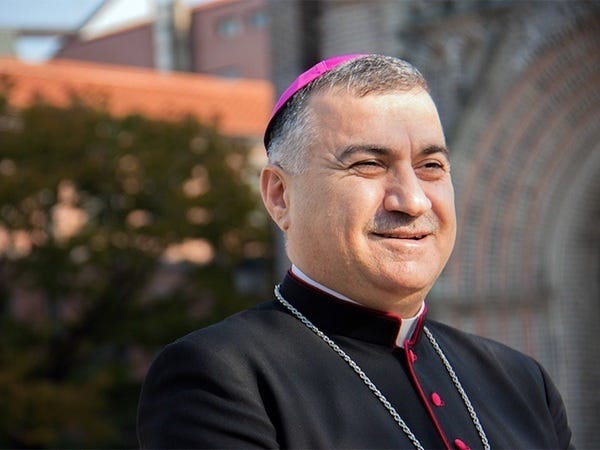
‘Solidarity is more than just a concept’ — Warda looks to future for Chaldean Catholic Church
“We find ourselves in a pivotal moment.”
Chaldean Catholics were surprised this month, when the Eastern Catholic Chaldean Patriarch Cardinal Louis Raphael Sako saw his resignation accepted March 10 by Pope Leo XIV.
Sako told Catholics that he had resigned “so that I could devote myself quietly to prayer, writing, and simple service.” But the patriarch’s resignation came at the same time as that of the embattled San Diego Chaldean Bishop Emanuel Shaleta — who is now facing 16 criminal charges in California — leaving the Chaldean Church facing questions about its present, and a referendum on its future.
Chaldean bishops are expected to gather in a synod after Easter to elect the next patriarch of the sui iuris Eastern Catholic Church, whose patriarchal see is Baghdad, and which includes more than 500,000 Catholics, most of them in diaspora around the world.
Among the bishops expected to be influential in the discussion is Archbishop Bashar Warda, leader of the Archeparchy of Erbil, in the northern Kurdistan region of Iraq.
In an interview by email, Warda talked with The Pillar about the present and future of the Chaldean Catholic Church.
Archbishop, can you describe the patrimony and culture of the Chaldean Catholic Church?
When discussing the Chaldean Church, we are not only referencing historical events, but rather highlighting a vibrant faith that is deeply entrenched in a region where Christianity has thrived since its inception. We believe our heritage is apostolic because, according to our tradition, the Gospel reached these lands through St. Thomas and his disciples, Addai and Mari.
Our Church emerged from a profoundly biblical and spiritual context where prayers, community life, and faith were seamlessly intertwined. What sets this heritage apart is not just its age but its undeniable vitality. Our community has shown incredible resilience in living out its faith through adversity. Faith is woven into the everyday aspect of life as expressed in family gatherings, prayers, acts of fasting, and the way they deal with struggles. Our heritage isn’t something preserved only in books, it’s alive and has often been shaped through trials, and it continues to thrive.
However, this rich heritage is facing significant challenges. Each new conflict in our region doesn’t just destroy buildings; it also raises the question of whether our faith can endure constant violence and hatred.
ISIS was only defeated nine years ago, and now [we face] another war. Many families wonder: Can we continue to live here? Will our children be able to live decent lives? Would they be able to practice their faith? Or must we leave everything behind?
It is here where the Church has a crucial role to play, which is not only to preserve the heritage of its community, but also to resonate with the younger generation. The rise of social media and digital culture introduces both opportunities and confusion regarding faith. Therefore, we must strive to present our teachings with clarity and ensure that they are relevant to people’s real lives.
Chaldeans have faced severe persecution in Iraq, and now many live in diaspora. How does that affect the Church today and in the future?
What we are living through today isn’t just a single event; it’s the combination of many years filled with suffering. The violence, persecution, and displacement we’ve faced have profoundly challenged and changed our community. Families that once lived close together are now scattered across the globe.
At this moment, the Church is called to be a source of support for this dispersed community. However, we need to be honest with ourselves: the greatest threat is not migration itself, but the loss of hope and community. Families don’t leave their homes because they’ve lost faith; they leave in search of safety, dignity, and a brighter future for their children. We are currently witnessing this reality in Erbil. Due to recent attacks on the city, we have had to pause most of our educational and catechism programs. Some of our diocesan buildings have been damaged, and fear has spread, particularly among families and children.
In such times, the question looms large, can our children grow up safely here?
In response to these challenges, I believe the Church must do more than just react to emergencies; we need to establish something enduring and vibrant.
That’s why we’ve focused on building churches, creating pastoral, educational, healthcare, and humanitarian institutions. Most of these projects are not just for our Christian community; they are for everyone. In quiet yet meaningful ways, they reflect our Christian faith and respond to Jesus’ words: “You are the salt of the earth… You are the light of the world.” Through these institutions, we’ve also created safe job opportunities for young people. As of today, more than 890 young men and women are employed in these initiatives. We hold firm to the belief that staying in one’s homeland is about more than just faith; it’s about jobs providing dignity and opportunity and the ability to raise families.
The future of the Chaldean Church hinges on two key paths: maintaining a genuine presence in our homeland while also fostering a vibrant Church in the diaspora that remains deeply connected to its roots. When they see what we are achieving here in Erbil with our churches, school, university, and hospital, it keeps the deep connection very much alive and fruitful. They can feel both our suffering and thriving as the blood of the martyrs is the seed of the church.
What we build here is crucial for the diaspora as these roots of the Church anchor us and keep us together, no matter how far apart, strong in God. As Jesus said that He is always with us, we too say we are always with them.
How does the Church remain united in diaspora?
Unity in the Church is fundamentally about communion rather than just structure. It’s about sharing our faith, participating in the Eucharist, engaging in liturgy, and feeling a sense of belonging to one church, even if we’re separated by distance.
However, this unity faces significant challenges. Each wave of migration and every new conflict push us further apart, not just in terms of physical distance but also culturally and spiritually.
In this challenging environment, I find hope in what we are experiencing here in Erbil and may this echo to all in the diaspora.
As a Chaldean bishop looking after more than 4,000 families, I’ve made it a priority to stay in close contact with my fellow bishops, both Catholic and Orthodox, who are also caring for displaced communities from areas like Mosul, Baghdad, Kirkuk, and Basra since 2003. Together, we’ve formed a collaborative team to respond to crises, and by God’s grace, we’ve managed to overcome many obstacles. What we share goes beyond mere cooperation, it’s a living model of ecumenism.
One clear example of this was the Feast of the Exaltation of the Holy Cross. This feast carries deep theological, historical, and spiritual meaning for all Christian Churches, particularly in Iraq, where it is closely tied to both spiritual life and cultural tradition. It is not only a religious observance but also a cultural celebration, bringing families and communities together to share traditional food, play games, and rejoice in a spirit of unity.
In September, a five-day ecumenical festival held in Ankawa brought different Christian churches together to celebrate the feast collectively. It was warmly received both locally and among the diaspora, presenting a powerful image of a united Church. For those living abroad, such visible expressions of unity are especially encouraging.
The success of the event led Church leaders to establish the festival as an annual joint celebration of the Feast of the Exaltation of the Cross. This initiative aims to strengthen relationships between the Churches and reinforce Christian identity in Iraq. On the social media platform X [twitter.com], the response to last year’s event was particularly striking, signaling to the wider world that the Church in Iraq is vibrant, resilient, and committed to carrying its mission forward into future generations.
This stems from our shared suffering and collective service. Our community recognizes and values this effort because it illustrates a Church that genuinely embodies unity instead of just talking about it. At the same time, we must address the new challenges, especially those posed by the digital world. Young people have to contend with diverse voices and ideas and what is actually the truth. We need to communicate clearly and stay grounded and true in our tradition, steering clear of any oversimplified or generic portrayal of our faith.
Our young participate in many church activities and this is a fruit of our pastoral care and catechism programmes. The family here is very united in faith and responsibility caring for one another.
What about liturgical patrimony? What does it mean to preserve Chaldean patrimony today?
The liturgy truly is the heart of our Church. It’s where we express our faith, remember our history, and shape believers’ lives.
Yet preserving this heritage isn’t easy. When families are uprooted and find themselves in new cultural surroundings, maintaining their language, traditions, and liturgical practices becomes increasingly challenging. With each new wave of migration, there’s a risk that our heritage may be diluted.
The Chaldean Church communities continue to express concern about the decline of the Syriac language — Sureth — as a spoken language, particularly in the diaspora. However, the concerns go beyond losing a language; it is becoming a wider issue of cultural continuity, religious formation, and communal identity.
Right now, due to insecurity, just sustaining a regular liturgical life has become challenging. Pastoral activities are often disrupted by fear. That’s why it’s crucial to connect the liturgy with understanding what their faith in Jesus is anchored in. People, especially the youth, need to grasp the deep meaning of their prayers and the Eucharist both sacramentally and spiritually. They should realize that liturgy isn’t just about tradition; it’s about having a true and vibrant encounter with God.
To support this understanding, we’ve initiated a series of lectures on Scripture and Christian faith, which is referred to as the bishop’s teaching ministry. Our goal is to help people, especially young individuals, to deepen their faith in a meaningful way. Preserving our liturgy today is not only about tradition; it’s also a form of spiritual affirmation and resistance, safeguarding the identity, minds and souls of our people.
What wisdom can Chaldeans offer the wider Church about transmitting the faith?
Faith is something that truly comes alive when we continually embrace it in our daily lives. Many of us grew up in families where faith wasn’t just a set of beliefs; it was a real experience, and a family one, often shaped by challenges.
Today, with the world feeling so uncertain and unstable, we’re faced with a big question: How do we share our faith with our children when fear and anxiety are all around us? How do we nurture a vibrant faith when our usual gatherings and activities are disrupted?
Many young people today are grappling with feelings of anxiety and fear. This reality compels us to rethink how we convey our beliefs. Social media complicates things further, often twisting how faith is perceived.
Our goal shouldn’t be to simply spread our teachings far and wide; instead, we need to root them deeply in our Christian lives and the importance of family, presenting faith in its genuine form in the teaching of Jesus and making it relatable and meaningful. Faith flourishes when it is visible, in the way we pray, the forgiveness we offer, the help we give to others, and the resilience we show during challenging times.
We anchor our children in Jesus with extensive catechism programmes throughout the year, with summer camps. We run the yearly Ankawa Youth Festival in Ankawa that attracts more than 1,500 young people throughout Iraq; the four days are in pastoral programs supported by priests, sisters and trainers from Lebanon. Each year we expand its scope, deepen its content, and involve more youth and families from across the different Churches.
It gives our young [people] hope, inclusion and the building of relationships, in that they are not alone in their Christian faith.
The Chaldean Church is now looking toward its future. What are the main challenges and opportunities?
We find ourselves in a pivotal moment. The challenges we face are undeniable: migration, building the faith, the struggle to preserve our identity, and the need to balance our Church between the homeland and those in diaspora. With each new conflict that arises, these challenges only intensify. People begin to lose hope for the future, and more families are contemplating leaving the country, a reality we’re witnessing here in Erbil.
Yet, amidst the difficulties, there are real opportunities before us. Our young people hold immense potential, and our educational and healthcare institutions offer more than just services; they stand as beacons of hope and investment for tomorrow. We are called to shift from barely surviving to truly engaging in our mission: a Church that educates, supports, walks alongside its people, and fosters genuine opportunities for a better life.
The Middle East is again experiencing war. What does this mean for Christians, and how can Western Christians show solidarity?
We don’t just hear about war in the news; we live it every day. Each time violence escalates, we can’t help but ask ourselves: Is there a future for us here? Every conflict in this region doesn’t truly end when the shooting stops. It leaves lasting impacts on the Christian community and forces families into painful decisions about whether to stay or leave. With every new outbreak of violence, our uncertainty grows, fear deepens, and the pressure to emigrate becomes overwhelming.
What we are experiencing here in Erbil makes this all too clear. Recent attacks have not only caused physical destruction but have thrown our daily lives into chaos. Schools and community programs have come to a halt, and families, especially our children, are filled with anxiety. In times like these, even the simplest routines can feel precarious.
In this challenging environment, solidarity is more than just a concept, it needs to be a tangible experience. It starts with our prayers and a genuine commitment to peace. It continues with concrete support for the Church’s mission on the ground be it through education, healthcare, humanitarian aid, and initiatives that help families maintain their dignity and stay together.
We’ve also felt a powerful sense of support from beyond our borders. The love and concern expressed by the universal Church, especially through the voice of the pope, the Holy See, and organization such as Aid to the Church in Need, the Knights of Columbus and various bishop’ conferences, such as the Italian bishops’ [conference], whether they offered spiritually, monetarily or materially, this support reminds us that we belong to a wider communion. Our struggles are not faced in isolation; we are part of a broader community that carries our burdens with us.
Last, it’s important to see the Middle East as more than just a region of conflict; it’s a vibrant home for living Christian communities. We’re not asking for pity; what we seek is partnership and working together to keep the voice of Jesus in the land where He was born. Christians in this region are not relics of the past; they are active and vital members of the Church today and will be a crucial part of its future.


Besides CNEWA, does anyone know of ways to give alms to our Chaldean brothers and sisters? Prayers for this ancient Catholic Church, especially of protection and hope. 🙏🏽