South African bishop calls for calm ahead of anti-migrant deadline
Protest groups say undocumented migrants must leave by June 30.
A South African bishop appealed for calm Wednesday ahead of a deadline, set by protest groups, for undocumented migrants to leave the country.
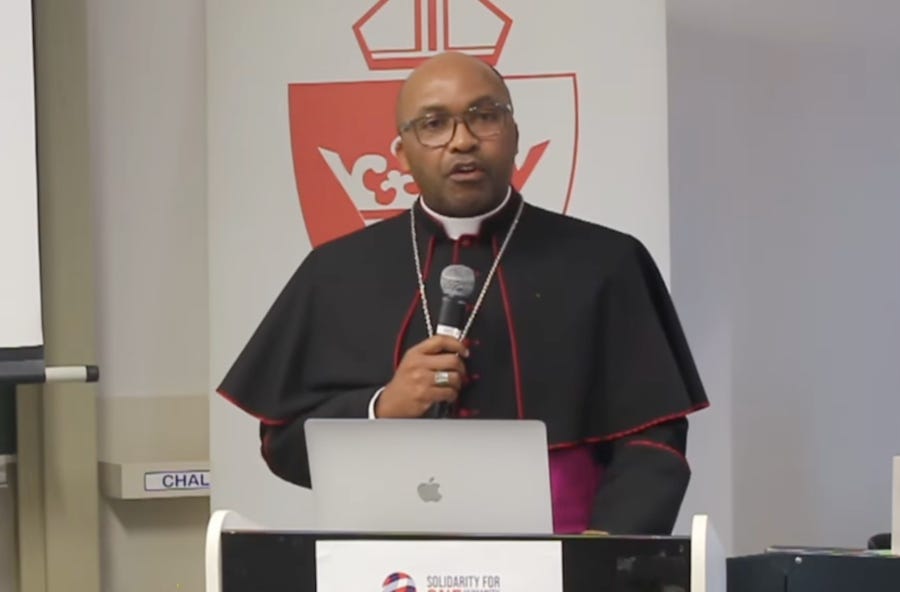
Bishop Thulani Victor Mbuyisa, C.M.M., said June 24 that the Church understood the protestors’ underlying concerns but believed they could not be resolved by targeting foreign nationals.
Mbuyisa, the chairman of the justice and peace commission for the Southern African Catholic Bishops’ Conference, said: “As the June 30 deadline for all undocumented foreigners to leave South Africa approaches, we appeal for calm and urge all those involved in anti-migration protests to refrain from violence against foreign nationals and to respect and uphold the rule of law.”
“We also call on the public to refrain from spreading misinformation, inflammatory rhetoric, and unverified videos that may further fuel fear, panic, and social tension.”
South Africa, a country of about 65 million people that had a system of racial segregation known as Apartheid from 1948 to 1994, has seen a new wave of anti-migrant protests and attacks in 2026. Previous waves occurred in 2008, 2015, and 2019.
Recent flashpoints have included KwaZulu-Natal, Gauteng, the Eastern Cape, and the Western Cape. Videos shared on social media depict vigilantes armed with sticks, clubs, and stones attacking suspected undocumented migrants.
South Africa officially has more than three million foreign-born residents, principally from the nearby countries of Zimbabwe, Mozambique, Malawi, and Lesotho. But there are also an unknown number of undocumented foreigners, mainly from the same four nations, with smaller numbers from Ghana and Nigeria.
South Africa suffered 350,000 job losses in the first quarter of 2026, mainly affecting young people. Its unemployment rate of 32.7% is one of the world’s highest.
The organization March and March, which describes itself as a citizen-led movement for immigration reform, has called for all undocumented migrants to leave South Africa by June 30. The declaration is supported by other groups opposed to illegal immigration, but the government has stressed that the deadline has no legal validity.
March and March’s founder Jacinta Ngobese-Zuma, a former radio presenter, has asserted that nationwide demonstrations planned for June 30 will be peaceful.
“All we are asking for is for illegal immigrants to leave the country and for the government to enforce the laws that already exist,” she said June 23.
In his June 24 statement, Mbuyisa, the 53-year-old Bishop of Kokstad, said: “We recognize that the underlying concerns which have prompted these protests — such as unemployment, crime, and pressures surrounding informal trading — are real and should not be dismissed.”
“The economic hardships faced by many in our country are indeed serious and deserve a responsible and comprehensive response. However, lasting solutions will never be found in violence, scapegoating, or threats against foreign nationals.”
South African Church leaders have expressed increasing alarm in 2026 about rising hostility toward migrants. There are almost 4 million Catholics in South Africa, with a significant foreign-born presence in big city parishes.
The country’s Catholic bishops issued a pastoral statement May 20 condemning “acts of violence, intimidation, and displacement directed at migrants and refugees.”
The statement, signed by bishops’ conference president Cardinal Stephen Brislin, blamed the upheaval on failures in governance, accountability, and leadership.
It said: “Competition for scarce resources such as jobs, housing, and public services has further intensified tensions between locals and migrants, particularly in economically disadvantaged communities.”
“Porous borders, corruption within the Department of Home Affairs [the government body responsible for immigration control], and irregular immigration processes have weakened public confidence in the state’s ability to manage migration effectively.”
South Africa’s President Cyril Ramaphosa outlined a five-point plan for tackling the crisis in a June 7 address to the nation. The plan focused on cracking down on law violations, securing borders, fighting corruption, reforming laws, and coordinating with other African nations.
Cape Town’s Catholic Archbishop Sithembele Sipuka, the president of the ecumenical South African Council of Churches, met with Ramaphosa in Pretoria June 17.
Speaking on behalf of a delegation of religious leaders, Sipuka said they had watched with dismay as individuals, mainly from other African countries, had been “hunted down, harassed, violated, their livelihoods destroyed, and their lives threatened unless they leave.”
Addressing Ramaphosa, he went on: “Mr President, if tomorrow every African foreign national were to leave this country, our problems would still be with us. The lack of basic service delivery would persist. Unemployment would remain. The insecurity and the drugs would remain. Because the cause is not the foreigner. The cause is the elephant in the room. In isiXhosa we say ukufa kusembizeni — the problem is in the pot itself.”
“That elephant is an education system that does not equip our young people to create work for themselves. It is the corruption that has hollowed out our institutions and collapsed the services on which communities depend. It is businesses that exploit foreign nationals for cheap labor to avoid paying fair wages — something you yourself noted in your address to the nation. To blame the stranger is to let these true culprits escape scrutiny.”
Sipuka said later that the delegation had received assurances that law enforcement would be deployed to tackle violence ahead of the planned June 30 protests.

