SSPX announces plan for bishop consecration
Without papal permission, the move would be an act of canonical schism
The Society of Saint Pius X announced Monday that it plans to consecrate new bishops on July 1, a move that comes after months of talks with Vatican officials.
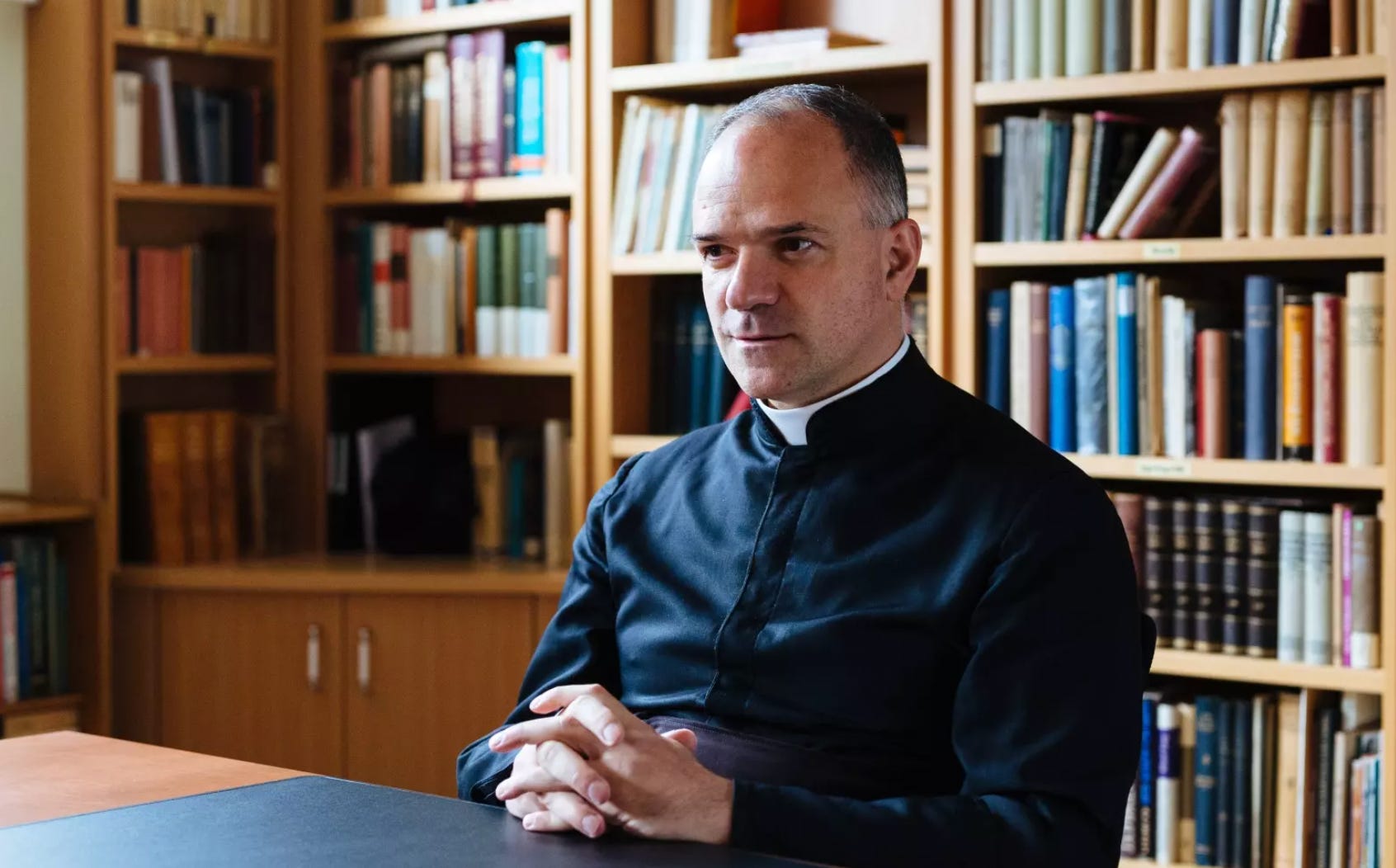
Fr. Davide Pagliarani, superior general of the SSPX said that the decision came after requesting an audience with Pope Leo XIV in August last year and after receiving “a letter from the Holy See in recent days that in no way responds to our requests.”
The Society of St. Pius X is a priestly fraternity founded by Archbishop Marcel Lefebvre in 1970 in response to the reforms of Vatican Council II. Lefebvre was excommunicated by Pope St. John Pual II in 1988 for schism, after consecrating four bishops without a papal mandate, and for many years the SSPX was widely considered a schismatic organization.
The group has only two bishops of the four consecrated by the group’s founder in 1988: Bishop Bernard Fellay, 67, and Bishop Alfonso de Galarreta, 69.
Bishop Bernard Tissier de Mallerais died in 2024, and Bishop Richard Williamson was expelled from the group in 2012 and died last year. Archbishop Lefebvre died in 1991.
The society said in a statement that Pagliarani had requested an audience with Pope Leo in August, “informing him of his desire to filially explain the current situation of the Priestly Fraternity of St. Pius X.”
“In a second letter, [Pagliarani] explicitly addressed the Fraternity’s particular need to ensure the continuation of the ministry of its bishops, who have been traveling the world for nearly 40 years to respond to the many faithful attached to the Tradition of the Church and desirous that the sacraments of Holy Orders and Confirmation be conferred for the good of their souls,” the letter adds.
The decision to consecrate new bishops came after “having received a letter from the Holy See in recent days that in no way responds to our requests.”
“Father Pagliarani, supported by the unanimous opinion of his council, believes that the objective state of grave necessity in which souls find themselves requires such a decision,” said the letter.
The Catholic Herald reported that the SSPX and Rome were expected to continue with meetings in February or March, but that SSPX decided to cancel those meetings after receiving the recently sent letter from the Holy See, mentioned by Pagliarani
Sources close to the situation told The Pillar that the meetings would have been led by Cardinal Kurt Koch, prefect of the Dicastery for Christian Unity and officials of the Dicastery for the Doctrine of the Faith, with both SSPX bishops and the superior general taking part of the discussions.
Another source close to the SSPX told The Pillar that, while discussions about ordaining new bishops had been an open secret for about a year, the move to announce plans might be intended to pressure Rome to take the SSPX’s demands seriously.
“Setting a date [for the consecrations] is a way of pressuring the Holy See, and making it negotiate,” the source added.
—
If plans for the consecration proceed without Vatican authorization, they would mark a new act of canonical schism by participants, with excommunication automatically incurred by both the bishop or bishops performing the consecration and those men who receive it. Such a move would effectively reset relations between the Holy See and the society back to their original nadir in 1988.
In recent decades, the Vatican has described the society as having “institutional irregularity” with the Church, rather than describing it as a schismatic sect.
In 2009, Pope Benedict XVI lifted the penalty of excommunication incurred by the society’s bishops through their illicit episcopal consecrations. At the same time, Benedict clarified that the SSPX has no canonical status in the Church, and said its priests could not exercise legitimate ministry.
The society has had ongoing discussions with Vatican officials over the years about normalizing its status in the Church.
The pontifical Ecclesia Dei commission, which is constituted within the Dicastery for the Doctrine of the Faith, has said that while some communion exists between the Church and the SSPX, it is “imperfect communion” and further reconciliation, or “institutional regularization” is needed.
Pope Francis continued Benedict’s dialogue with the SSPX, aiming towards reconciliation. While the theological distance between the Vatican and the SSPX appeared to harden or even increase under Pope Francis, institutional regularization also appeared to draw nearer in practical terms.
Francis extended priests of the society the faculty to hear confessions during the Year of Mercy in 2015, and extended that faculty indefinitely the following year.
Francis met in 2016 with then-superior of the SSPX, Bishop Bernard Fellay.
The meeting “lasted 40 minutes and took place under a cordial atmosphere,” the society said at the time. “After the meeting, it was decided that the current exchanges would continue. The canonical status of the Society was not directly addressed, Pope Francis and Bishop Fellay having determined that these exchanges ought to continue without haste.”
In 2017, the secretary of the Ecclesia Dei commission, Archbishop Guido Pozzo, who was in charge of dialogue with the SSPX at that time, said in an interview that a working group was “currently working on improving certain aspects of the canonical structure [of the SSPX], which will be a personal prelature,” indicating that a potential agreement could be close.
In 2017, Pope Francis also said that, under very limited circumstances, diocesan bishops could give priests of the SSPX the faculty to validly witness Catholic marriages.
That same year, Fellay, the Society’s then-superior, claimed in an interview he had received a letter in 2016 from Rome that said that the society could ordain priests without the permission of the local ordinary.
Those sacramental concessions have focused on the spiritual good of Catholics who attend chapels administered by the SSPX, with Pope Francis emphasizing that he did not want Catholics who attended those chapels to be without the possibility of confession, or a way to marry validly.
But many bishops have continued to discourage Catholics from attending SSPX chapels because of their irregular canonical status. In 1996, one bishop declared that Catholics who join SSPX chapels can be subject to excommunication, which remains particular law in the Diocese of Lincoln, Nebraska.
The group reportedly has some 700 priests in ministry around the world, mostly concentrated in Europe and in the United States. The group claims that some 600,000 Catholics attend its Masses, claiming 25,000 regularly attend in the U.S.


The SSPX deserves very little sympathy, in no small part because of this. I have traditional liturgical leanings and therefore agree with their laments about the decline of reverential worship. But at this point the SSPX are just Protestants with cassocks.
Pray that this schismatic act doesn't happen. This tears at the Body of Christ.