SSPX illicitly ordains four new bishops
‘The authorities in the Church have been animated by a spirit that is contrary to that of the faith.’
The traditionalist Society of St. Pius X illicitly ordained four new bishops Wednesday, despite a last-minute appeal by Pope Leo XIV, and the prospect of declared canonical penalties for the ecclesiastical crime of schism.
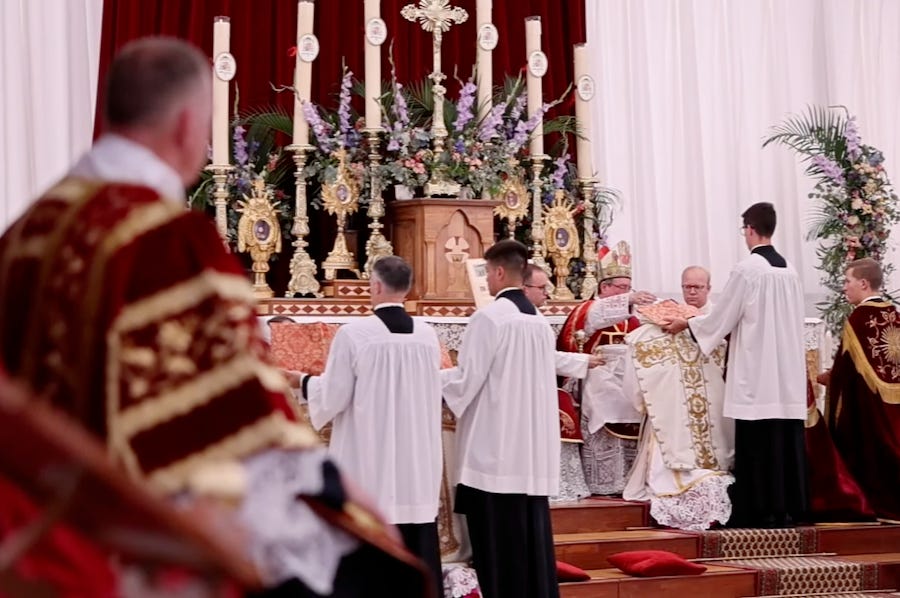
SSPX Bishop Alfonso de Galarreta was the principal consecrator at the July 1 ceremony at the organization’s headquarters in Écône, southwest Switzerland, with Bishop Bernard Fellay serving as co-consecrator and giving the homily.
The Holy See, both via the Dicastery for the Doctrine of the Faith and in Pope Leo XIV’s letter to the society’s superior, had repeatedly warned that the consecrations would be an act of schism.
The consecrations, which took place amid both sunshine and rain, saw the episcopal ordinations of the French nationals Fr. Marc Hanappier, 36, and Fr. Michel Poinsinet de Sivry, 42, the U.S. national Fr. Michael Goldade, 46, and the Swiss citizen Fr. Pascal Schreiber, 53.
Goldade, originally from North Dakota but raised in St. Marys, Kansas, is the rector of the SSPX’s St. Thomas Aquinas Seminary in Dillwyn, Virginia.
The roughly five-hour ceremony — celebrated according to 1962 editions of the Roman Pontifical and Roman Missal — went ahead despite a statement from the Vatican that the consecrations would constitute an excommunicable offense in their own right, as well as a schismatic act, which also results in excommunication under Church law.
The event also took place in spite of a June 29 appeal from Pope Leo XIV to SSPX superior general Fr. Davide Pagliarani to “turn back” from the consecrations, warning that “to tear the seamless garment of Christ is a sin of extreme gravity.”
The ceremony began at 9 a.m. local time with a procession to a large event tent, where the consecrations took place because Écône’s Church of the Immaculate Heart of Mary — the principal church of the International Seminary of St. Pius X — was deemed too small.
Around 1,300 SSPX priests and religious, and more than 15,000 laypeople, were present. When the heavens opened later in the ceremony, those outside of the tent donned rain ponchos and opened umbrellas, including some in the yellow and white colors of the Vatican flag.
Tens of thousands of people followed the consecrations online, via a live stream broadcast with audio commentaries in French, English, German, Spanish, Italian, and Polish. The ceremony also had a dedicated website, which sold souvenir bottles of wine, and its own Telegram channel.
When the ceremony reached the point where the principal consecrator asked the notary whether he had an apostolic mandate — which comes from the pope — the notary replied: “It is the Catholic and Roman Church, always faithful to the holy traditions received from the Apostles, who in entirely exceptional circumstances demands that we provide for the upholding of these traditions, that is the deposit of faith and that we take the means necessary to transmit them faithfully to all men for the salvation of their souls.”
He added: “From Vatican Council II up to the present day, the authorities in the Church have been animated by a spirit that is contrary to that of the faith and have been acting against holy tradition. They will no longer endure sound doctrine, turning their hearing away from the truth and turning toward fables, as St. Paul says to Timothy in his Second Epistle.”
The episcopal ordinations were the SSPX’s first since June 30, 1988, when the group’s French founder Archbishop Marcel Lefebvre consecrated four bishops.
Following the deaths of Lefebvre in 1991, Bishop Bernard Tissier de Mallerais in 2024, and Bishop Richard Williamson (who was expelled from the SSPX) in 2025, de Galarreta and Fellay were the sole remaining SSPX bishops.
The SSPX first announced the new episcopal consecrations on Feb. 2, 2026, arguing they were a legitimate response to an “objective state of grave necessity.”
The SSPX rejected Feb. 18 a Vatican request to postpone the ordinations and engage in a structured theological dialogue on Vatican Council II. The ecumenical council’s decrees and subsequent liturgical changes spurred Lefebvre to found the SSPX in 1970.
The SSPX repeatedly sought a face-to-face meeting with Pope Leo XIV ahead of the ceremony. It sent an open letter to the pope and the world’s cardinals on the eve of the June 26-27 extraordinary consistory in Rome. The letter was accompanied by a 154-point “Profession of Catholic Faith.”
SSPX leader Fr. Pagliarani replied June 30 to Pope Leo XIV’s last-ditch appeal, making clear that the episcopal ordinations would go ahead as scheduled.
He said: “One day, all the difficulties between the Holy See and the Society will be resolved. A gesture of understanding on Your part, far from harming unity, could only manifest before the world and before all Christians Your concern for unity and Your goodness as a father.”
In a statement after the consecrations, the SSPX said: “The Society sincerely regrets that, owing to exceptional circumstances, these consecrations had to be conferred without the authorization of the Holy Father.”
“It regrets in particular that the superior general of the Society was not afforded the opportunity to meet personally with His Holiness Pope Leo XIV, in order to set before him filially the grave reasons which rendered this ceremony necessary.”
“The profound joy inspired by these episcopal consecrations cannot, however, be overshadowed. By securing the means necessary for the preservation of the sacred heritage of Tradition, the gift of these four new bishops constitutes truly a very great grace for the Society itself and for the whole Church.”
Vatican doctrinal chief Cardinal Víctor Manuel Fernández left open the possibility of future dialogue in July 1 remarks to the Irish-English journalist Michael Haynes.
“They didn’t consider useful the dialogue we’ve proposed. But we hope in future, thanks to the action of the Holy Spirit, it’ll be possible. I’m sure, but we’ll need time,” the cardinal commented.

Soooo…since they didn’t have the apostolic mandate and the notary gave some nonsense answer, does that mean they didn’t follow the rubrics of the liturgy? Sounds like some “Spirit of Vatican II” liturgical funny-business to me ;).
The Orthodox churches survived because they actually had roots. SSPX (and Old Catholic, Independent Catholic, PNCC, etc.) are seeds thrown on rocky soil.
I have a hope that Pope Leo will use this as an opportunity for inflection and reflection on the liturgy and any doctrinal questions that have cropped up in the last 80 years. JPII had too much upheaval to manage; Benedict started movement in the right direction; Francis, likely by accident, lit a fire that moved people to talk more about these things.
Hubris. Prideful to the extreme. Pure and simple, this openly says “we know better and are holier than you are so we’ll do what WE want no matter what the successor to St Peter or Catholic teaching says” and it makes me feel terribly sad. May God have mercy on them and bring them to repentance and reconciliation.