Survey: Fewer Russians identify as Orthodox
Reception of Holy Communion is rising despite the overall decline in identification.
The proportion of Russians identifying as Orthodox has fallen from 78% to 65% in the past 15 years, according to a new survey.
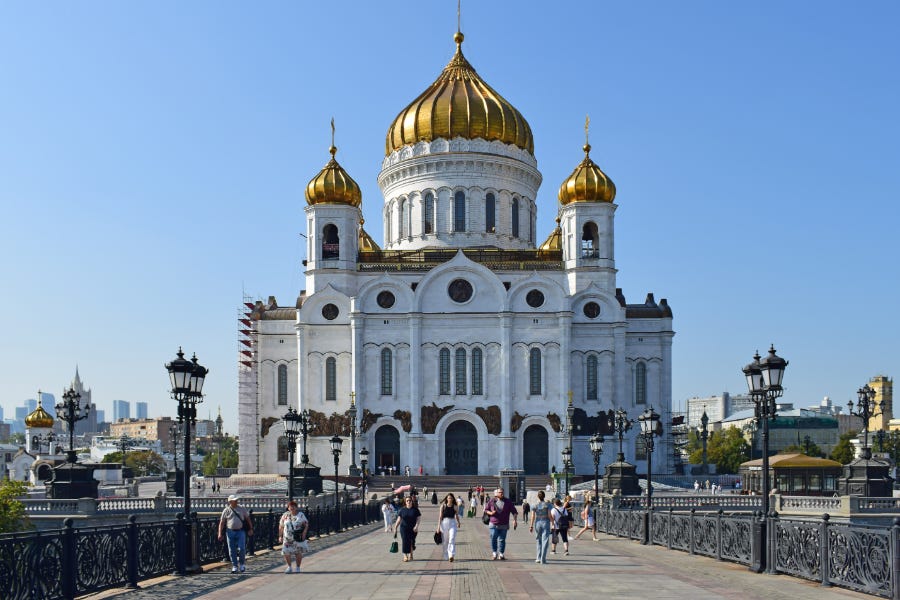
The survey, conducted by Russia’s Public Opinion Foundation on behalf of St. Tikhon’s University in Moscow, also concluded that the proportion of Orthodox Christians who never attend services has risen from 28% to 32% in the same period.
The findings, reported May 14 by the Vedomosti newspaper, are significant because the Russian Orthodox Church is the largest of the 14 universally recognized self-governing Eastern Orthodox Churches. Estimates of its membership vary, with some counts suggesting there are 110 million Russian Orthodox Christians worldwide, including 95 million in Russia. But the number of active believers is considered to be far lower.
The new research, based on a survey of 1,501 adults in February and March, also sheds light on the state of Russian Orthodoxy amid Russia’s full-scale invasion of Ukraine, which was launched in 2022 with the support of Patriarch Kirill of Moscow.
But some Russian Orthodox commentators have cast doubt on the survey’s findings. Fr. Alexey Volkov, a priest in Ulyanovsk, western Russia, told the country’s National News Service that he saw no decline in practice.
He said: “I view these figures with skepticism, because what I see at the church where I serve, and at other churches, suggests exactly the opposite. The number of parishioners is growing, and the number of people attending services is not declining. There is no decline in people’s faith or in Orthodoxy.”
He added: “Participating in the Church’s liturgical life is one of the most important attributes of faith. However, no one requires a certain number of services attended per year. There are no such quotas. Not everyone who doesn’t go to church on Sundays fails to be Orthodox. They simply have their own personal rhythm of Church life.”
The new survey also explored how intensively Russia’s Orthodox Christians practice their faith, providing detailed figures about how often they receive Holy Communion. Broadly speaking, Orthodox Christians tend to receive Communion less frequently than Catholics because of more detailed requirements concerning fasting and recent confession.
But the survey found that the proportion of active Orthodox Christians receiving Communion once a month or more has increased significantly, from 14% in 2011 to 45% in 2020 to 64% in 2026.
Among Orthodox Christians in Russia as a whole, the overall proportion receiving Communion monthly has only risen from 2% in 2011 to 5% in 2026.
Elena Prutskova, a senior researcher at the Sociology of Religion Research Laboratory at St. Tikhon’s Orthodox University, suggested that the increase reflected a contrast within Russian Orthodoxy between a highly committed core of believers and a broader group that identifies with the Church because it forms part of their ethnic identity.
Commenting on the decline in self-identification, Russian professor Valentina Slobozhnikova noted that religiosity in Russia grew strongly in the three decades after the 1991 collapse of the Soviet Union.
But she told Vedomosti that this upward trend stopped around 2019, after which the number of believers began to decrease, especially among the country’s largest religions. She suggested the trend was part of a broader European-wide decline in religious affiliation, with the younger generation taking a more individualistic approach to religion.
But she argued that active Orthodox Christians were becoming even more committed amid contemporary challenges in Russia, such as the war in Ukraine.

