
The Syriac Catholic Patriarchate of Antioch said in a statement Thursday that a gathering of the Eastern Church’s synod had already been called by the Church’s patriarch, before bishops called for a special session to vote on removing the patriarch.
The statement followed speculation that Patriarch Ignace Youssif III Younan had moved to convene the synod of the Eastern Church in response to a move by Syriac bishops to remove him, the first use of a new law issued last month by Leo XIV to create a mechanism for removing an Eastern patriarch.
The September 17 statement, released in multiple languages via the patriarchate’s website, said it was necessary to “refute all past and potential future writings, rumors, claims, fabrications, and lies that mislead public opinion and distort facts that are as clear as day.”
The patriarchate’s statement did not indicate what “fabrications and lies” it was aiming to refute, but indicated the prospect of future legal action, presumably against media outlets and social media posts covering the escalating tension within the Eastern Catholic Syriac Church.
The statement explained that the patriarch “currently refrains from responding to these claims, fabrications, lies, and vulgar verbal attacks,” while at the same time “it reserves full rights to respond and take legal actions at the appropriate time against those who market and circulate them.”
But the statement did address the allegation, first made by bishops of the Syria Church, that Youssif has not convened a meeting of the Church’s full synod for a number of years.
That charge is believed to be one of the central allegations circulated among the Eastern Church’s bishops which contributed to a Sept. 4 decision to attempt removing Youssif, which came just days after Pope Leo XIV issued the motu proprio Mutua concordia, allowing for the prospect of Eastern Catholic bishops moving to remove their patriarchs.
“Regarding the claim that His Beatitude [ the patriarch] did not convene for a Synod meeting over the past three years, this claim is entirely unfounded,” the statement said.
“His Beatitude had convened for a Synod to be held in November 2024, which was subsequently postponed by mutual agreement with the Fathers of the Synod until July 2025 due to the war in Lebanon at that time, when the ‘so-called Synod’ was convened in Rome.”
The “so-called Synod” referred to in the statement was a gathering on the bishops of the ordinary synod of the Syriac Church which was received in private audience with Pope Francis and discussed, according to reports at the time, governance issues in the Eastern Church as well as the ongoing practical challenges facing the Church, the ancient territory of which includes the modern states of Lebanon, Syria, and Iraq.
The statement added that the patriarch and the Church permanent synod — a kind of standing executive body among the bishops — had already decided at a July meeting to convoke a full synodal meeting of the Church’s bishops.
“Prior to the issuance of the Apostolic motu proprio by His Holiness the Pope Leo XIX [sic] on August 29, the Fathers agreed to convene an Ordinary General Synod in the second half of November. Consequently, His Beatitude issued a formal invitation to the synod’s fathers on September 2 to hold the Synod meeting from November 17 to November 20, 2026.”
The date of September 2 is significant because on Sept. 4, senior bishops of the Syriac Church’s synod formally triggered the legal mechanism for a vote to remove the patriarch, according to the norms of Mutua concordia. However, the patriarch’s call for a November meeting of the synod was only made public following the Sept. 4 decision.
That the patriarch’s call was only made public after the announcement of the effort to remove him led to speculation that Youssif had only called the synodal meeting in November in direct response to the attempt to remove him.
“Therefore, this clarification was necessary,” the statement said.
The papal motu proprio, formally issued on Aug. 28, amended the Code of Canons of the Eastern Churches, the body of canon law which applies to all the 23 Eastern Churches in communion with Rome, in addition to their individual governing laws.
The reform created a mechanism by which the bishops of an Eastern Church’s synod can convene a meeting to vote for the removal of the patriarch or major archbishop of an Eastern Church if they were found to have caused “irreparable damage” to the communion of Church.
According to Leo’s new law on the subject, a synodal meeting to remove an Eastern Catholic patriarch should be called by the senior bishop of the synod who is in favor of removal. A two-thirds majority of the voting members of the synod, usually the diocesan bishops of the Eastern Catholic Church, is required to effect the removal, and the pope must confirm a removal decision.
While the law does not define legal criteria for defining or establishing the alleged irreparable damage to internal communion, it does require that the patriarch be allowed to defend himself before the synod.
In the Syriac Catholic Church, the bishops are expected to convene in late September or early October for a meeting that could conclude with the deposing of the patriarch, although Youssif’s own announced gathering of the synod would see them instead meet in November.
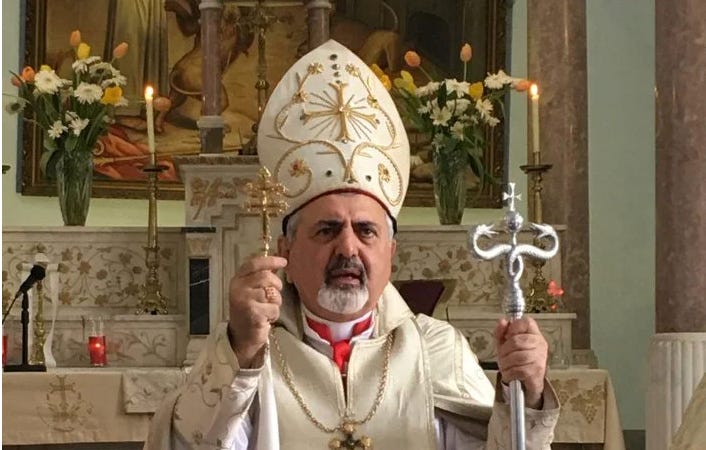
Patriarch Youssif, 81, has led the Syriac Catholic Church since 2009, his formal title is Patriarch of Antioch and All the East of the Syrians.
Dissatisfaction among Syriac bishops has reportedly centered around Youssif’s refusal to convene governing synodal meetings for the Eastern Catholic Church, despite repeated requests from bishops over the past three years. Sources close to the Syriac Church have told The Pillar that a patriarchal call for a synod this year is likely to be seen as “too late,” among broad episcopal frustration with Youssif.
There are some 160,000 members of the Syriac Catholic Church, with the majority living in Syria, Iraq, and Lebanon. Roughly 16,000 Syriac Catholics live in the United States, worshipping in the 11 parishes of the Eparchy of Our Lady of Deliverance.