Syro-Malabar basilica resumes public Eucharistic liturgies
Public Holy Qurbanas were suspended for 3 years at St. Mary’s Cathedral Basilica.
One of the most painful chapters in the Syro-Malabar Church’s liturgical dispute ended Monday when the Eucharistic liturgy was celebrated publicly at St. Mary’s Cathedral Basilica in southern India for the first time in three years.
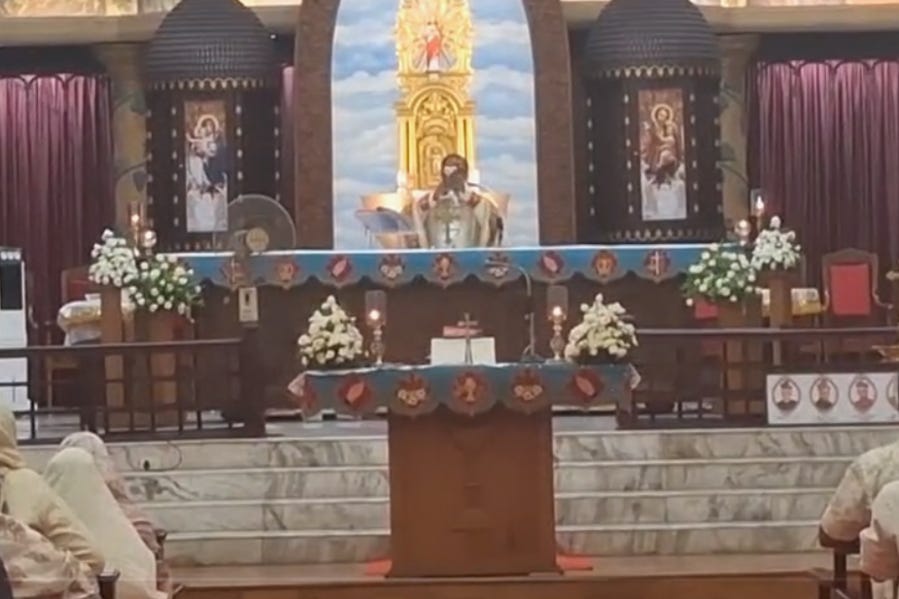
The Syro-Malabar Eucharistic liturgy, known as the Holy Qurbana, had not been celebrated with public participation at the basilica in Ernakulam, Kerala, since December 2022, due to clashes between supporters and opponents of a new uniform liturgy.
Fr. Thomas Mangatt, the basilica’s administrator, celebrated the Holy Qurbana with a congregation at 6 p.m. on Dec. 1, after the Kerala High Court granted his request that police maintain order at the basilica as public celebrations resumed.
The Dec. 1 Holy Qurbana was celebrated versus populum, or facing the congregation, the form of the Eucharistic liturgy favored by most priests and people in the local Archeparchy of Ernakulam-Angamaly.
Members of the archeparchy fiercely resisted a Vatican-backed effort to end celebrations of the Holy Qurbana versus populum and impose the uniform liturgy, in which the priest faces the people during the Liturgy of the Word, turns toward the altar (ad orientem) for the Liturgy of the Eucharist, and faces the people again after Communion.
Following an agreement reached in June 2025, the archeparchy’s priests are permitted to continue celebrating the Holy Qurbana in their preferred style, provided that at least one uniform liturgy is offered in each parish on Sundays and feast days.
One Holy Qurbana will now be celebrated in the uniform mode on Sundays at St. Mary’s Cathedral Basilica.
In a Nov. 2 statement, Riju Kaanjookkaran, a spokesman for the pro-versus populum lay group Almaya Munnettam, said: “The Masses resumed after it became clear, following an appeal from the basilica administrator before the court concerned, that there is no order preventing the Mass at the cathedral.”
“A consensus over the mode of Masses was reached as the administrator received a reply that there is no hurdle before offering the Mass if the Church leadership permits.”
The resumption of public Eucharistic liturgies at the basilica will come as a relief to the leaders of the Syro-Malabar Church, the largest of the 23 Eastern Catholic Churches in full communion with Rome after the Ukrainian Greek Catholic Church.
The basilica was one of the major flashpoints at the height of the dispute over the introduction of the uniform liturgy.
Disturbances at the basilica began after the Synod of Bishops — the Syro-Malabar Church’s supreme authority — approved the introduction of the uniform liturgy in all eparchies (dioceses) from November 2021.
On April 10, 2022, Cardinal George Alencherry, the then-head of the Syro-Malabar Church, launched the uniform liturgy at St. Mary’s Cathedral Basilica under police protection due to local opposition to the change.
But when Archbishop Andrews Thazhath, the then-apostolic administrator of the Ernakulam-Angamaly archeparchy, attempted to celebrate the uniform liturgy at the basilica on Nov. 27, 2022, he was blocked by protesters.
The protesters filled the cathedral and locked the gates before Thazhath’s arrival. Police later cleared protesters from the basilica and locked the gates to prevent further incidents, leaving the basilica closed to worshipers. During the basilica’s temporary closure, local Catholics prayed outside the locked gates for several days.
When the cathedral reopened, supporters of the versus populum liturgy occupied it, holding continuous prayer services.
On Dec. 20, 2022, protesters also prevented Fr. Antony Puthuvelil, the basilica’s then-administrator, from celebrating the uniform liturgy.
On Dec. 23, 2022, Puthuvelil walked up to the altar while priests were celebrating the Eucharistic liturgy versus populum. Dressed in vestments, he stood facing the priests across the altar, seemingly about to begin celebrating the uniform liturgy. Video footage showed police on the sanctuary steps attempting to restore order.
The next day, Dec. 24, lay people stormed up the sanctuary steps while priests who supported the versus populum liturgy were praying at the altar. The protesters pushed the portable altar — on which Pope John Paul II celebrated Mass during his 1986 visit to India — to the side of the sanctuary, knocking objects to the ground. The priests were jostled as they tried to prevent the altar from being moved.
When the protesters could push the altar no further, they pulled off the altar cloth, sending red missals flying. A group of priests bunched together beneath the high altar, while another group of clerics formed a protective circle around a priest in vestments holding a chalice and pall to his chest. Police in khaki-colored uniforms penned in the protesters beside the altar.
Public liturgies, beginning with Midnight Mass, were suspended indefinitely at the basilica. Public celebration of the Eucharist at the basilica ceased entirely for the next three years.
An agreement to reopen the basilica to the public in June 2023 broke down soon after it was announced.
The basilica was reopened on March 26, 2024, after 486 days of full closure, following a local court order. Catholics were able to enter the basilica to pray the rosary and Stations of the Cross, and attend confession. But priests did not publicly celebrate the Eucharistic liturgy at the basilica due to the unresolved liturgical dispute.
Talks between representatives of the clergy of the Ernakulam-Angamaly archeparchy and Syro-Malabar bishops resulted in the June 2025 compromise on the celebration of the Holy Qurbana versus populum, which paved the way for the basilica’s full reopening at the start of the Church’s new liturgical year.

Strange! Permitting two different forms of the same liturgy to be celebrated by the same priests in the same church building?
A complete capitulation by Rome to something that never should have been made an issue. The only person who seemed to want to make this an issue was Francis, and he almost provoked a schism over it.
Nobody is going to fault Leo or the synod for just walking away from an untenable situation. Let everyone understand that clearly for later applications.