Syro-Malabar Church battles demographic decline in India
The Church has announced a 'Community Empowerment Year' amid fears of demographic 'extinction'.
The Syro-Malabar Church has announced a “Community Empowerment Year” amid fears of demographic “extinction” in the Eastern Catholic Church’s Indian heartland due to emigration.
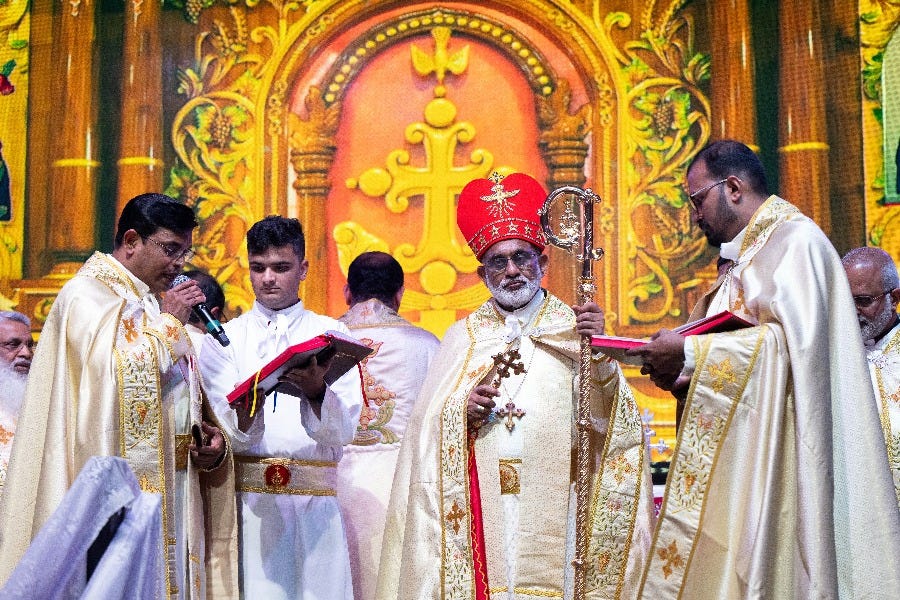
In a Jan. 10 circular letter, Syro-Malabar leader Major Archbishop Raphael Thattil cautioned against “thoughtless migration” to countries outside of India, arguing that it can lead to large debts and a weakening of faith.
Thattil’s letter, issued after a Jan. 6-10 meeting of the Syro-Malabar Church’s Synod of Bishops, also addressed rising anti-Christian persecution in India — one of the drivers of emigration — and the Eastern Church’s decades-long liturgical dispute.
In the post-synodal circular, which will be read out in churches on Sunday, Jan. 18, Thattil highlighted the high rate of emigration among Syro-Malabar Catholics in India.
The Syro-Malabar Church has an estimated five million members worldwide, making it the largest of the 23 Eastern Catholic Churches in full communion with Rome after the Ukrainian Greek Catholic Church, which has more than 5.5 million.
More than four million Syro-Malabar Catholics live in India, with 2.3 million based in the southern state of Kerala, according to a 2011 census.
The Syro-Malabar Church has 35 eparchies (dioceses), with 31 in India and four serving diaspora communities in Australia, Canada, the U.K., and the U.S. respectively.
But Syro-Malabar emigration is not limited to the Anglosphere. There are also sizeable communities in the Middle East, notably in the United Arab Emirates, and Germany, where Fr. Joshy Pottackal, a Carmelite priest from Kerala, will be ordained an auxiliary bishop of the Mainz diocese in March.
A 2023 report said that according to Church statistics, around 600,000 Syro-Malabar Catholics had migrated overseas in the previous 20 years. It added that in the past decade, 100,000 families had relocated to Australia, Canada, and the U.S.
In his circular, Thattil said the bishops had decided to declare 2026 a Community Empowerment Year to “enable young people and families to bravely face the challenges faced by the modern world.”
“The demographic decline that weakens our presence in public places should be a topic of discussion in our families,” he wrote.
He added: “The thoughtless migration to foreign countries that is happening among our community members is leading some to huge debts and loss of faith. We must understand our potential to become job creators and job providers, not just job seekers.”
“It is noteworthy that commendable examples have been created in some of our dioceses that show that agriculture can be scientifically cultivated and provide employment to many people, even though it is said that it is not profitable.”
“I call on everyone to seriously take up the action plans of the Community Empowerment Year to overcome the crises facing us in the present time.”
Syro-Malabar Church spokesman Fr. Tom Olikkarott told the news website Onmanorama it was vital to address an increasing death rate and declining birth rate.
“More than just reducing our representation, the community is facing extinction, a reality affecting most communities in Kerala, not just Christians,” he said.
“This is not a new issue; the Church has been addressing the need for families to discuss having more children since 2010.”
He added: “A major concern is that as youngsters migrate to foreign countries, there is no one to look after the elderly. Furthermore, many in the new generation do not want to marry, or if they do, are against having children.”
“As the family is the basic unit of society, its shrinking size is alarming. We need larger families that promote responsible parenthood. The Church has been, and remains, committed to supporting families who struggle to raise their children through various schemes and scholarships.”
Factors pushing young Syro-Malabar Catholics to leave Kerala include high unemployment and low wages, combined with a high literacy rate and strong ties with diaspora communities. Young people working in nursing and IT are especially drawn to opportunities abroad, where salaries are higher.
A 2018 Church survey concluded that most emigrating professionals under 40 do not return to Kerala.
The Syro-Malabar Church has attempted to slow the community’s demographic decline by offering financial incentives to married couples to have more than two children and distributing leaflets highlighting local job opportunities.
In his circular, Thattil also lamented a spate of attacks on Christians in India in the run-up to Christmas.
“The atrocities committed against Christian churches and prayer groups, denying even the constitutional rights granted to them, are extremely painful,” he wrote.
“Allowing a culture of hatred to grow, interpreting our acts of love as forced conversions, weakens the very secular nature of our country.”
Addressing the Syro-Malabar Church’s long-running liturgical dispute, Thattil said the Synod of Bishops had hoped that its 2021 decision to adopt a new uniform version of the Syro-Malabar Eucharistic liturgy in all 35 eparchies would strengthen unity.
But he lamented that unity had “not been fully realized” due to opposition in the Archeparchy of Ernakulam-Angamaly, the most populous Syro-Malabar eparchy.
Years of protests ended in a compromise in which the archeparchy’s parishes are permitted to use their preferred form of the Eucharistic liturgy as long as they offer at least one new uniform Eucharistic liturgy on Sundays and major feast days.
Thattil said the Synod of Bishops’ 2021 decision “remains unchanged.”
“In the special situation of the Archeparchy of Ernakulam-Angamaly, we appeal to the decision to implement the unified Holy Eucharistic celebration gradually, and call on everyone to abandon the path of protests that are not in keeping with the Christian ideal and to adopt the path of reconciliation,” he wrote.
