
The head of the Syro-Malabar Catholic Church has dissolved a controversial tribunal established in 2024 to hear the cases of priests accused of defying orders related to the introduction of a new “uniform” liturgy, after the Vatican’s supreme court suspended the tribunal’s proceedings.
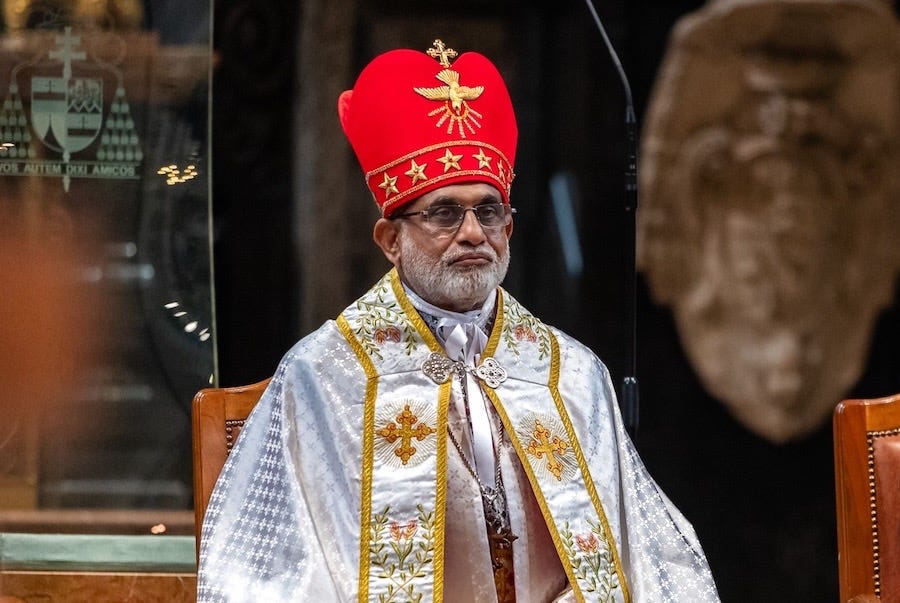
Major Archbishop Raphael Thattil signed a decree on Sept. 30, 2026, approving the dissolution of the Special Tribunal for the Archeparchy of Ernakulam-Angamaly, a jurisdiction in Kerala, southern India, that is the epicenter of a decades-long liturgical dispute within the Syro-Malabar Church. The decree was published in the November edition of Ernakulam Missam, the archeparchy’s official monthly bulletin.
The Ernakulam-Angamaly archeparchy, which serves around 500,000 Catholics, is the most populous eparchy in the Syro-Malabar Church, one of the 23 Eastern Catholic Churches in full communion with the pope.
Thattil established the special tribunal on Dec. 18, 2024, to address “ongoing disciplinary issues” relating to clergy of the Ernakulam-Angamaly archeparchy. As Major Archbishop, Thattil is also the Metropolitan Archbishop of Ernakulam-Angamaly. Day-to-day administration of the archeparchy is entrusted to his vicar, Archbishop Joseph Pamplany, and previously to apostolic administrators.
The special tribunal was created amid rising tensions between Church authorities and members of the archeparchy over attempts to introduce a new form of the Syro-Malabar Eucharistic liturgy, which is known as the Holy Qurbana.
Most priests and lay people in the Ernakulam-Angamaly archeparchy favored the Holy Qurbana celebrated facing the congregation, a local custom adopted more than 50 years earlier.
Members of the archeparchy fiercely resisted a Vatican-backed effort to introduce the uniform liturgy, in which the priest faces the people during the Liturgy of the Word, turns toward the altar for the Liturgy of the Eucharist, and faces the people again after Communion.
The uniform liturgy is seen as a compromise between the Holy Qurbana facing the people throughout (versus populum) and facing the altar throughout (ad orientem), harmonizing celebrations in the 35 Syro-Malabar eparchies worldwide.
The archeparchy announced in December 2024 that disciplinary measures against Fr. Varghese Manavalan, Fr. Joshy Vezhaparambil, Fr. Thomas Valookaran, and Fr. Benny Palatty would be referred to the special tribunal.
The four priests were referred to the tribunal by Bishop Bosco Puthur, the then-apostolic administrator of Ernakulam-Angamaly, following disciplinary action against them. Puthur had appointed administrators to oversee the parishes associated with the four priests, provoking protests by local lay people.
The archeparchy said the priests were ordered to leave their residences, where they were “staying illegally,” and move to other locations, where they would be permitted to celebrate the Holy Qurbana in a private chapel.
The archeparchy said the priests were no longer permitted to celebrate the liturgy elsewhere or hear confessions. The cases against the four clerics were referred to the special tribunal for penal proceedings.
The Sept. 30 decree said that Archbishop Mathew Moolakkatt, the General Moderator of the Administration of Justice of the Syro-Malabar Church, received a complaint alleging that two proceedings before the special tribunal had procedural defects.
Moolakkatt responded by temporarily suspending the proceedings. Fr. James Mathew Pampara, the special tribunal’s presiding judge, disagreed with the suspension and appealed to the Apostolic Signatura, the Catholic Church’s supreme tribunal.
The Apostolic Signatura examined the allegation of procedural irregularities as well as “questions concerning the competence and functioning of the special tribunal,” the decree said. On Oct. 1, 2025, the Apostolic Signatura ordered the suspension of all cases before the tribunal, prohibited the opening of further cases, and requested the records of pending cases.
The Apostolic Signatura sent the remaining two pending cases back to the ordinary ecclesiastical court in Ernakulam-Angamaly, rather than allowing the special tribunal to continue dealing with them. It instructed the Metropolitan Tribunal of Ernakulam-Angamaly to first consider whether the cases should be abandoned. It also indicated that the special tribunal could be formally abolished if the cases were brought to an end.
The Metropolitan Tribunal examined and disposed of both cases at first instance, following the Apostolic Signatura’s instructions. This paved the way for Thattil to dissolve the special tribunal.
The archeparchy’s published clergy listings show that the four priests whose cases were initially referred to the tribunal remain listed among its clergy. The listings alone do not make clear how each case was resolved.
Fr. Varghese Manavalan is described as being on medical leave. Fr. Joshy Vezhaparambil is designated as vicar of St. Mary’s Forane Church, Muttam, Cherthala. Fr. Benny Palatty is named as vicar of Lourde Matha Church, Perumanoor. Fr. Thomas Valookaran is listed as vicar of St. Joseph’s Church, Nayathode, and chairman of the People’s Dairy Development Project charity in Kalady.
The Sept. 30 decree was published above a separate notice from Fr. Antony Vazhakkala, chancellor of the Ernakulam-Angamaly archeparchy, stating that suspensions imposed on two priests — Fr. Jacob Pozholipparambil and Fr. Varghese Manavalan — in 2024 were revoked in April 2026 and June 2026 respectively.
The notice said that “both priests are free to administer the sacraments and sacramentals anywhere to any Catholic faithful as the general law of the Catholic Church prescribes.”
Fr. Pozholipparambil is listed in the clergy directory as pro-vicar of Infant Jesus Church, Karimugal, and St. Jude Church, Ambalamedu.
The November edition of Ernakulam Missam also published a Sept. 10, 2026, letter from Thattil to his vicar, Archbishop Pamplany, highlighting a declaration in August by the Syro-Malabar Synod of Bishops.
The statement reaffirmed the terms of a June 2025 agreement that permitted parishes in the Ernakulam-Angamaly archeparchy to continue celebrating the Holy Qurbana with the priest facing the congregation throughout, provided that they also offered at least one celebration in the uniform mode on Sundays and other holy days of obligation.
The declaration could be submitted to civil courts as the synod’s official statement of the Church’s position in cases concerning disputes within the Ernakulam-Angamaly archeparchy.