
The Vatican announced on Friday the election of a new Dean of the College of Cardinals, Cardinal Antonio Luis Tagle, the Pro-Prefect of the Section for First Evangelization and New Particular Churches within the Dicastery for Evangelization.
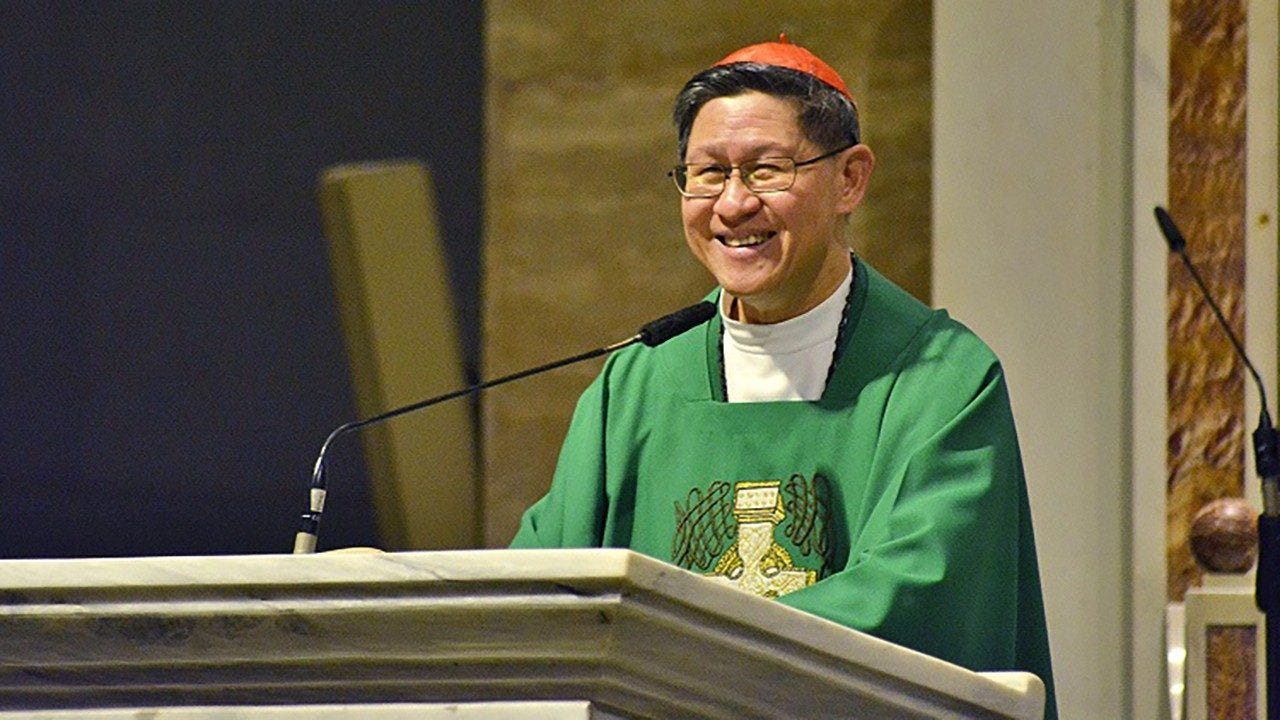
According to an official Vatican media news report, Tagle was elected by the cardinal-bishops, the most senior ranking cardinals of the college, on Thursday Oct. 8 and will now serve a five-year term as head of the college, renewable once.
Tagle was elected by the nine other cardinal-bishops and was one of only two among their number actually able to fulfill its functions in the event of a conclave, the other being Cardinal Pietro Parolin. All the other cardinal-bishops are over the age of 80, four of them over 90.
Tagle’s election as dean, who is “first among equals” of the college and plays several key roles during a papal interregnum and conclave, brings to an end the tenure of the now-dean emeritus, Cardinal Giovanni Battista Re, who was elected to the position in 2020, following the death of the previous dean, Cardinal Angelo Sodano.
Previously a lifetime appointment, the position of dean was reformed by Pope Francis in 2019. The Vatican did not make any announcement about the status of the office of subdean, currently Cardinal Leonardo Sandri.
The age and status of the head of the college, and the practical application of Pope Francis’ 2019 reforms to their offices, was a source of some confusion in the final year of the last pontificate, with both men being confirmed in office after five years by papal fiat, instead of reelected, and despite both being too old to participate in the conclave which elected Cardinal Robert Prevost as Leo XIV.
Re, 92, and Sandri, 82, were both elected in 2020 and past the age of participation in the 2025 conclave when the Vatican announced that Pope Francis had “extended his approval” for the two to continue in office after their terms officially lapsed in January of that year.
That “extension of approval” raised a number of canonical questions. According to the 2019 motu proprio, the pope approves the election of the dean and subdean, following their election by the cardinal bishops.
Canonical norms provide that the one competent to approve an election for a set period of time is also competent to notify them of their term of office lapsing, which formally triggers the office becoming vacant. In Re’s case, then, he would seem to have been able to continue his role as dean until the pope formally notified him that his five-year term had lapsed, so it was unclear if a formal “extension of approval” was legally necessary.
The dating of the 2025 extension to several weeks before Re’s term lapsed — though only announced Feb. 6 — suggested the pope was preemptively acting to forestall the cardinal bishops electing a new dean.
Pope Francis’ separate decision to “extend his approval” for Sandri to serve as subdean one week after doing so for Re raised several other questions.
Neither the Code of Canon Law, nor Francis’ 2019 motu proprio defining a five-year term of office for the dean of the college, create a similar term limit for the subdean, so it was unclear why Francis formally extended his approval for Sandri, since his office does not lapse after a period of time.
Since no announcement has been made about Sandri’s office of sub dean, he is believed to be continuing in office.
—
The rank of cardinal-bishop is a legal term of art. Most cardinals are bishops, but the formally designated “cardinal-bishops” are the most senior members of the college, who are given the titular leadership of the Diocese of Rome’s ancient suburbicarian dioceses.
Other cardinals have the rank of either cardinal priest or cardinal deacon, and are given honorary titles attached to ancient churches of the Roman diocese, with the three orders of cardinals serving as a historical nod back to the time when the Bishop of Rome was elected by the clergy of the diocese.
Along with his election as dean, the Vatican announced Friday that Tagle will assume the title of the Suburbicarian Church of Ostia while retaining the cardinalatial title of the Suburbicarian Church of Albano. Tagle did not previously have title to a suburbican diocese, despite being a cardinal-bishop.
Over the past decades, the ranks of cardinal priests and deacons swelled considerably, as popes broadened membership of the College of Cardinals to ensure a global voice in the election of the pope in a conclave. But because of the historic link of the rank of cardinal-bishop to Rome’s ancient suffragan dioceses, the ranks of cardinal bishops remained limited.
Then, in 2018, Pope Francis added four new cardinals to the rank of cardinal-bishop, granting them full membership of the order, even though there were no vacant suburbicarian titles to assign them.
The pope did so again in 2020, promoting Cardinal Tagle to the rank without a titular diocese, alongside Cardinal Beniamino Stella, giving him the then-vacant titular diocese of Porto-Santa Rufina.
In both 2018 and 2020, Pope Francis made it known he wished to see membership of the rank expanded, in line with the rest of the college, and pointedly conferred the rank on cardinal prefects of major Vatican dicasteries even if there were no suburbicarian titles to assign them.
He did so for Cardinal Tagle as prefect of the then-Congregation for the Evangelization of Peoples, having also previously promoted for his predecessor Cardinal Fernando Filoni, along with the Secretary of State, Cardinal Pietro Parolin, the then-prefect of the Dicastery for Oriental Churches, Cardinal Sandri, and Prevost’s predecessor, Cardinal Marc Ouellet.
In 2025, the Vatican announced that Pope Francis had promoted Cardinal Robert Prevost, then-prefect of the Dicastery for Bishops, to the order of cardinal-bishops and assigned him the titular suburbicarian diocese of Albano, previously held by the last dean of the college, Cardinal Angelo Sodano, who died in 2022.
Prevost’s elevation, and his assignment to the vacant title of Albano, was notable in that he was only made a cardinal in 2023, when he was appointed to lead the Dicastery for Bishops.
Prevost was therefore junior, both in his appointment to a senior Vatican role and creation as a cardinal, to Cardinal Lazarus You Heung-sik at the Dicastery for Clergy, though senior in precedence as a cardinal to both Cardinal Víctor Manuel Fernández of the Dicastery for the Doctrine of the Faith and Cardinal Claudio Gugerotti at the Dicastery for Eastern Churches.
It was understood at the time that Francis had delayed the election of a new dean, and allowed Battista Re to continue in his role despite his age, in order that Prevost could be elected as dean of the college instead of Cardinal Parolin or Tagle.
Instead, Prevost was elected by a conclave two months later and became Pope Leo XIV.
S.N.A.F.U.