
‘The best decision I’ve ever made’ - Australia sees surge in adults entering Church
"People are searching for something they can trust."
Samuel Carden, an Australian high school student preparing for graduation, still remembers the shock on some of his family members’ faces when he told them he would be entering the Catholic Church at Easter this year.
His family, whom he describes as lifelong atheists, could not comprehend why he would do such a thing when he had been raised without reference to Christianity -- or religion at all.
But Carden had been asking questions about faith for years. He sensed there was a higher power, he said, and atheism just didn’t seem to gel. This led him to study various religions, and then to explore philosophy before realizing the Catholic Church was the answer he had been seeking.
Carden is just one face of a counter-cultural phenomenon quietly growing across Australia and around much of the world – more and more people from widely differing backgrounds, many young and male, seeking to enter the Catholic Church.
Bendigo, where Carden lives, is a regional city of about 160,000 people, in the Australian state of Victoria – part of the Diocese of Sandhurst.
This year, Carden is one of about 60 adults in the Diocese of Sandhurst who will enter the Catholic Church at the Easter Vigil.
Last year, that figure was just 10.
The surge of interest in joining the Church is not limited to a single diocese.
The Archdiocese of Sydney will see 457 people joining the Church this Easter. In a February press release, Archbishop Anthony Fisher OP said the steep increase from 2025 – catechumens this year are up by 35% and candidates by 95% on last year’s figures – is “proof that the Holy Spirit is active and alive.”
Figures from the Catholic Inquiry Centre, an office of the Australian Catholic Bishops’ Centre for Evangelisation, show similar trends in other dioceses across the country.
The Archdiocese of Brisbane will welcome 454 new Catholics at Easter this year. Two years ago, that number was 198.
The coastal New South Wales Diocese of Wollongong is set to receive 96 new Catholics this Easter, compared to 52 last year.
In the island state of Tasmania, the Archdiocese of Hobart – the smallest of Australia’s archdioceses – will welcome 13 new Catholics this year, compared to just three last year.
In the nation’s capital, the Archdiocese of Canberra Goulburn is set to welcome 315 adults into the Church this Easter, compared to just 25 new Catholics five years ago.
In Bendigo, the people entering the Church this year include a mine worker, a young city lawyer practicing family law, a clerical officer, and a university student studying finance and hoping to become a financial trader.
Like their lives, their journeys to the Church and their reasons for joining are all unique.
John Box, a fly-in-fly-out mine worker and father of four currently working in the Bendigo region, began contemplating entering RCIA when his wife Sarah and their children returned to attending Sunday Mass each weekend.
“I thought ‘I’m just going to find out what this Catholic Church is all about’,” he said. “It’s the best decision I’ve ever made.”
At first, his parents thought his Church attendance was not really serious.
“But they’re starting to realize now that it’s not a joke,” he said with a smile.
His wife, Sarah, is a cradle Catholic who stopped attending Mass for many years.
“I sort-of woke up one day and thought ‘I’ve got to get back to Church,’” she said, adding that she wanted to “fill in” the bigger picture of the Catholic faith for her children, who are homeschooled.
She sees her own journey back to the Church as part of a broader trend.
“I really think God is moving in the world and people are starting to think, ‘Oh, maybe there really is something to all of this’,” she said.
For Kelly Manzie, a clerical officer and mother of two, the feeling that she was being called into the Church was strong. But at the same time, she was apprehensive at taking what seemed like such a momentous step.
She had explored a variety of other belief systems, but sensed deep within herself that they didn’t have the answers she was searching for.
What finally prompted her was the strong feeling that her guardian angel was leading her to inquire about becoming a Catholic.
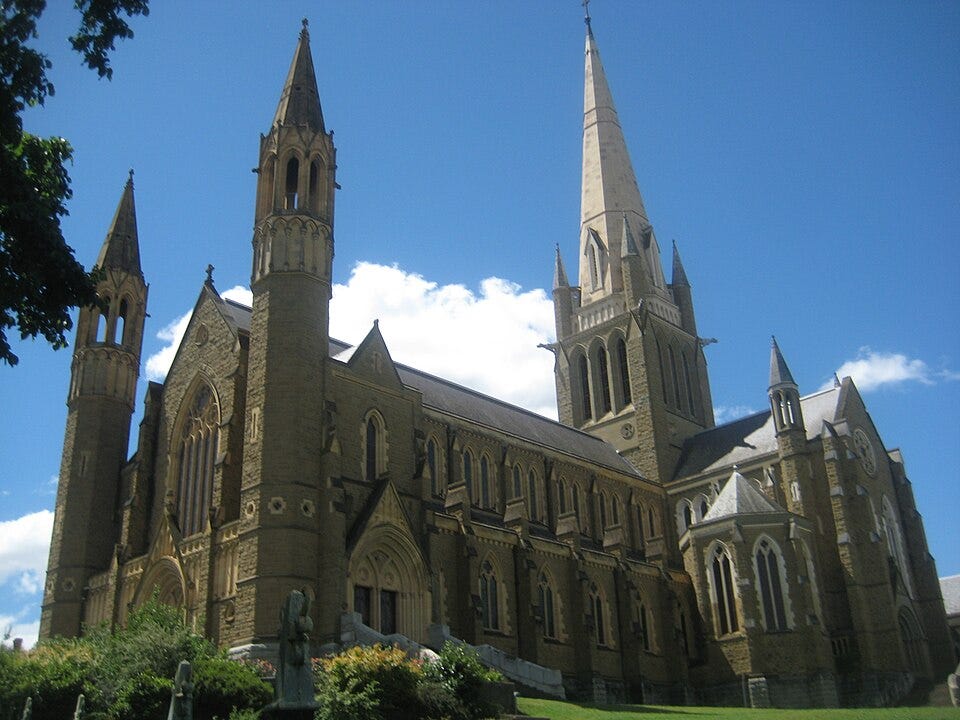
On that day in August 2025, she drove to Sacred Heart Cathedral. Instead of walking inside, she walked around the outside of the building several times, debating what she should do.
It was a week later that she finally walked into the cathedral and inquired about entering the Church.
From there, she said, “things just fell into place.”
Manzie said she had never before made God the center of her life. Now, she can’t wait to formally enter the Church.
“I’m impatient to become a Catholic - but I also know that God is preparing me for that moment.”
For Samuel Carden, the high school student from a family of atheists, the journey took years.
“It was a long process, really,” he said. “Despite my upbringing, atheism never really ‘clicked’ with me.”
“That kind of idea doesn’t work in terms of human values. What I had been told about life and religion and what I knew of my own value as a person didn’t add up for me.”
His feelings about a divine presence started very early, around the age of seven. In his teenage years he started reading as much as he could about different religions, and then began exploring philosophy as he searched for something he could believe in.
One day he came across the word ‘theology’ in his reading and decided to find out what it meant.
“I believed in a higher power, and the ontological arguments for God made sense,” he said. “It all clicked. And that’s when I started asking ‘who is God?’”
Carden said the wonder he experiences at the created world was an inspiration to him.
“I was impressed not just by a creating God but by the order in everything,” he said.
“I thought that if God is self-sufficient, he doesn’t need creation -- but he still creates. And that showed me a deep level of care.”
As he looked into various world religions, he concluded that everything pointed to Christ.
“Finally, after a year as a Christian in my own head, I thought ‘I have to go to Church’,” he said.
He still remembers that experience.
“The first time I walked into St Monica’s [in the Bendigo suburb of Kangaroo Flat] … my very first thought was ‘I’m home.’ From that day on I thought of myself as a Catholic.”
Carden began attending Mass, but not receiving the Eucharist. He spoke with a priest, who referred him to the RCIA program.
“I told Dad and Mum but they didn’t really get it at all,” Carden said. “They were shocked. They didn’t understand it whatsoever.”
Ultimately, he says, the Eucharist is the reason he wants to be Catholic. He’s counting down the days until he can receive Christ sacramentally.
“I’m fully convinced it will be the greatest day of my life. I think I’ll cry,” he said.
Father Jackson Saunders is the priest at Sacred Heart Cathedral in Bendigo who has accompanied this year’s catechumens and candidates through the RCIA process.
He says he already has 16 inquiries for next year.
“It’s early days, but this level of interest is way up on even last year’s increased figures – and it’s only March,” he said.
“I really think people are searching for something they can trust and believe in more than ever,” he continued. “So much in the world is happening, and I have no doubt that what we’re seeing – plain and simple – is God at work.”
Amid the increased interest in joining the Church, Saunders has noticed something else. He said he has been surprised by the deep questions people have been asking him.
“People are not asking questions like whether I really believe God exists,” he said. “They’ve already concluded that God is real, personally present to all of us and loves us.”
“They’re asking, often, deeply complex and nuanced theological questions, and I think this is showing something quite significant about what’s really going on beneath the surface of our society. This is not just a fad.”
In fact, the priest said, interest in joining the Church has grown so much in recent years that it is starting to strain personnel and resources.
“In a sense, we’re struggling to keep up with interest,” Saunders said.
“But,” he added, “if you have to have problems, it’s a good problem to have.”
There's something really crucial here - the movement of the Holy Spirit in people's hearts before any pastoral strategy, the role of which in these stories to respond to what has already happened. Pope Leo said it today at the Chrism Mass:
"The surprise of Pentecost is repeated when we do not presume to control God’s timing, but place our trust in the Holy Spirit, who “is present, even today, as in the time of Jesus and the Apostles: is present and at work, arriving before us, working harder than us and better than us; it is not for us to sow or awaken him, but first and foremost to recognize him, welcome him, go along with him, make way for him, and follow him."
Nice article, thank you.