
On September 15, 1963, The New York Times declared on its front page that Pope Paul VI’s admission of some handpicked “qualified laymen” to the Second Vatican Council was “the first time in the history of the Roman Catholic Church that laymen have been admitted to such a council.”
Numerous other media outlets made similar claims about Vatican II in the 1960s, including Catholic ones. Indeed, many Catholic churchmen and thought leaders in the era billed the council as unprecedented in its respect toward the laity and its inclusion of lay auditors—to the point that many Catholics today, more than 60 years later, still see Vatican II as inaugurating an “Age of the Laity.”
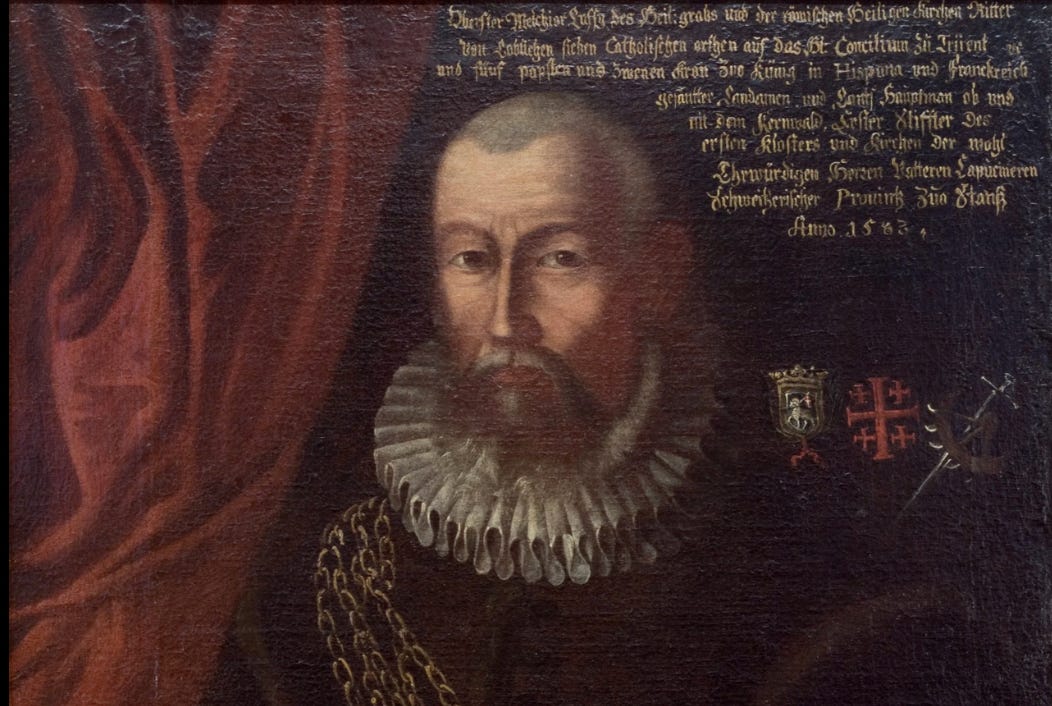
Could he have seen far into the future, a pious Catholic soldier and magistrate named Melchior Lussy would have puzzled over this.
In March of 1562, the 33-year-old Swiss mercenary reluctantly set out from his home in Nidwalden to the Council of Trent in the Italian Alps. Despite his protestations, he had been chosen by the leading laymen of Switzerland’s Catholic cantons to represent them in the proceedings.
As a military man, Lussy was unsure what he could contribute to conversations that would, he assumed, be mostly theological in nature.
But Lussy was a dutiful son of the Church. He had recently commanded troops for the Papacy in its latest war. He also disliked the heresies that dominated in Zurich and other parts of the Swiss Confederation, deeply dividing his countrymen in new ways. Furthermore, some churchmen he trusted really wanted him at the council, among them a 23-year-old cardinal he had recently befriended—Charles Borromeo, Pope Pius IV’s nephew and a future canonized saint.
So, to Trent Lussy went, traveling on horseback for more than a week through difficult Alpine terrain.
Two other Swiss laymen accompanied him, Balthasar Luchsinger and Martin Schorno of Schwyz, to serve as his secretary and second, respectively.
Lussy and his companions were received warmly at Trent by many bishops and lay representatives from other countries who were eager to hear from the Swiss. This was the first time that Switzerland had sent representatives to a drawn-out council that had been interrupted several times since 1545 by wars and unsupportive pontificates. The Swiss were so welcome, in fact, that the council organizers had even invited representatives of the Protestant cantons in the hopes of achieving a reconciliation. Like other Protestants in Europe invited to Trent, however, the Swiss Protestant invitees dismissed the whole affair as irrelevant and Satan-spawned.
Lussy chose to say less than he was allowed to at Trent. This, at least, is what historian Richard Feller tells us in his two-volume German-language biography of Lussy. Instead, Lussy had a hermit named Diamante speak for him, believing that this enhanced his dignity as an agent of the ancient, Catholic cantons of Switzerland. Feller adds that many at the council thought this was strange and indicative of typical Swiss cunning.
Other laymen at Trent’s final sessions made stronger impressions. The French had also decided, finally, to participate, after years of ignoring invitations from the council organizers. And among the leading laymen representing the Eldest Daughter of the Church was the jurist and poet Guy du Faur, the Seigneur de Pibrac. About the same age as Lussy, Pibrac was known to be sympathetic with Protestants and to favor policies of toleration for them by Catholic states.
Pibrac was also skeptical—as the French bishops at Trent alsowere—that badly needed reforms in the Church in many countries could be achieved by means of a papacy-driven conciliar process. So he advocated, in an eloquent but controversial address, for the preservation of France’s historic liberties vis-à-vis Roman meddling.
Similarly zealous on behalf of his national church was one of Spain’s delegates, Claudio Fernández Vigil de Quiñones, the Count of Luna. Since the joint reign of Queen Isabella and King Ferdinand decades before, Spain had spearheaded ecclesiastic reforms within its domains before it was a European trend. The popes had allowed the Spanish monarchs to select most bishops in their domains, too. Luna worked to preserve royal, lay control over certain ecclesiastical affairs in Spain where some bishops were seeking to take over.
Among the many topics debated in the last sessions of the Council of Trent were the extent to which celibacy should remain mandatory for all Roman Catholic clergymen and, if so, in what precise terms the council fathers should decree as much. Some clergymen and laymen at the council from lands where Protestant ministers were now regularly taking wives favored a loosening of the traditional discipline, at least within those territories.
Augustin Baumgartner, a lay representatives of Bavaria’s young Duke Albert V, led the charge in this area in an address he made to the whole assembly at Trent. He was disappointed that, although the final decrees technically left the matter open for further debate, the bishops voted in favor of a canon that anathematized anyone who claimed that any man in holy orders could validly contract a marriage.
The presence of laymen such as Baumgartner, Lussy, and these others was not minor at Trent. In fact, the bishops at the council—around 250 at the most well attended sessions—were outnumbered by the lay envoys, secretaries, and other members of the entourages of secular princes and princes of the Church who were present. The Portuguese alone sent a mostly lay deputation of about 80 men.
Furthermore, it had been the Holy Roman Emperor—first Charles V, then Ferdinand I—who had pressured the Church’s bishops to proceed with the reforming council. This was consistent with an ancient tradition of imperial pressure being used for the benefit of the Church going all the way back to Constantine the Great’s calling together the First Council of Nicaea.
The Habsburg emperor also helped safeguard Trent’s proceedings with his soldiers alongside those of the Prince-Bishop of Trent. And both Charles V and Ferdinand I made personal appearances at the council—as did other European sovereigns, who of course were, in that era, the Church’s leading laymen.