The monstrance, the Congress, and El Zorro: Highlights of Leo in Spain
Christ “is comfort to the weak, light for families, hope for the sick and peace for those who suffer.”
Pope Leo XIV arrived in Spain on June 6 for the first papal visit to the country in 15 years.
Given Spain’s tense political climate, its deep Catholic heritage, and the pope’s own affection for the country, dating back to his years as a student in Italy, expectations were high.
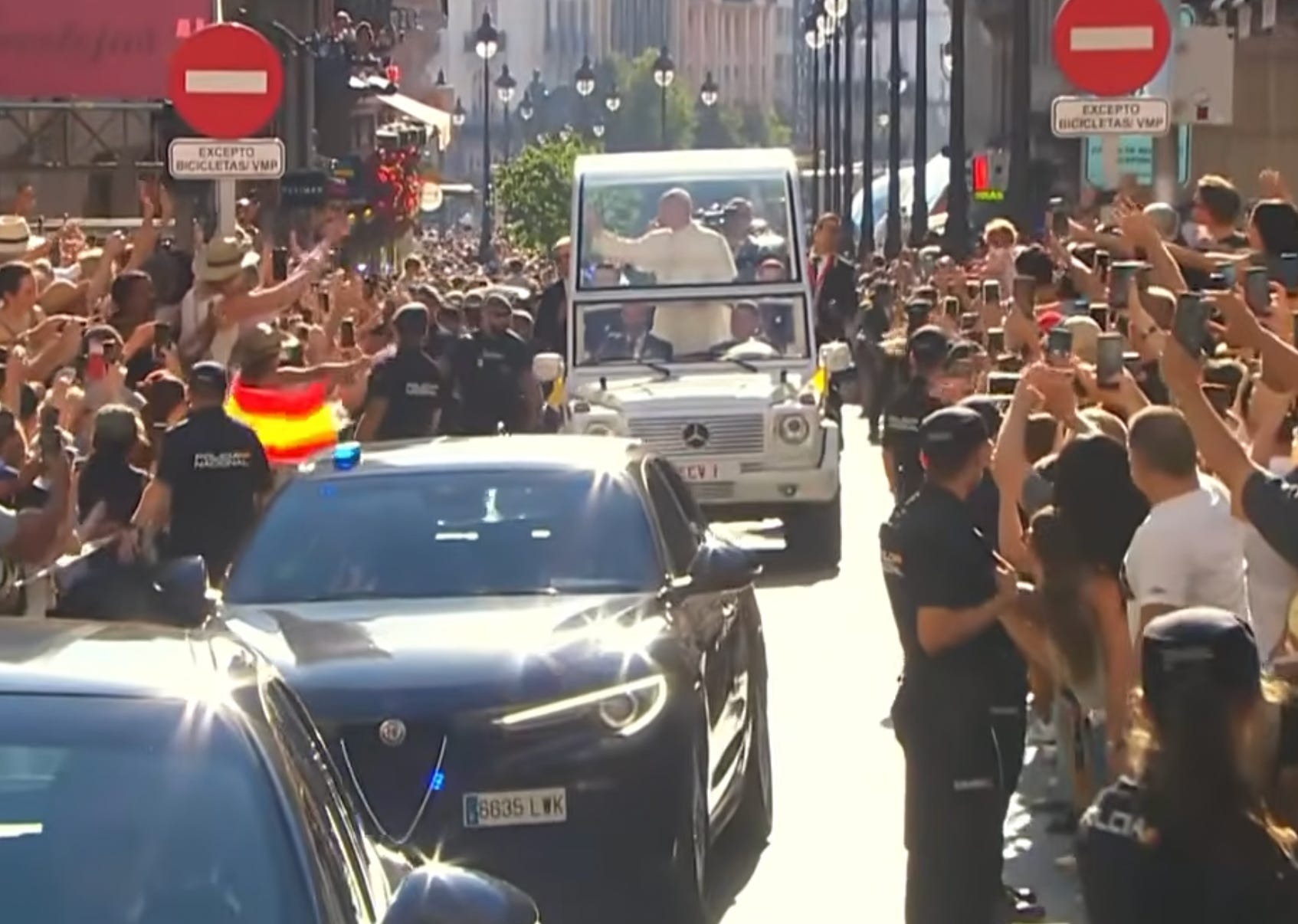
So far, the overwhelming sense in the country is that they have been met — if not exceeded.
While 300,000 people were expected at Saturday’s prayer vigil with young people, more than half a million attended. And while one million were expected for the pope’s Corpus Christi Mass on Sunday, official estimates put attendance at 1.5 million.
So what have been some of the key moments of the pope’s visit to Spain?
Check them out:
Youth prayer vigil
The pope held on Saturday a prayer vigil for youth, including a Q&A, after which he led the gathered crowd in Eucharistic adoration with benediction.
The first question to Leo was about which saints, aside from Saint Augustine, had helped him grow as a Christian, to which he mentioned Saint John Chrysostom, Saint Thomas of Villanueva – a Spanish Augustinian bishop in the 16th century – and Saint Toribio of Mogrovejo, a Spanish missionary bishop in 16th century Peru.
“Reflecting on the lives of these saints, I said to myself, as did Saint Augustine: If they were able to do it, why not me? It is a question I am pleased to share with you, too, as I invite you to choose examples of a good life that are inspiring both to you and to others,” he said.
Leo was next asked about his missionary years in Peru, to which he said he remembered “above all the people’s witness of faith — a faith marked by many difficulties, yet full of hope. It was precisely my encounter with the people’s hardships and also their joys that helped me grow in my own journey following Jesus.”

“By experiencing this faith in the word of the Lord, I have seen how the Word of God can turn conflict into peace,” he added.
The pope was also asked how to recognize God’s voice and how He accompanies people in their journey of faith.
“When seeking to recognize God’s voice, silence is what can help us the most. I believe it is very important for each of us to cultivate the ability to be silent. Often we wear headphones, listen to music or seek distractions, and we don’t know how to be silent. I believe that it is often precisely in this experience of silence that God can speak to us or that we can discern God’s voice,” said the pope.
“Secondly, you can be sure that God knows your voice well: he hears you and will answer you. Do not be afraid to express what is in your heart… Prayer is a free voice precisely because it does not speak in order to prove ourselves, to demonstrate that we are prepared or to make us feel important. When we become prayer ourselves, the Lord responds to us with his Word, who became man for us, showing that he loves us with his whole being.”
Lastly, Leo was asked by a newlywed couple about how to live as committed Christians in today’s world and what his mission for young people in the Church is.
“As I said before, do not be afraid to consider a vocation—marriage is also a vocation. Do not be afraid of marriage and starting a family!” he said.
“I want to entrust all of you [with] the mission to be truly human. Yes, be human: men and women of flesh and blood!… Be human as Christ is human, the perfect man, the risen One who shares history with us in every age.”
Corpus Christi

June 7 marked the first occasion in modern times a pope celebrated the Solemnity of Corpus Christi outside of Rome, where the feast is kept on Thursday. The occasion included a Eucharistic procession led by the pope himself.
The pope used a 1943 monstrance held in the Cathedral museum of Madrid. It was designed for the Colegio de la Sagrada Familia de Chamberí, an institution originally dedicated to the care of vulnerable children and orphans. The monstrance was designed in Granada, using gilded silver, enamels, amethyst and diamonds, with a cross whose ends feature the four evangelists.
In his homily, the pope said that “Corpus Christi is more than just another celebration on the liturgical calendar. It is a way of returning to the heart of the faith to renew our love and fidelity to God. The solemn processions held on this day have for centuries shaped the piety, art, music, architecture and life of the Spanish people.”
“Even today, they still express and manifest the spiritual sentiments of this country through the beauty and elegance of the floral carpets, the altars erected in the streets, the carefully crafted monstrances and stands, the hymns and the liturgical vestments. This is not an exhibition, a remnant of folklore or a simple display of beauty. It is a profession of faith in the presence of the risen Lord,” he added.
The pope then reflected on the meaning of Eucharistic processions.
“The procession shows that he is not confined to the church, but comes out to meet us. Jesus travels the streets, crosses the squares and visits our neighborhoods, dwelling in the settings of our daily lives. He is a God who is close to us, who walks with his people," the Lord of history.”
“He is comfort to the weak, light for families, hope for the sick and peace for those who suffer. The Christ who processes through the streets in the monstrance is the same one who identifies with the poor… It is not merely a matter of bringing out the monstrance, but of allowing ourselves to be brought out of our selfishness and indifference.” he added.
The pope then called the Spanish Church to “ensure that the religiosity which has shaped and defined this country for centuries is not a museum of the past to be visited, but a school of faith from which to draw even today.”
“A school that teaches us to kneel before God and before our neighbor, because no one can kneel before the Lord and despise their brother… A school from which we learn that God is a real presence and that we too are called to be present in the realities and challenges of society, not shying away, but personally committing ourselves to the building of the common good.”
El Zorro meets the pope
On June 7, the pope met with representatives from the world of art, sports, and culture. During the encounter, Hollywood actor and producer Antonio Banderas spoke about the connection between the Catholic faith and art in his life.
Banderas started his speech by saying that “the relationship between the Catholic Church and art has not merely been fruitful: it has been decisive. The Church has been the greatest producer of art in human history.”
“At the heart of that creative impulse is the one who spans the centuries, styles, and cultures, and who has undoubtedly been the most depicted figure in the history of art: Jesus Christ, The central character in the movie of life,” he added.
Banderas, who hails from Málaga in southern Spain, also discussed how the processions and popular devotions in his hometown impacted his faith.
“Those popular celebrations that take to the streets, unfolding a majestic ritual of art and faith, of roots and devotion… of theatrical liturgy that each year transforms the city into a space where the artistic and the spiritual merge. And it was there… that at just 4 or 5 years old, a question arose within me that contained only one word: God?”
“Little by little, I found answers, some as simple as the one I recognized in my mother’s eyes as she fixed her gaze and her devout heart on the Our Lady of Hope passing by on her throne…Or among the humble, good people of my city who, every year, took to the streets—and still do—carrying their neighborhood on their backs, bearing the images that help them find themselves as they seek God,” he added.
Banderas concluded his intervention by quoting a phrase by Saint Augustine that is often referenced by Pope Leo.
“‘You say that times are bad. Be better yourselves, and times will be better. You are the times,” as St. Augustine said.
“Holy Father, I am here because of ‘Godspell,’” Banderas said, as he is a producer for a Spanish version of the 1971 play. “I am here today to confess that I have fallen under the spell of God. Thank you very much,” he concluded.
The address to the Spanish Congress
Pope Leo became the first pope to address the Spanish Congress on Jun. 8.
While Saint John Paul II visited Spain on five separate occasions, and Benedict XVI on three, none had ever addressed a joint session of the Spanish Congress.
There was considerable expectation surrounding the speech, given Spain’s complex Church-state relations. The country’s left-wing government has advanced policies on abortion, euthanasia, and LGBT issues, while also finding common ground with the Church on migration and environmental concerns.
At the same time, tensions remain high over issues such as the Valley of the Fallen, public funding for Catholic education, and the handling of the abuse crisis. The political environment has been further complicated by a series of corruption scandals in recent months involving senior government officials and a former prime minister.
The pope’s speech focused on the relationship between law and human dignity, drawing on Spain’s rich intellectual and religious heritage in reflecting on that question.
“From the timeless pages of Don Quixote, where Cervantes proclaimed that ‘freedom… is one of the most precious gifts that heaven has bestowed upon men’... to the spiritual depth of Saint Teresa of Ávila… Spain has known how to view the human being as more than just a cog in the social, economic or political order… in a word, as someone whose dignity takes precedence over all utility and to whose service legislative action is subject.”
The pope also highlighted the legacy of the School of Salamanca, the 16th-century circle of Spanish theologians, philosophers, and jurists whose reflections on human dignity, natural law, and the rights of peoples helped shape the foundations of international law during the early period of Spain’s colonization of the Americas.
“Salamanca [undertook] with particular clarity, the moral and legal reflection that the situation demanded. At that university, 500 years ago, when new worlds and immense possibilities were opening up in relations among peoples, some teachers understood that reason could not be invoked to legitimize whatever force… seemed convenient. They thus introduced into historical discernment the question of the irreducible value of every human being and the moral limits of power.”
“From Spain, the reflections of the School of Salamanca… helped to shape a legal and moral consciousness capable of remembering that authority always entails responsibility and that every human being must be recognized as a subject of rights and duties.”
The pope called Spaniards to follow the Salamanca thinkers’ spirit in placing human dignity and the common good at the center of political and legal reflection.
“Every truly just society is built upon the recognition of the inviolable dignity of the human person. Such dignity precedes any concession by the State and cannot be subordinated to shifting social consensus or the whims of the majority at any given moment… The Christian faith proclaims it on the basis of Revelation; human reason can recognize it as a requirement inscribed in the truth of man.”
Pope Leo also made an impassioned defense of life from conception to natural death.
“In this sense, if life ceases to be recognized as a fundamental value, what future can our societies have? Can a community that casts into the shadows the unborn child, the elderly, the sick, those who suffer in silence, or those who depend entirely on the care of others be called fully just?”
“The defense of human life is neither a partisan issue nor a confessional interest: it is a goal of civilization. Every human life must be recognized and safeguarded from conception to its natural end, in every circumstance of its existence. When this certainty is obscured, the most vulnerable are the first victims, and the law loses its deepest meaning: to serve and protect every person. For this reason, the moral greatness of a nation is manifested, above all, in its capacity to accompany, protect and love those lives that are most fragile,” he added.
The pope followed that remark with a call to respect the human dignity of migrants while defending the right not to be forced to migrate through the improvement of local conditions.
“The tragic drama of migration also challenges the conscience of nations and the ethical foundation of the international order today. Numerous men, women, and children are forced, by often dramatic circumstances, to leave their communities and leave behind loved ones, histories, and ties.”
“This gives rise to a twofold demand for social justice: to offer safe and legal pathways, a respectful welcome and real opportunities for integration; and, at the same time, to promote the right to remain in one’s own land, working to ensure that no one has to leave their home due to a lack of peace, security or decent living conditions.”
The pope also defended religious freedom, and more specifically, the seal of confession, in what seemed to be a reference to recent attempts in France to force priests to reveal information obtained during the sacrament of confession.
“The sacramental seal of confession holds special importance for the Catholic Church. It is part of the broader sphere of religious freedom, which guarantees believing communities their own space for life, organization and internal discipline… To protect it legally… means preserving a sacred space of inner freedom, where the believer can open his or her soul to God without fear of external pressures,” he added.
The pope finished his speech by reminding the true meaning of freedom and the law in Catholic thought.
“Being free does not simply mean being free from coercion or having many choices; it means being able to recognize the good and commit to it responsibly. For this reason, every truly free society also requires a proper limitation of public power… Faith does not seek to impose itself through privileges or coercion; yet neither can it be silenced as if it were irrelevant to public life.”
“A law does not attain its true greatness merely by having been formally enacted; it attains it when, in addition to being valid in form, it can stand before the dignity of the person and pass that test without shame,” he concluded.
Afterwards, the pope entrusted the country to the protection of Our Lady of Pillar and Saint James the Apostle, and was followed by a seven-minute long standing ovation.
The Catalan shadow
Pope Leo will travel to Barcelona on June 9. Controversy has erupted in the region after it was announced that the pope will not deliver his address in Catalan — a language he does not speak — and will instead bless in Spanish the Tower of Jesus Christ at the Sagrada Familia Basilica.
In fact, Miriam Nogueras, speaker of the independentist party Junts per Catalunya in the Congress of Deputies, spoke with the pope before his address to the Spanish Congress asking him to speak in Catalan.
“Like Gaudí, I am Catalonian. Speaking the tongue of the land that welcomes you is a wonderful act of love and respect,” Nogueras told the pope in English. The party’s speaker in the Senate said something similar to the pope in Italian.
Many members of Catalonian independentist parties refuse to speak Spanish in official settings, and were part of an initiative approved in 2024 to have Catalan, Basque, and Galician translators in the Spanish Congress, despite the fact that all members of the Spanish Congress speak Spanish.
During his speech, the pope praised the Spanish language as a “language that unites continents.”

Former president of the Generalitat – the Catalonian equivalent of governor – Carles Puidgemont called Catalonians to boo the pope during his visit to the Sagrada Familia, while Silvia Orriols, a well known Catalonian mayor, said she will not take part in the planned activities if the pope speak in Spanish.
Cardinal Juan José Omella of Barcelona has defended the pope’s decision, saying that Pope Leo doesn’t speak Catalan.
Still, some parts of the Mass at the Sagrada Familía will be in Catalan. When Pope Benedict XVI visited in 2010, he preached his homily in Spanish, but two large paragraphs were in Catalan. Omella said that he expects the pope will speak some Catalan during the Mass and in his public interventions in Barcelona.
“I know he’s trying his best to speak in Catalan. He’s a polyglot, he speaks English, Spanish, French and Italian perfectly,” Omella said in an interview.
The address to the bishops’ conference
The pope reminded the bishops of the importance of the sacraments, “the Bread of the Word and of the Eucharist are even more necessary to us than material food because they open for us the way to salvation.”
“It is not a matter of how to make the celebration more or less attractive; it is about feeling that, if we are part of him, his absence causes in us a restlessness comparable to physical hunger. The sacramental life gives rhythm to our existence… like that of an athlete gauging the strength needed to reach the finish line.”
The pope then suggested that some aspects of the evangelizing model that emerged during the Spanish Reconquista — the centuries-long process by which Christian kingdoms in the Iberian Peninsula gradually recovered territory from Muslim rule — could offer lessons for the Church today.
“This is not the first time Spain has faced such a situation: in the past, for example, when the Church had to rebuild its presence in scorched lands, models of evangelization emerged that were later exported to the Americas, and they can help us here in our mission.”
“We too are called to build a new reality through respectful dialogue and the use of new languages, like the famous “holy mufti” of Granada, Friar Hernando de Talavera, and later Saint Toribio de Mogrovejo in the Americas, an exemplary bishop who reached out to others in a time of mission and ecclesial reorganization and whose third centenary of canonization we are celebrating,” he said.
Friar Hernando de Talavera OSH was the confessor of Servant of God Queen Isabella of Castille appointed Archbishop of Granada in 1493, after Spanish forces retook Granada. Talavera was well known for his opposition to forced conversions, and for befriending Muslims and understanding their texts and culture as a means of evangelizing them.
The pope then followed with a reflection on vocational and youth ministry.
“Vocational ministry cannot be reduced to a mere pursuit of numbers. It springs from living communities, from happy priests, from families capable of bearing witness to the beauty of fidelity, from a Church that knows how to show with simplicity that following Christ does not impoverish existence, but rather expands it,” he added.
He then spoke about the process of reorganization of Spanish seminaries, underway since 2024 at the request of Pope Francis.
“The preservation of structures cannot take precedence over the good of the vocation itself. Seminarians have a right to the best possible formation, and the Church, for her part, has a right to well-formed priests.”
“The criterion for seminaries to be authentic houses of formation is that they ensure an adequate experience of community life; that they have formators fully dedicated to study and teaching, with experience in spiritual accompaniment… To this end, it is essential not only to join forces but also to learn to work together in managing these challenges,” he said.


