‘The most beautiful diocese in the world’: Meet the bishop of southern Russia
Bishop Pickel was elected president of Russia’s bishops’ conference for a second time in March.
For more than two decades, Bishop Clemens Pickel has led a diocese that is larger than Texas and California combined.
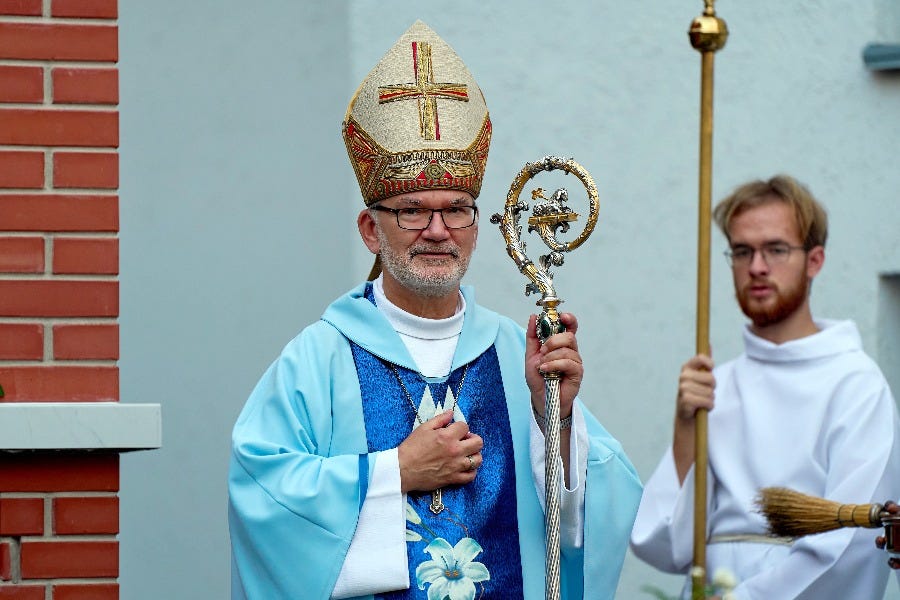
His Diocese of St. Clement at Saratov covers much of Southern Russia, stretching all the way from the Caucasus to the Ural Mountains. Yet it serves only around 20,000 Catholics.
Pickel is originally from Germany, but he didn’t grow up in the prosperous, capitalistic western part of the country. He was born in the German Democratic Republic, or GDR, on Aug. 17, 1961, just days after the construction of the Berlin Wall. His family belonged to the Catholic minority, a marginalized community in the Soviet-dominated eastern state that espoused an atheist ideology.
In 1988, he was ordained a priest of the Diocese of Dresden-Meissen. He transferred from East Germany to the Soviet Union in 1990. A year later, the USSR collapsed, triggering a disorienting political and economic transformation in the world’s largest nation by land mass.
The Latin Catholic Church’s structures also changed. The area in which Pickel served went from being called the Archdiocese of Mohilev in 1990 to the Apostolic Administration of European Russia in 1991 to the Apostolic Administration of Southern European Russia in 1998, the year Pickel was named an auxiliary bishop at just 36 years of age.
The jurisdiction was renamed yet again in 2002, as the Diocese of St. Clement at Saratov, and Pickel was named its first bishop — appropriately given his first name is the German equivalent of Clement. The diocese was named after St. Clement I, the late first-century pope who, according to tradition, was exiled to Crimea.
Saratov is a major city on the Volga River. Since the 18th century, it has served as the center of the ethnic German community, who settled along the Volga at the invitation of the German-born Russian Empress Catherine the Great.
Pickel also has national-level responsibilities within the Catholic Church in Russia. He was first elected president of Russia’s bishops’ conference in 2017 and for a second time in March this year.
Russian Catholicism is currently in a delicate moment of transition following the May 2 resignation of Moscow’s Archbishop Paolo Pezzi. Pickel had a private audience with Pope Leo XIV May 25, during which the two men likely discussed the challenges facing the local Church.
In an email interview with The Pillar, Pickel spoke about his upbringing, what took him to Russia, and what Catholic life is like in his diocese — and the country as a whole.
This interview has been edited for clarity and length.
You were born in communist East Germany in 1961. How did your vocation to the priesthood arise in a culture where religious belief was widely discouraged?
Yes, religious faith was discouraged. You’re right about that. There was no persecution of the Church in the GDR. No one was imprisoned for their faith. Young, professing Christians were usually denied admission to universities. That was almost the worst thing that could happen to someone.
Compared to the western half of Germany, we naturally saw ourselves as suffering, but we knew almost nothing about the real Way of the Cross our brothers and sisters further east were going through.
At first, the fact that Christ was calling me to become a priest seemed to me to be a matter between the two of us: Him and me. It was only over time that I realized how many people were part of this journey we call a vocation.
Believing parents, a daily evening prayer we said together at home since childhood, good pastors who came to visit us even though — or perhaps because—we were the only Catholic family in the village… A small world in which God and the saints had their firm place.
That was my answer to the auxiliary bishop’s question when it came to my entry into the seminary: “I want to become a priest because I feel at home in the Church and want to share that with others.” Of course, motivations need to be purified and strengthened, but for a start, that was enough.
Later came eight years of paralyzing doubt, during which God let me wander but never let me fall. There, too, it was the people along the way to whom I owe the fact that I didn’t give up: friends my own age in what was then Czechoslovakia who courageously lived out their uncompromising faith underground, a famous theology professor who gave me so much of his precious time, my patient parents, and many others.
Why were you sent in 1990 to serve in the Soviet Union? And what was it like?
It was my own request to be allowed to go. At that time, the GDR was a closed country. Our East German dioceses had practically no missionaries, students, or the like abroad.
In August 1989, I asked the bishop in Dresden for a leave of absence to provide pastoral care in the Soviet Union — that is, even before the fall of the Berlin Wall, during a very turbulent time. To justify my request, I had memorized Canon 271 of the Code of Canon Law.
I did not see myself as a missionary, but as a pastor for people who had been waiting for a priest for decades. And the bishop agreed.
A pen-pal friendship with deported Volga Germans, which had existed since 1979 — when a grandmother from the USSR was visiting Germany and distributed addresses in the hope of establishing contact with the Church — led to my first trip behind the Iron Curtain.
That grandmother asked us in all seriousness: “The Holy Father in Rome — does he still exist?”
That evening, for the first time, I felt how isolated Christians in the Soviet Union had endured for generations, without a priest, without a church, without a Bible or religious instruction, etc.
So, starting on Aug. 1, 1990, I was able to spend three years with these people, who, just a short time before, had gathered for prayer in cemeteries on Sundays for decades and would quickly scatter whenever a stranger appeared, because church gatherings were forbidden and punished.
To be honest, I felt a little proud, because I went to help in a way that no one else could. I was in demand as a priest: for confessions, for the Eucharist.
However, within a very short time, I had to admit to my conscience: these believers helped me more than I could help them. In their lives, faith so clearly came first. Yes, there were few who had endured or survived. Wonderful people who had experienced indescribable suffering. Unaware of it, they taught me to say without fear: “I love the Church.” I learned many things from them that I had never heard of in the seminary, but which now became essential to my priesthood.
In April 1991, as the Soviet Union was already crumbling, Pope John Paul II appointed the first two bishops for Russia. This marked the beginning of the revival of Church structures in the country. The bishop appointed for the Asian region, Fr. Joseph Werth, S.J., had just begun building a church in the very place where Stalin had deported the Germans in 1941. Survivors returned to the Volga full of hope, “because there is a priest there,” as they said.
He asked me to come from Dushanbe in Central Asia to the Volga to continue what he had begun. It was a time of new beginnings, full of joy and hope, even though difficult economic years lay ahead.
Most of the Catholics I met were of German nationality. This is due to Empress Catherine II, who was German herself and invited her compatriots to the Russian Empire in the second half of the 18th century.
When the Soviet Union collapsed (Christmas 1991) and the Iron Curtain fell, most of them seized the opportunity to return to the homeland of their ancestors. Our revived parishes began to dwindle, becoming significantly smaller, yet at the same time more Russian-speaking and multinational. (More than 190 ethnic groups live in Russia.)
Since the image of family is part of our understanding of the Church — we are brothers and sisters — and this is particularly evident in practice in diaspora regions, our small Catholic communities had a certain appeal that, coupled with our intensive charitable work, nearly proved our undoing: We were accused of proselytism, of “recruiting people.”
You were named a bishop in 1998, at the unusually young age of 36. Why do you think you were given this responsibility so early in your ecclesiastical life?
The reason is simple. After the two bishops, appointed in 1991, had spent a few years in Rome asking for help — that is, for auxiliary bishops — candidates were sought.
The pool of candidates was not large. Perhaps I was credited with merits that were in truth the fruit of the magnificent pastoral care provided by local religious sisters with whom I had the privilege of working.
Pope John Paul II, in any case — how could it be otherwise? — was not privy to all the details. When I visited him for the first time four months after my episcopal ordination, he said (in Russian) with a smile: “Well, such a young bishop!” And I continued the joke in reply: “It’s not my fault…”
Why is there such a strong connection between the Catholic Church in Russia and the Church in Germany?
First: The Catholic Church in Germany provides aid in many parts of the world. The willingness to donate, even though it is declining for understandable reasons, is a very positive sign of the open eyes and open hearts of many people in Germany. Adveniat, Missio, Caritas, the German Holy Childhood Association, Aid to the Church in Need, Renovabis… We must be very grateful for this organized aid.
The division of Germany after World War II also plays a role. For over 40 years, East Germany was shaped by Soviet influence. This created a special — albeit for many, unwanted — proximity. Clergy, especially from the former GDR, were already attempting to travel to the USSR as early as the 1970s: to Central Asia, Siberia, and the Caucasus, to establish contact with German Catholic Christians, bring Bibles and prayer books, and much more.
We currently have three German bishops in Russia [Pickel, plus Bishop Joseph Werth, S.J., and Bishop Stephan Lipke, S.J.]. And the connections of the Russian-German emigrants — or their history in general — play a significant role.
One can also confirm a similarly close connection to the Catholic Church in Russia with the Church in Poland, the U.S., and Italy, whereby priests and religious orders present here play a role, but so do material support and general interest.
We are experiencing just how fragile all of this is — what I have just spoken of — in the present time.

You have led the Diocese of St. Clement at Saratov since 2002. How would you describe the diocese to a Catholic living in, say, the United States?
I’ve never been to the U.S. So how can I describe it? At a gathering of 100 bishops from around the world, shortly before the turn of the millennium, an American cardinal introduced me to the others with these words: “And this is our Benjamin from Russia. He’s suffering because he doesn’t have a curia, but I tell him: That’s a blessing!”
Joking aside: I know that my diocese doesn’t comply with canon law down to the last “dot on the i.” We are few in number: 20,000 Catholics among 52 million inhabitants — a minority of less than 0.05%. There are hardly any governing bodies. For official consultation, I have the vicar general and six deans, but in practice also other priests, religious, and laypeople. We have a good catechetical commission. And in the office, the “curia,” there are three of us: a nun serving as treasurer and secretary, the vicar general, and myself — though I spend more than 50% of my time away from the office.
Some airports here in southwestern Russia have been closed for several years. I drive a lot when I visit parishes. Some trips take me two days. The diocese covers 1,342,807 square kilometers [around 520,000 square miles] — roughly the size of Portugal, Spain, France, and Germany combined. The 24 locations where Catholic priests live here are thus far apart, like oases in the desert.
Once a year, I invite all priests and religious to a five-day pastoral conference, because loneliness can become overwhelming. There are lectures for professional development, but also time for communal prayer, sharing experiences, and rest. These meetings are very important for individuals, but also for us as a diocese, so that we can continue walking the same path together. Four times a year, I ask everyone to gather at the deanery level. The focus of pastoral care has shifted in recent years from children and youth to families.
As I said, our parishes are hundreds of kilometers apart. Often, the faithful do not know their neighboring parish. But one can say: whoever is Catholic is not so by chance. The atmosphere is warm and welcoming. When I arrive, I am received as one who belongs to the family, without any reservations. Many are poor.
For example, when I travel to the south or northeast of the diocese for confirmations, it’s more than 1,000, even 1,500 kilometers. We don’t have highways here. Sometimes it takes me two days to get there and two days to return. You can imagine how much time is left for office work.
I believe my diocese is the most beautiful in the world, and not just because of the people. The North Caucasus with the 5,642 meter [18,510 ft] Mount Elbrus and Astrakhan on the Caspian Sea, 28 meters [92 ft] below sea level, the Black Sea, the Volga and the Don rivers, borders with Kazakhstan, Georgia, and Ukraine, the steppe, and the foothills of the Ural Mountains …
How has the diocese and life in southern Russia changed in the more than two decades you have served as bishop?
Well, we can’t boast about our numbers. Anyone who looks in the Annuario Pontificio, the Vatican’s directory of the worldwide Church, will see that the numbers are slightly declining.
We have had and continue to have very few local priests. Almost all of them were and are foreigners. I am grateful to them for their willingness to make sacrifices, because living conditions here are less comfortable for most of them than in their home countries. Moreover, most receive no salary and live on Mass stipends and small grants.
Currently, we do not have a single young man studying at the seminary for our diocese. Foreigners are returning home for health or age-related reasons. Some have been deported in recent years. Religious communities (especially sisters) are closing their branches. And in 30 years of freedom, we still haven’t managed to get the Catholic Church in Russia back on its feet. The wounds of persecution in the last century run deeper than we had expected. Priests are addressed as “Otets” (Father), not just as a title, but because many, after a difficult childhood, are looking for a good father…
I don’t want this to sound pessimistic. But it is true that pastoral ministry in Russia is hard work if one takes it seriously — just as true as the hundredfold reward that Jesus promises even now (Mark 10:29).
We have grown weary, which is certainly also related to the situation in the world. Sometimes I pray: “Lord, don’t forget that ultimately it is Your Church that is at stake here!” It is important that we remain spiritually alert. I speak to some people about this too often.
What has changed? I would say there is no linear trend. After years of ups and downs, parish life in the major cities has stabilized to some extent. (There are six cities with more than a million inhabitants in the diocese.) There are fewer children, both in our parishes and overall, with the exception of some regions in the Caucasus.
Because of significantly better wages, men still travel to Russia’s major cities for weeks or even months at a time, which has a negative impact on family cohesion. As a diaspora Church with long distances, cold winters, and often poor parishioners, we rely on donations from outside. This is a difficult issue in times of economic sanctions and the like.
You were elected bishops’ conference president for a second time in March.
What do you think are the biggest challenges and opportunities facing the Catholic Church in Russia as a whole?
A current situation immediately comes to mind in response to this question: The Archbishop of Moscow recently resigned. The two bishops in Siberia will turn 75 next year. In the (Russian-speaking) Catholic Church in Kazakhstan, too, two bishops have reached the age limit. I believe this presents a major challenge not only for the decision-making bodies in Rome, but also for us as the local Church in the former Soviet Union.
I see a major challenge in the synodal process initiated by Pope Francis. In many places, it seems to me, it is still being confused with a democratization of the Church. We are not starting from “zero,” but a certain balance is lacking: neither should the laity carry the priests, nor the priests their parishes. And yet, “Bear one another’s burdens” (Galatians 6:2). Synodality means “walking together” — attentively, indeed, lovingly.
In this context, I also see the first part of the Greatest Commandment. Secularization has long since made itself at home in the Church. Probably none of us can say, “Except in my case.” In a different way, and yet just as I did 35 years ago, I see the Church’s mission in Russia as bringing Jesus Christ back home.
It is a great challenge to live in a country where people speak of “our Church,” but do not mean yours. Our place lies somewhere between tolerated and desired. And each of us should gladly and wholeheartedly accept this place, because ultimately it is the Lord who has placed us here.
Our opportunity is today. It’s not about achieving impressive statistics, or about schools, kindergartens, hospitals, or a raise… I’d like to put it simply: our opportunity is to please God today. If we do that, He’ll take care of the rest.


That’s a blue chasuble. Can we get a story on blue chasubles??