The rise of Bishop Sipuka
Leo XIV’s first appointment to a South African diocese is a notable one.
Pope Leo XIV made his first episcopal appointment in South Africa Friday — and it was a notable one.
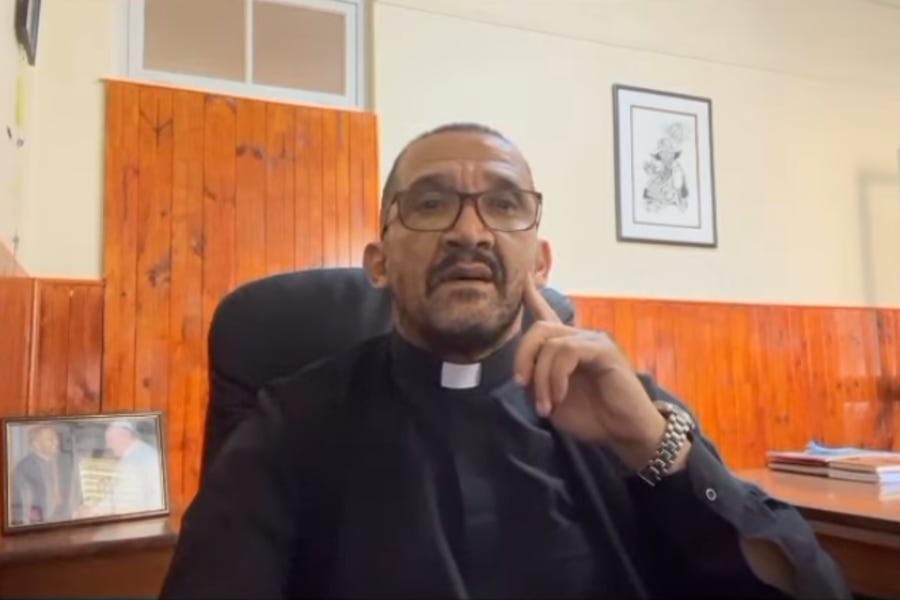
The pope named Bishop Sithembele Sipuka as the Archbishop of Cape Town Jan. 9, succeeding Cardinal Stephen Brislin, who was transferred to Johannesburg in October 2024.
Sipuka, 65, has served since 2008 as the Bishop of Mthatha (also known as Umtata), a diocese in South Africa’s Eastern Cape province. The small, rural diocese has a population of under 40,000 Catholics.
Why has Sipuka been chosen to lead the Cape Town archdiocese, home to around 276,000 Catholics? While Sipuka’s flock has been relatively small, his stature is sizable — and it’s likely to continue to grow when he arrives in Cape Town.
Who is Bishop Sipuka?
Sithembele Anton Sipuka was born on April 27, 1960, in Idutywa (now known as Dutywa), the hometown of Thabo Mbeki, South Africa’s president in the early 2000s.
Idutywa reportedly means “place of disorder” in Xhosa, Sipuka’s mother tongue. But the future bishop seemed to flourish in the Eastern Cape province town. After two years working as a post office clerk, he entered a major seminary and was ordained as a priest of the Diocese of Queenstown in 1988, six years before South Africa’s apartheid system ended.
In an early sign that he was on the ecclesiastical fast track, Sipuka was sent to Rome in 1992 to study at the Pontifical Urban University. When he returned, he taught philosophy and theology at seminaries. In 2000, he was named rector of St. John Vianney Seminary, the South African Church’s national seminary.
Eight years later, he was chosen to be the Bishop of Mthatha, where the majority of the local priests and people spoke the Sotho language, and there were few Xhosa speakers. More than half of the diocese’s priests were Fidei Donum, or clergy sent as “gifts of faith” from elsewhere.
Sipuka gained important international experience and contacts when he was elected second vice president of the Symposium of Episcopal Conferences of Africa and Madagascar, a post he held for six years.
In 2019, his profile rose further, when he was appointed both president of the Southern African Catholic Bishops’ Conference and first vice president of SECAM.
Despite being a soft-spoken and unshowy figure, he emerged as a vigorous advocate of peace, not only in southern Africa but also in the Holy Land. He was also quick to embrace synodality, the watchword of the Francis pontificate, but was able to articulate its principles without becoming bogged down in jargon.
In 2024, Sipuka became the first Catholic to be elected head of the ecumenical Southern African Council of Churches — a mark of his commitment to dialogue and the respect in which he is held by other Christian communities. The election was also notable because the Catholic Church is perceived as a newcomer to South Africa by other Christian groups: the Catholic hierarchy was only established 75 years ago, in 1951, though Portuguese Catholics were present in the late 15th century.
In an initial sign of Leo XIV’s favor, Sipuka was appointed a member of the Vatican’s Dicastery for Interreligious Dialogue in July 2025. That same month, South Africa’s President Cyril Ramaphosa named the bishop to the country’s 31-member National Dialogue Eminent Persons Group.
In a press release marking Sipuka’s appointment to Cape Town, the Southern African Catholic Bishops’ Conference said: “Over the years, Bishop Sipuka has become one of the most prominent and respected Church leaders in Southern Africa, known for his commitment to justice, peace, dialogue, and ethical leadership. His experience extends well beyond diocesan boundaries into national, continental, and global ecclesial structures.”
Sipuka described his transfer to Cape Town as a “sweet-sour feeling,” after 18 years in the Mthatha diocese.
What’s next?
Under Pope Francis, the notion that there are “cardinalatial” sees, where the incumbent can expect to be made a member of the College of Cardinals, weakened. Nevertheless, the Cape Town archdiocese is associated with red hats.
Owen McCann, the Archbishop of Cape Town from 1950 to 1984, was made a cardinal in 1965. Stephen Brislin received the red hat from Pope Francis in 2023.
This cardinalatial history points to the Cape Town archdiocese’s prestige. The city’s St. Mary’s Cathedral is the oldest Catholic cathedral in the country and it is regarded as the mother church of South African Catholics.
The country has two living cardinals: Brislin, 69, and Cardinal Wilfrid Napier, 84. Sipuka is unlikely to join them immediately, but after several years in Cape Town, it’s certainly a possibility.
Sipuka’s immediate focus is likely to be on the needs of his archdiocese, which faces the financial challenges and personnel shortages common in dioceses in southern Africa.
But he won’t limit himself to ecclesiastical matters. The Cape Town archdiocese contains sharp contrasts, covering both affluent areas and impoverished townships. Sipuka has never been afraid to speak out about poverty, corruption, and social division. There will be plenty more opportunities to do so in the coming years.

The problem with the good bishop becoming a Cardinal anytime soon is that Pope Francis' neglect of naming Cardinals from the most important Christian countries in Africa has led to there being no current conclave voting-age Cardinals from Angola, Kenia, Mozambique, Uganda, Cameroon, and the Ivory Coast, and only one from Nigeria. This may need to be corrected by Pope Leo XIV first before naming a second South African cardinal.
He seems like a very good person.