The road runs out, but the Church continues
Catholic life in Alaska’s rugged north
After the 8am Sunday morning Mass, a few Catholics wander over to a local dive bar/breakfast joint — Oasis — to grab breakfast, coffee and watch Sunday morning football.
Back east, it is already afternoon, but in Fairbanks, Alaska, locals enjoy a slow breakfast, catching up with fellow parishioners, and watching the first slot of NFL games.
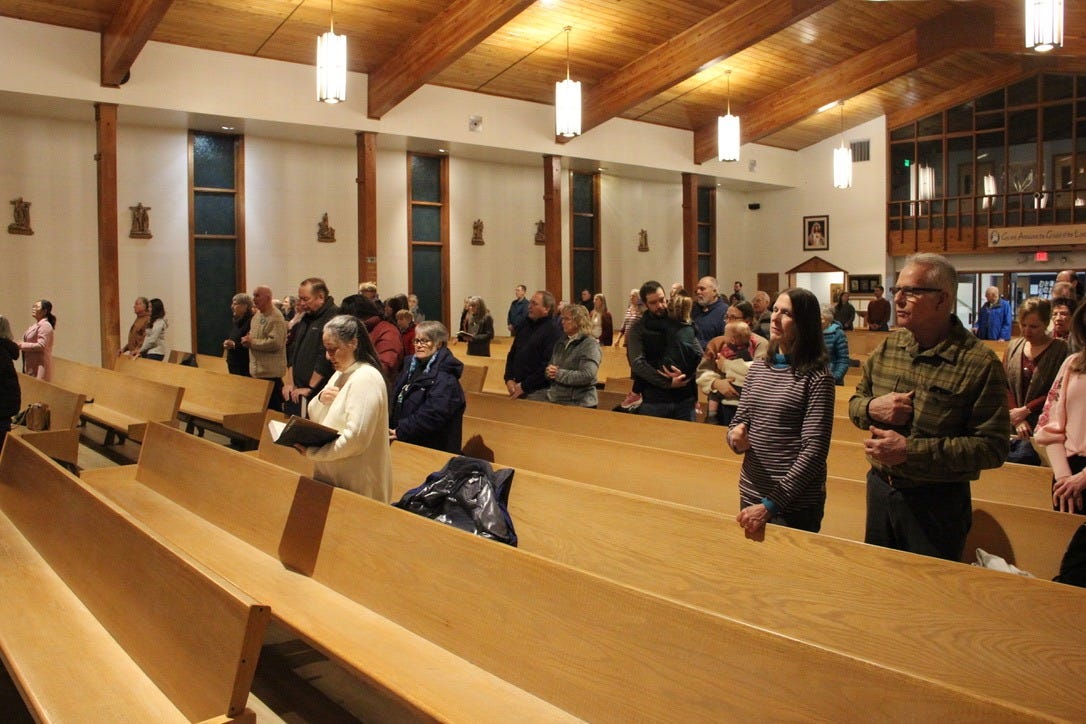
Fairbanks is a small town — roughly 32,500 people — and the Catholic population is even smaller, with around 5,000 Catholics living “in town,” and a scattering further afield.
Everybody knows everybody, and people take care of one another.
The diocese
While the town is small, the Diocese of Fairbanks is huge — covering the northern 409,849 square miles of Alaska, making it by far the largest diocese in the country. It has 46 parishes — only nine of which can be driven to — served by 24 priests.
There are about 10,000 Catholics across the diocese, half living in Fairbanks, the other half living in rural and remote villages dotting the Alaskan wilderness.
The majority of diocesan territory is rural terrain, either mountainous landscapes to the south of Fairbanks, or q frozen tundra to the north. To reach all but eight of its parishes, priests are required to take bush planes, snowmobiles — locally called snow machines — or boats.

In 1779, Franciscan missionaries celebrated the first Catholic Mass on record in Alaska.
In 1794 the Russian Orthodox established the first permanent Christian presence on Kodiak Island, In 1877 the Nulato mission was established by Catholic Archbishop Charles Seghers.
The diocese was formally established August 8, 1962, after Jesuit missionaries had been evangelizing and establishing parishes both in Fairbanks and in the bush since the early 1900s.
The Jesuits have played a critical role in the establishment of Alaska’s Catholic Church and has had priests serving in the diocese its entire history, with the last two due to retire and conclude the mission this summer.
Given its remoteness, the diocese is an international missionary diocese — the last one in the country — which means that a majority of the support and personnel comes from outside the diocese, and that its overseen in Rome by the Dicastery for Evangelization.
Only eight of its 46 parishes are self-sufficient, meaning that the other 38 are dependent on diocesan funding. Over 80% of the diocese’s operating funds come from grants and donors from outside the diocese.
There are about 10,000 Catholics across the diocese, half living in Fairbanks, the other half living in rural and remote villages dotting the Alaskan wilderness known commonly as “the bush.”
The majority of diocesan territory is rural terrain, either mountainous landscapes to the south of Fairbanks, or the frozen tundra to the north. The villages have various levels of development, some with running water, others with no indoor plumbing, minimal infrastructure. Eleven diocesan parishes do not have running water or flush toilets.
Fairbanks’ former bishop, Bishop Michael Kaniecki SJ, personally flew a Cessna 207 to visit the villages.
The bush
Only two years into the job, Bishop Steven J. Maekawa, O.P, has grown accustomed to riding snow machines, and eating seal meat on his trips out to the bush.
But he’s also learned how diverse his diocese really is.
“What I learned pretty quickly is that when you visit one village, you visit in one village, which sounds kind of, so kind of odd as these villages are only separated by 40 miles on the Yukon River,” Maekawa said.
“Then they often have family members and histories combined with each other. But they all have their own unique challenges and struggles and unique cultures.”
Still, he said, “when you dig deeper, one thing about the scale of this ministry is you discover that it is just one community of people — the Church.”
When the Jesuits first evangelized in the bush, they divided northern Alaska with the Anglicans and Presbyterians. The Anglicans and presbyterians would work in the Northeast, upper Yukon corridor of the state, the Catholics along the Bering Sea coast, and the lower Yukon River and the western coast of Alaska, thus the majority of parishes are concentrated within this geographic area. Along the coast, the Russian Orthodox Church also established churches in villages, in which the Catholics and Russian Orthodox created strong relationships.
In Catholic villages, participation and engagement with the Church varies from village to village. When preparing new priests to be sent to the bush, Father Robert Fath, vicar general and judicial vicar for the diocese, emphasizes the importance of personal relationships.
“We have very few catechists and so it means that the priest is becoming the primary catechist instead of having a cadre of volunteers to help,” Fath said. “A lot of the village ministry is really a ministry of relationship. You’re visiting people in their homes. You’re going, fishing with them, you’re berry picking, you’re meeting them at native dance or at basketball games at the school, and getting to know them that way as opposed to you know, so many of us in the larger urban parishes, the normative relationship we have with our parishioners is, you, the five minute conversation after mass.”
Michael Olsta, director of faith and family in the Fairbanks diocese the diocese, regularly coordinates formation programs for the villages, occasionally visiting.
“Since you are having to fly to certain parishes means you really can only do so much in person and you’re relying a lot on catechists,” Olsta told The Pillar.
“Unfourtantelty, there was something in the recent past where there was there was this failure from family to family to pass on the faith so there’s just this missing generation in the middle which makes it very difficult because, you know, there’s a continuity missing there.”

“You just have to be physically present in the village even when no one’s there at Church,” Father Yakubu Aiden told The Pillar. “These people do not come to you. They are always at home so you must go to them and meet them where they are.”
But it’s a challenge to have a priest show up so infrequently.
“The biggest struggle that the faithful have is to maintain a Eucharistically centered relationship with the Church when Mass is only offered every 4 to 6 weeks,” Fath said. “They do have Sunday celebrations in the absence of a priest in the form of liturgy of the Word, with the distribution of Holy Communion. But it lacks the sacrificial aspect of the Mass.”
The town
Catholic life in the bush contrasts sharply with the liturgical reality in Fairbanks itself, where five parishes incorporate the 5,000 Catholics living within the city.
“In town, one of the things more unique is the connection between the various parishes,” Fath said.
“Oftentimes, parishes [elsewher] are relatively insulated in their programming; they offer religious ed, they do their own VBS program for the kids. They offer their own adoration for things like that. Here, certain bigger events …. like our confirmation programs and marriage prep have been done across parishes.”
Jeff and Amber Hayes concur. They say the vibrant Catholic community has drawn their military family of nine to request a Fairbanks military assignment several times.
“The Church has been our favorite part of living here,” Ambre Hayes said. “Growing up, the faith was 60 minutes on the dot every week and there wasn’t anything outside of that. And it’s just been completely different here. The first families that we met here were incredibly inviting and welcoming, and people wanted to spend extra time outside of Mass with us.”
“I had never seen that before while growing up.”
The vibrant community is an optimal place to raise their family, as there are numerous other large families at their parish — St. Nicholas — and supportive older parishioners.
“It’s real people who are just doing their best to live a Catholic life,” Jeff Hayes said. “It’s terribly refreshing to know that you don’t have to be surrounded by marble saints, but, you know, they genuinely understand where you are and you want to help you and that extends to the clergy, it extends to the staff. It’s just a very good, healthy place to grow a family and ground them in.”
There is one Catholic school in the diocese — Monroe — a pre-k through 12 diocesan school, sponsored by the Society of Jesus.
“The early Church in Alaska, which means up until the early 2000s, was run by a lot of Jesuits. Several of our bishops were Jesuits, the school was founded by Jesuit priests early on they had Jesuit priests in their classroom, they had Jesuit volunteers here teaching,” Patrick Riggs, principal of Monroe’s upper school, told The Pillar.
“But we have always been run by the diocese.”
Fairbanks presents its own set of challenges for faculty and staff — only 50% of the student body is Catholic, the students can play outside until it dips below -20 Fahrenheit, and due to the remoteness, faculty turnover is high.
In that environment, everyone pitches in.
“It’s been an interesting year so far. I started teaching a math class after being predominantly theology since I have my undergrad in physics,” Nicholas Shamrell, a high school and middle school teacher at Monroe.
“The temperature creates a different environment. The kids have not gotten it through their heads that it’s pretty cold out there and your car could potentially break down so you shouldn’t be traveling to school in just sweatpants or gym shorts.”
Though students are separated from the lower 48 by 1,500 odd miles, and 5,000 miles to Rome, they are still exposed to the universal Church, especially through the numerous foreign priests in Fairbanks.
“The kids have a lot of exposure to the different priests in the diocese, there’s a constant rotation of priests for daily Mass so they get to see the African, Polish, Indian priests in our diocese. They have a lot of exposure to the universal aspect of the Church,” Shamrell said.
The number of international priests creates a unique, universal environment within Fairbanks, which enhances the faithful’s experience of the Church.
“The priests I knew growing up were all American,” Shamrell said. “It’s neat to see the range of experiences from the African priests to India and a lot from Poland. It is interesting to see their perspective, their way of practicing the liturgy, which isn’t like outrageously different or anything, but to hear the stories of their experiences back in their villages or their towns in Poland or whatever,and then their experiences ministering in the villages here is powerful and helps you appreciate the universality of the Church.”
Yet even with the universality of the Church, parishes remain vibrant hubs where people from all walks of life feel welcomed and at home.
Rose Wage, has had two very different experiences in the Diocese of Fairbanks. For years, she lived in the village of Utqiagvik, Alaska, formerly Barrow, the northernmost town in the United States.
A priest only visited a few times a year. But Even without a priest, a rich Catholic community formed, Wage said.
“It was something to get used to not having a priest every weekend but you have to stay more faithful, pray more often,” Wage told The Pillar.
“We would gather every week for some type of prayer and there was a strong Catholic community up there even without a priest.”
Wage eventually moved to Fairbanks, where she found a vibrant community which welcomed her, she said, specially after her husband died.
“We have a pretty close knit community here,” Wage said. “I’m not really sure, maybe it is because of the harsh climate so we all stick together and help one another.”
“People here help me, they go out of their way,” Wage added. “Hospitality is a huge thing here, they help me, an old widow a lot. In turn, I bake desserts for the soup kitchen.”
Parishioners stressed that Alaskan culture is not the “lone wolf” environment it’s often presented as.
“There’s a lot more older people in the parish but there are a lot of big families and many vibrant groups, young adults and they all want to participate and help,” Olsta said. “It is a sharp contrast to that rugged individualism that is very unique in Alaskans.”


