
According to in-the-know vaticanisti, somewhere on Pope Leo’s long to-do list is a line that reads “Traditional Latin Mass” – that is, the old rite, extraordinary form, usus antiquior, or (in the Holy See’s current zingy phrase) “the Missal antecedent to the reform of 1970”. Given everything else going on in both Church and world, we might assume that it is rather far down the list. But Leo seems energetic and efficient. And this, perhaps, might prove one of the easier items to tick off with satisfaction.
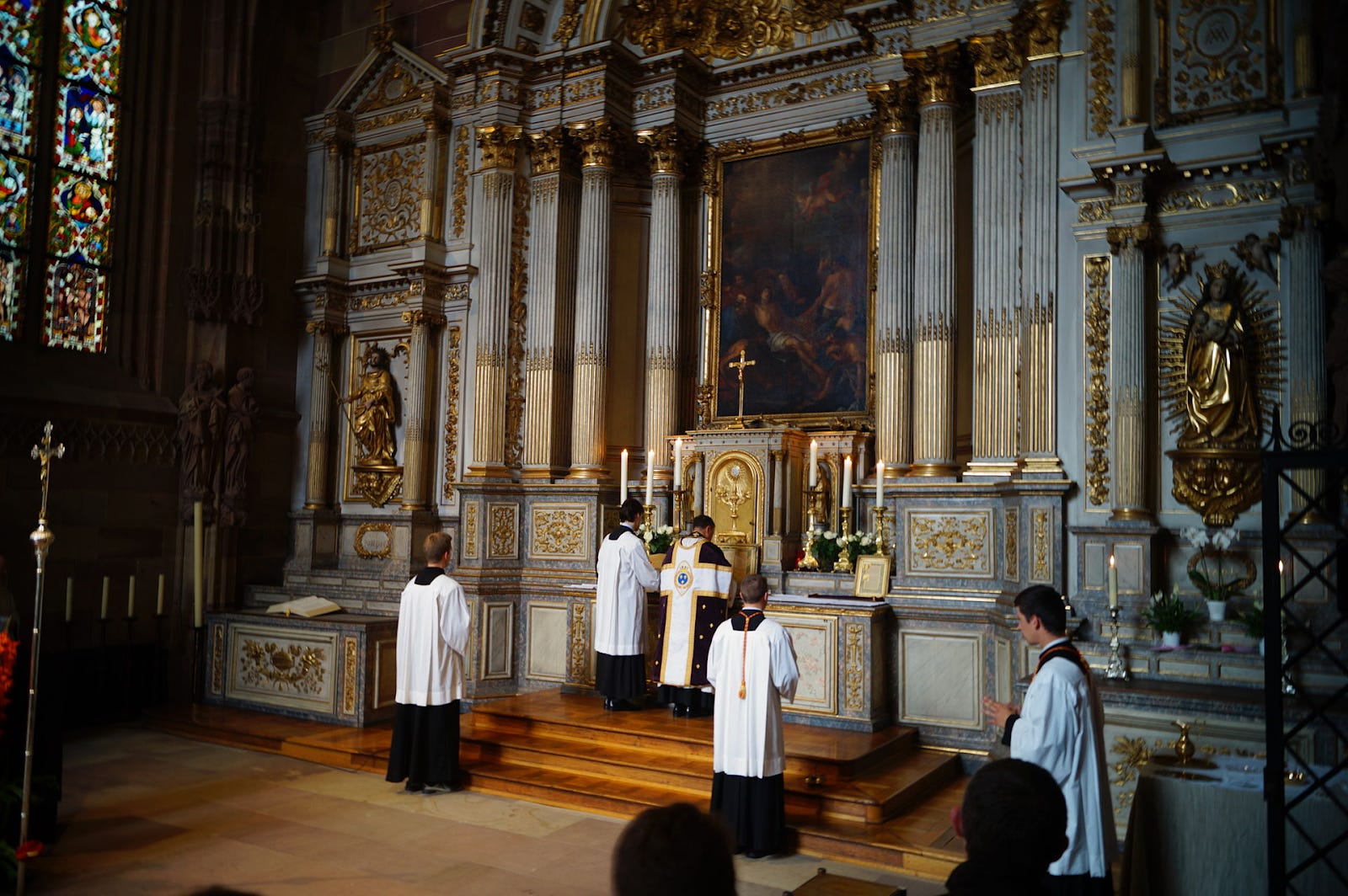
Certainly, something needs to be done. Pope Francis’ 2021 Traditionis custodes heavily restricted celebrations of the TLM, repealing his own predecessor Benedict’s sweeping liberalization in 2007’s Summorum pontificum. Chief among Francis’ reasons were that “a rejection not only of the liturgical reform, but of the Vatican Council II itself” was rife among TLM congregations. Well-placed sources suggest that America was a source of special concern on this front.
Nevertheless, the problem – if it is indeed a problem – of thriving TLM congregations, disproportionately attracting those who, born long after the Council, ought to be young enough to know better, has not gone away. For some, the TLM’s outré nature has only increased its allure: an ecclesial Streisand Effect. If Traditionis custodes’s diagnosis is correct, then surely the remedy needs to be much stronger, up to and including an outright ban. But if it is not correct? That is, what if Francis’ crackdown, howsoever well-intentioned, was based on misinformation? In that case, Traditionis custodes is doing a good deal of needless pastoral harm, and fuelling precisely the kind of polarization and division it sought to reduce. Both basic positions have strong backers. Leo must adjudicate between them, while taking, and being seen to take, the concerns of both sides seriously.
Add to this the looming threat of the (at best) “canonically irregular” Society of St Pius X illicitly consecrating more bishops, currently scheduled for July 1. Though not directly connected, the Vatican has used the liturgy as part of its Tradpolitik before. While he would probably be unwise to tie his TLM policy to the SSPX issue, there would be symbolic value in signaling “for” (or indeed “against”) the old Mass around this time. Seasoned Vatican-watchers will hence be on high-alert on 7 July: the fifth anniversary of Traditionis custodes, and the nineteenth of Summorum pontificum.
Over the past four years, we – two sociologists, one an American Latter-day Saint, the other a British Catholic – have been studying Americans who attend Traditional Latin Masses within the mainstream Church (i.e., not SSPX). We’ve used the full toolkit of our peculiar trade: fieldwork in seven states, dozens of interviews, surveys of hundreds of practicing Catholics (both TLM-ers and not), off-the-record chats with bishops and cardinals. Though conscious of the limits of social-scientific methods, all in all we feel we’ve gained a pretty good sense of this small corner of the U.S. Church. We present the full picture in a book, due out later this year. At the risk of giving away spoilers, we found little evidence to justify the negative stereotypes of American TLM goers. For instance, attendance at the Novus Ordo is perfectly common and normal among TLM-goers. Only the very fringiest regard it as invalid; one can indeed love them both. And while Vatican II rejecters certainly exist—we interviewed a few of them—they are a minority among ordinary “trads.”
We finished writing the book in late 2025, just a half-year into the new pontificate. No major move regarding the TLM seemed on the cards the. Nor had the SSPX yet announced a decision to (re)cross the episcopal Rubicon. Social scientists are terrible at predicting the future, and neither of us is a gambling man. Nevertheless, we felt duty bound to hazard a prediction at what the new Pope Leo might plausibly do. (Full disclosure: As has been widely reported, we had the honor of discussing our work with the Holy Father at a private audience in March 2026. What follows was, of course, written before that meeting, and appears in the draft manuscript we gave him.) Here’s our modest, and we hope irenic, proposal:
In brief, we don’t regard any “nuclear option” – occasionally rumored in the latter years of Pope Francis – to be a plausible vision of the future. Whatever the full backstory to Traditionis custodes, recent leaks suggest that the data used to justify it were far less damning of TLM communities than was claimed. The world’s bishops were not clamoring, en masse, for a major crackdown. Many would doubtless have preferred to leave things as they were. Whatever particular intra-Vatican circumstances gave rise to the document, then, it seems unlikely that the animus and political capital necessary to drive a further crackdown exists. Note too the less-than-enthusiastic compliance in many (not all) American dioceses. Most bishops, obedient as they are, probably do not feel so overburdened with Massgoing Catholics, including disproportionate numbers of young adults and families, that they are anxious to make their religious lives more difficult. The same is true in other countries too.
Pope Leo, an American bishop among much else, is unlikely to be ignorant of this. There is little reason to think he has any particular animosity toward the TLM either. While he has expressed concerns about what one might loosely call the weaponization of the TLM — “people have used the liturgy as an excuse for advancing other topics. It’s become a political tool, and that’s very unfortunate... It’s become the kind of issue that’s so polarized that people aren’t willing to listen to one another, oftentimes,” he has said — he also permitted the first TLM to be held in St Peter’s Basilica since 2022. This was celebrated by Cardinal Raymond Burke in October 2025, as part of the annual Summorum pontificum pilgrimage, with a reported attendance of c. 3,000.
Might Traditionis custodes be rescinded? A formal, public reversal of the previous pope’s policy feels unlikely, especially so soon after the last such reversal. More probable is keeping the current law in place, but significantly easing its application. At present, Traditionis places a significant bureaucratic burden, both on individual dioceses trying to work within it, and moreover on Rome itself. Decisions over which parish church might be “exceptionally” permitted to host the TLM, or whether young Fr. So-and-So might be permitted to start celebrating it, are now taken centrally. This system, the liturgical equivalent of a command-and-control economy, is inefficient, and runs counter to significant de-centralizing trends within the Church since Vatican II. However, it would not take much for the Holy See to devolve much more to local bishops, who could be quietly informed that, while they must still lodge their requests for exemptions and faculties with the Congregation for Divine Worship, they may assume that all reasonable requests are granted “automatically” unless they hear otherwise.
In practice, that would mean that Rome retained a power of veto—in cases where anti-Trad fears seem to be locally merited, or if it is felt a particular bishop is “pushing his luck” in some way—while sparing an overworked staffer at a desk in Rome from needing to micromanage pastoral-planning in a diocese they’d struggle to locate on a map. Some specific rules in Traditionis custodes—the ban on establishing new stable groups or personal parishes groups, for example—could be amended, without wholesale repeal. Along with this would also go a tacit “decriminalization” of, say, listing TLMs in the parish bulletin. In classic Vaticanese, this could all be explicitly justified as being truer to the underlying pastoral intention of Francis.
A new normal along these lines would not simply return things to how they were under Summorum pontificum. Those bishops who find either the TLM itself, or particular groups in their own dioceses, problematic would retain their Traditionis powers to regulate matters very closely, up to and including a blanket ban. As noted above, the Holy See would also find it easier to intervene in TLM matters, should it need to. But this rebalancing would free those bishops who either are TLM-affirming, or simply adopt a “may a thousand liturgical flowers bloom” attitude, to take a different approach—while also retaining their powers, should they ever come in handy.
Going out even further on our limb, Pope Leo might do something that even Pope Benedict never did, at least as pope: celebrate, or preside at, a public TLM. His own diocese of Rome has several TLM churches, including a thriving FSSP-served personal parish, Santissima Trinità dei Pellegrini, which we visited while researching this book. A one-off visit to celebrate a particular feast day, or even to confirm some of the parish’s many children, would, on the one hand, be a perfectly normal piece of pastoral work. Pre-Traditionis, at least, there were plenty of bishops who, though not particularly pro-TLM, would gamely celebrate it when visiting TLM congregations in the normal course of their work. On the other hand, it would send a clear signal, lest it ever have been thought otherwise, that TLM communities are fully integrated into the Church.
Might this admittedly wildly speculative solution not be, in the fitting phrase of Vatican II’s document on the liturgy, “pastorally efficacious to the fullest degree?”
“Trads: Latin Mass Catholics in the United States” (Oxford University Press) is due out in December.
"Those bishops who find either the TLM itself, or particular groups in their own dioceses, problematic would retain their Traditionis powers to regulate matters very closely, up to and including a blanket ban."
This is precisely where it all falls apart, as I write from the Diocese of Charlotte. If we're trying to avoid the ideological pendulum wildly swinging back and forth by not going back to Summorum, letting bishops decide for themselves just creates 1000 pendulums. Maybe there are some TLM-sympathetic bishops who felt obliged to shut down Masses they didn't want to--okay, this solution helps them. But otherwise, the pro-TLM bishops get all the indults they need, and the anti-TLM bishops shut everything down and leave their TLM-loving faithful with no recourse. Which changes precisely nothing about the current situation.
Until the bishops are willing to set aside their ideology to try to discern the genuine pastoral needs of their people, the pendulum persists--whether it's in the Vatican or the chancery. As far as I can tell, no pro-TLM bishop is going to decide a TLM community is toxic, insular, and unhealthy and needs to be shut down, and no anti-TLM bishop is going to decide that their TLM community would be best served by expanded TLM access.
It's just liturgical ideology, all the way down. THAT'S the problem. And from where I'm sitting in Charlotte, it feels less like an ideological pendulum swinging than a scythe.
TC has had a fatal flaw from the beginning. It is unjust. As more info has come out this has only been reenforced. Leo has to address this aspect, or it won't do anything to move things closer to reconciliation