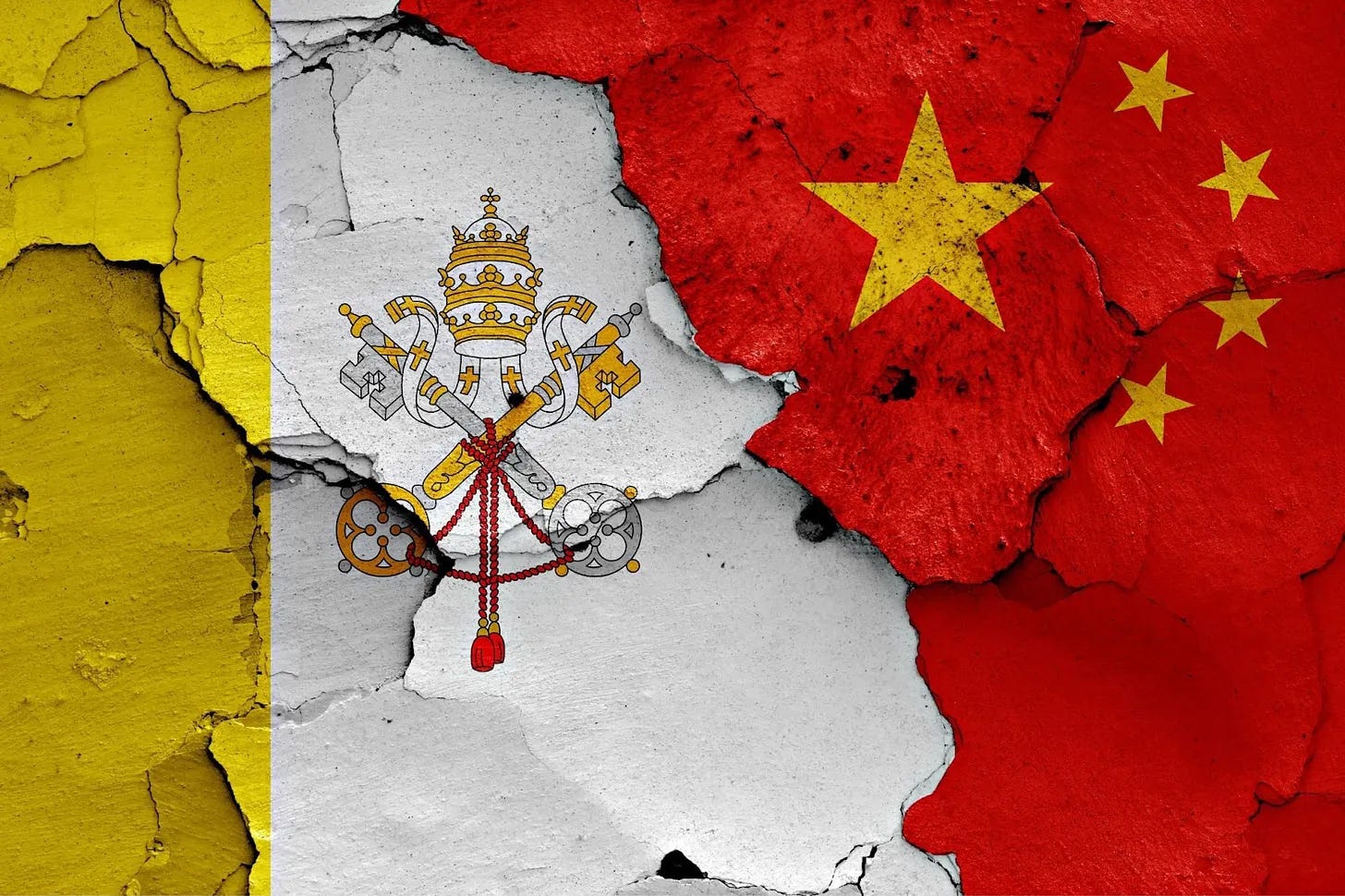
The Vatican announced on Monday the most recent in a growing list of bishops selected and installed under the norms of the 2018 agreement with the Chinese government on episcopal appointments.
Bishop Paul Liu Honggang was consecrated Aug. 31 and installed as the new head of the Diocese of Datong, which had gone more than three-quarters of a century without a publicly acknowledged leader.
Liu is the latest in a growing queue of relatively smooth episcopal appointments for the Chinese mainland since the election of Pope Leo XIV last year. After years of dysfunction, with mainland authorities choosing and installing bishops without reference, or even prior notice, to the Vatican, the 2018 Vatican-China deal appears to be working, at least at the technical level. Candidates are selected internally via the state-sponsored Chinese Patriotic Catholic Association, submitted to Rome for approval and then installed and announced on a schedule coordinated between Beijing and the Vatican.
Liu, himself a well known CPCA member and supporter, is increasingly of a type making up the emerging mainland episcopal cohort, though some appointments have indicated the acceptance of figures from what is still commonly referred to in China as the underground Church.
But if the appointment process appears to be running smoothly, ecclesiastical sources in China and Rome warn that tensions remain between the state and Catholics, including laity, clergy, and some bishops. And, they have told The Pillar, both sides appear to be backing themselves to ultimately come out on top in a waiting game.
Ahead of the deal’s next scheduled renewal in 2028, the emerging question seems to be whether these tensions will hold within the Chinese Church in the medium term, or if a new schism is inevitably brewing.
—
Lingering underneath the newfound smoothness of the appointment of bishops are a number of structural tensions between Rome and Beijing. Some of these are procedural.
For example, the Chinese authorities insist on there being no prior public notice given, either of the selection of candidates or the date and place of their installation. The reason for this, according to sources in Rome familiar with the terms of the 2018 agreement, is that the government does not want the installations to become any kind of public event or gathering — positive or negative. Meanwhile, every publication of an appointment out of Rome which comes on the same day of the installation fuels speculation about the Vatican’s actual level of influence and underlines how abnormal the entire arrangement with China is.
Meanwhile, there are signs that the Vatican is prepared to give ground, too, on the Chinese government’s insistence that the diocesan map of the mainland be substantially redrawn to reflect provincial and municipal boundaries. This is not, in itself, an unreasonable desire by the government — diocesan boundaries in almost all other countries reflect civil jurisdictions. But it represents a massive structural accommodation by the Church, one for which nothing very much in particular seems to be on offer.
If these are the structural and procedural issues in the status quo, they appear to be being managed reasonably well for the time being. But the lived reality on the ground is where the real tension is building.
It is not the case that every bishop appointed under the Vatican-China deal’s terms is a career CPCA cleric. Notable exceptions exist, even in the small sample size of the last year or so. Nor is it the case that every CPCA-minted bishop is entirely a creature of state authority, or a cynical Communist play-acting at Catholicism. Among the Chinese bishops there exists a real grey area, both in the aggregate and in individuals, which offers either balance or tension between “patriotic” sensibility and buy-in to the government’s Sinicization of religion, and sincere adherence to the Catholic faith.
In a broader social and legal context that was otherwise stable, this might be argued to be a workable ongoing arrangement for the Church in China, a kind of life of compromise. However, Catholics on the ground report a very definite direction of travel, one which points to a breaking point for the local Church sooner, rather than later.
Even as the Vatican and Communist authorities appear to have reached a workable settlement on the appointment of bishops, Catholics across China report escalating enforcement of strict rules on religious practice and ever-tightening restrictions on the possession and dissemination of religious materials, both physically and online.
In particular, The Pillar has been told by Catholics in China, that across different regions Communist rules against children being allowed in churches or given formal religious instruction are being enforced. “It is not just here and there, where local officials want to be noticed or seen to do their jobs zealously,” said one cleric on the mainland. “It is everywhere, it is both policy and priority, that much is clear.”
But the cleric and others on the mainland told The Pillar, that crackdown is in turn sustaining a large and growing practice of underground Catholicism.
“If you consider the actual rules, they are not meant to create a stability for the Church,” said a priest on the mainland. “The purpose is to strangle. Some things are allowed, so the basic impression is of tolerance, but the grip tightens and tightens.”
The same sense of a ratcheting up of pressure on Catholic faith and practice has also been reported in Hong Kong recently, with clergy there also reporting a kind of tactical repression to achieve strategic suppression of religious practice.
For some senior Chinese clerics, most especially those who have never been supportive of the Vatican-China deal, the trend is evidence of the continuing need for the underground Church. “It never went away,” said one underground cleric who spoke with The Pillar. “It is a political deal between Vatican diplomats and the Communists. The charitable view is that maybe it has political uses, but practically it has not opened an inch for evangelization.”
But even among those clerics who circulate among the CPCA-approved bishops and overground churches, the common opinion is that both sides, Rome and Beijing, understand the long term unworkability of the current situation.
“As the pressure increases, the middle ground which this agreement was meant to create, will disappear. Right now there is room enough for bishops and priests on both sides, and some who properly live in both worlds, over and underground,” said one senior mainland cleric. “But it will not last. It cannot last many more years at this rate.”
Asked if the end result would be a new schism between the state and underground Churches and bishops, the clerics replied “apart from something changing far beyond just the [Vatican-China] agreement, it is inevitable.”
“The expectation [on the part of the Chinese authorities] is that the grey area and mixing of sanctioned and unsanctioned Catholic communities is basically an intelligence gathering opportunity. The underground Church cannot be erased or controlled, but it can be more easily watched this way for the time being.”
Meanwhile, in Rome, the sense around Vatican diplomatic circles seems to be a mixture of realism, resignation, and hope. One source close to the Secretariat of State told The Pillar that the Holy See was “not unaware” of the deteriorating situation in China, but that there was little sense of a clear forward course of action.
“Things are as they are,” he said. “There is little expectation of a change by the government in its current form. But we have to consider the far horizon. The world is always changing and China changes too, perhaps slowly. For the moment, the important fact is that the Church in China is alive.”
The senior cleric on the mainland offered an alternative framing of this Vatican perspective. “I think [the Vatican] hopes things can survive as they are, more or less, until the end of the Xi [Jinping] era and either let the whole agreement lapse or reassess in the light of what follows. The alternatives — pull out immediately or double down on cooperation — are even more dangerous. The former risks the freedom, even the lives, of Catholics now. The latter is the effective death of an evangelizing Church with any credibility for generations.”
“The real problem,” said the cleric, “is that young Catholics live at the biting edge of this reality and see a difference between figures like [Bishop] Shen Bin [of Shanghai] and [Cardinal Stephen] Chow [of Hong Kong] on one side and bishops like [Cardinal] Zen on the other. They have a sense of who is on their side, but increasingly whose side Rome is on, too.”
Both in Rome and in China, there is increasingly frank acceptance that the current Vatican-China deal is not a path to any particular destination, but a mutually agreed holding pattern as tensions increase.
For the moment, each side appears to be wagering on being able to outlast the other — one slowly moving to stifle the Church and the other waiting for a change of regime. What neither wants to see, particularly, is the forcing of a crisis point. How much either side is willing to give to avoid one remains to be seen.

