‘There’s nothing wrong with being countercultural’ — Archbishop Moth on renewing English Catholicism
The new de facto leader of Catholics in England and Wales discusses priestly vocations, talk of a 'quiet revival,' and diocesan mergers.
During a recent television interview, Archbishop Richard Moth, the new de facto leader of Catholics in England and Wales, found himself fielding a question about cheese.
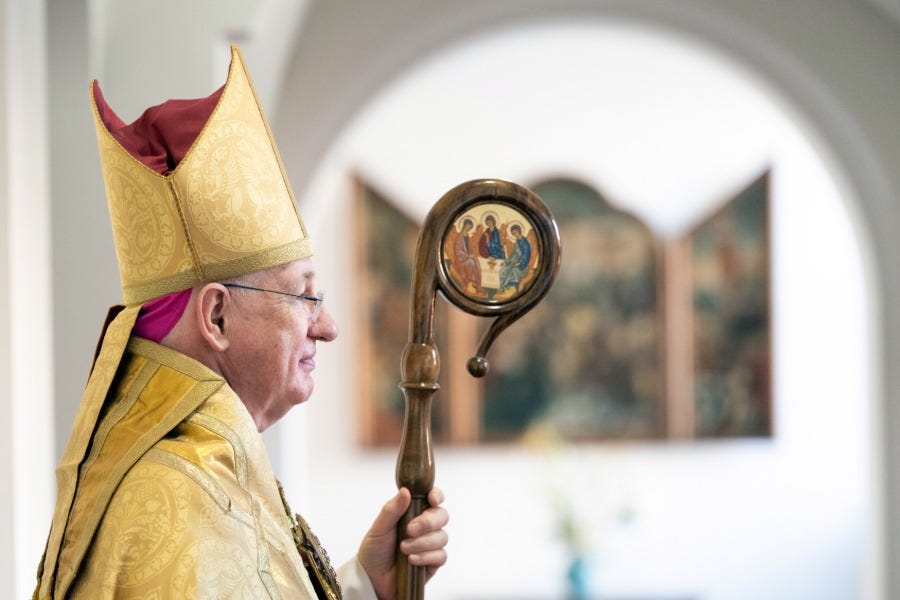
The Archbishop of Westminster — the diocese covering North London and its environs — had mentioned that he was looking forward to consuming the dairy product on Easter Sunday, after giving it up for Lent.
“Blue, hard, or soft?” the interviewer probed.
He replied: “Oh, all three.”
Moth told The Pillar in an April 9 interview conducted on Zoom that he found the sudden media interest in his fondness for cheese “a bit bizarre.”
But perhaps it is a useful reminder, less than two months into his tenure at Westminster, that he is now a national figure facing a level of scrutiny normally reserved for politicians and celebrities.
Moth, who previously served as Bishop of Arundel and Brighton, spoke to The Pillar from Archbishop’s House, Westminster, a grand but somewhat dilapidated residence attached to Westminster Cathedral, the mother church of Catholics in England and Wales.
Fresh from presiding at his first Holy Triduum at the cathedral, he discussed whether there are signs of a revival in English Catholicism, what he makes of Belgian Bishop Bonny’s plan to ordain married men, and if England’s diocesan boundaries will be redrawn.

This interview has been edited for clarity and length.
What was it like to preside at the Triduum for the first time as the Archbishop of Westminster?
They were wonderful celebrations. The music here at Westminster is exceptionally fine. There were very, very big numbers of people. On Good Friday and Easter Sunday morning, the congregation was out into the piazza outside. A few hundred people were outside the doors because not everybody could get in.
At the Vigil, we had eight baptisms, I think, and eight receptions, and another two on top of that for confirmation. So that made for 18 confirmations.
It was a lovely celebration of the Triduum.
Did you get the feeling you were speaking to the nation as well in some way with your homilies?
To an extent. A number of people picked up on some of the things I said in the homily on Easter night, where I mentioned the fact that we’re living in a world that’s conflicted and at war, arising from greed and a misuse of power.
One or two people coming out of Mass on Easter Day thanked me for that and said they hoped that people might be listening beyond Westminster. So there is a sense now that people are a little bit more interested in what I’m saying than they might’ve been when I was in Arundel and Brighton.
You consistently expressed skepticism about the notion that there is a ‘quiet revival’ of Christianity in Britain.
What did you think when you heard the study that launched the ‘quiet revival’ debate had been withdrawn because of methodological problems?
I think “skeptical” is a bit strong. I would say “cautious.” My caution arises because a statistician would not say that one or two years of increased baptism numbers is a revival. A statistician would say, “Well, let’s wait five or 10 years and look back and see what’s been happening.”
You can do all sorts of things with statistics. They can be read in all sorts of different ways. Regardless of whether the data that was used was as accurate as it might have been, we are seeing increased numbers of people coming for baptism.
At our Rite of Election here in the cathedral this year at Westminster, there were 790 people — and that wasn’t from every parish in the diocese — preparing for baptism and confirmation.
In my old diocese of Arundel and Brighton, they had to have two Rites of Election this year. In fact, we realized last year we should have done that because we were a bit too full. And the story around the country is that we are seeing increases in numbers.
I’m just a bit cautious about getting too excited, because I go back to what I said at the beginning: a statistician will say, “Well, let’s give this a bit longer before we decide it’s a revival.” That’s where I’m at with this. If this continues for another two, three, four, or five years, then certainly we’ll have seen something.

What do you think is the significance of the rise in adult baptisms?
Some people see it as the spark that’s going to light a spiritual revival in Britain. Others see it as just a hangover from COVID times, when people couldn’t so easily come into the Church.
Where do you come down on that?
I suspect in some parishes there will be some catch-up post-COVID. But we’re a few years on now from the COVID pandemic, and one would imagine that most of that catch-up would’ve been achieved within the first two years. Most people’s RCIA programs, for instance, are about six to nine months. This far on now, one would think that the catch-up had happened.
This is anecdotal, but one hears and experiences many cases of young people coming to parish priests and saying, “I’ve started reading the Bible. What do I do next?”
Now, what is causing that? Some might say that, well, the world’s in a bit of a pickle. Are people turning to faith because of that? That may be the case. Ultimately, the voice of faith would say that perhaps the promptings of the Holy Spirit are being heard afresh.
I do sense that people are looking at the world we’re in, with all the pressures on people, and saying, “Surely there is more to it than this.” I think that’s a major issue.
I think it’s a combination of those things. I wouldn’t put it down to one cause. That would be too simplistic.
Adult baptisms are the growth area for the Church in this country and in other countries as well. But if we look at other sacraments, there’s less good news.
The total number of baptisms has been falling for a long time. First communions, confirmations, and Catholic marriages are all down year on year. It almost feels at this stage that it is inevitable that these sacraments will continue to fall.
As a bishop, do you look at this and think, ‘It’s a megatrend. I can’t really do anything about it’?
No, again, I think you have to be careful about just looking at the numbers. Taking the baptism figures, the fact is that the demographic is falling. There are fewer children being born, therefore there will be fewer baptisms.
This is just my personal experience, but in my last diocese, confirmation numbers last year went over a thousand. That was an increase, and that wasn’t as a result of COVID lag by that time.
I don’t know what the situation is in Westminster of those numbers. I haven’t learned those yet. But our confirmations are taking place between now and the summer, so we’ll know more later in the year.
If I can just say a word about marriage numbers in this country, I think there’s something very interesting about this. It’s that parishes prepare a lot of couples for marriage who are going to be marrying overseas. When you look sometimes at the statistics of marriages taking place, that does not represent the number of couples being prepared.
The number of marriages has come down, that is true, but it’s not as dramatic as that bald figure would suggest.

It’s common to hear Catholics in England these days saying that bishops are basically managers of decline, that their task is to manage the decline as efficiently as possible, close a parish here, merge a parish there.
I don’t accept that at all. I don’t think we’re managing decline. It is the case that we have a few less priests knocking around than we used to.
As I’ve said many times, pretty much everybody alive now was born and grew up in a time when, because of a significant increase in vocations post Second World War, we had almost more priests than we’d ever had before. And that’s all we’ve ever known.
Judith Champ, who died just recently, wrote about the fact that we are going back probably to a proportion of priests to people that we would’ve had 100 years ago. That’s not necessarily a bad proportion; it’s just a different one. It’s not what any of us know or are used to, but it does mean that we must carry out our mission slightly differently. And that’s where I see an opportunity.
So for me, it’s not about managing decline. It’s about saying, “OK, we may need to deploy our clergy slightly differently.” But also, I think this is an invitation to engage everybody in the Church’s mission. That’s the bit that I find really very positive.
The synodal journey that Pope Francis asked us to engage in is a help to that, because that’s not about doctrine, it’s about the way we do our business. It’s about having relationships, having conversations, talking to one another so that we can discern the way forward together. And then with priests, religious, deacons, lay faithful, married, single, consecrated, we can all see where our gifts and talents lie for the mission that the Lord has called us to carry out. That, to me, is the moment of excitement that we’ve got now.
I do think that the synodal pathway is opening up potentially new possibilities for that greater engagement in the mission on behalf of everybody. I don’t think it’s about managing decline. I think it’s about engaging in the mission in new ways.
Two new Westminster priests were ordained in 2025. The forecast is just one priestly ordination in 2026 and one in 2027.
What are the implications of that for the diocese?
It does present challenges. We’re blessed in Westminster, as many other dioceses are, to have assistance from religious congregations — some of those, not all of them, from overseas.
We’ve got big parishes in this diocese run by Jesuits and Dominicans. They’re not necessarily people coming from Africa or the Subcontinent, but we have those too, and they’re a blessing because we’ve got a multicultural Church here. Having priests from India, Africa, and elsewhere helps in a way to respond to the multicultural nature of the Church in this country.
But that doesn’t take away from the fact that we need to increasingly foster vocations from those who are, if I may use the term, homegrown. I remember when I was vocations director in Southwark [a diocese covering South London and surrounding areas], we had our first homegrown African seminary student.
That was a really good step forward for the diocese when that first happened, because it meant that the community that some years back had come to us from another part of the world were in a place where they were solidly rooted enough to produce their own vocations. There definitely is a challenge there, to greater prayer, greater openness to vocation.
If we’re able to help our priests to focus on the purpose of our ordination — preaching the Gospel, celebrating the sacraments, visiting the sick, chaplaincy to hospitals, all the things we were ordained to do — and the more we can lift other bits of what is often deemed the present priestly burden away from priests, I think in time we will see the vocation will become more attractive, because men thinking about priesthood won’t be seeing chaps stuck behind their desks all day.
That’s part of this business of everybody taking their part in the mission of the Church, because in time that will free priests to carry out the vocation for which the Lord called us in the first place.

Belgium’s Bishop Johan Bonny has said he cannot attract candidates to the celibate priesthood, so he intends to ordain married men in his diocese by 2028.
Would you consider following Bishop Bonny’s lead in the Westminster diocese?
Simple answer: no. I think the celibate priesthood is a great gift to the Church.
We live in a society where people tend not to do something for life. We see this in the nursing profession, for instance, that people will go into nursing for a while and then do something else. The traditional vocational roles in the world are not seeing people doing them for life, and yet we are asking people to do something for life. That’s the challenge.
I think if you said to somebody, “Will you be obedient to a bishop for five years, or be celibate for five years, or say the Divine Office for five years?” they’d say: “Yeah, I’ll give that a go.”
If you say to them, “Will you do it for life?” then that’s a big ask. And it’s countercultural. But there’s nothing wrong with being countercultural. In fact, I think we’re at a moment where those countercultural signs of the Gospel become more and more important, because it speaks to us of the ways of Christ. It speaks to us of the ways of the kingdom of heaven ultimately.
That’s something that we need to proclaim. All of our vocations in the Church — the priesthood, diaconate, religious life, marriage, the consecration of single women — they’re a different facet of the love of God.
You can’t really come at those from a purely pragmatic position. I think that’s something that is really key to the Church’s mission, that the world is not simply about pragmatism, it’s about the kingdom of God. That’s a different way of looking at things. I think we move away from that position a bit at our peril.
Is there anything we can learn from the Anglican Church when it comes to priestly vocations?
The Church of England ordains both married men and women, yet it too is experiencing a clergy shortage. There were 591 ordinands in 2020, but only 370 in 2024.
The model of Anglican ministry is quite different to our own in the way it’s lived out. It’s quite a different approach to the way the ministerial life is lived. So you’re not quite comparing like with like.
The other thing is that the Anglican Church is open in a way that our model of priesthood wouldn’t find so easy to the non-stipendiary approach. That’s never been our model. We have it in a sense with the permanent diaconate, but for the life of the priest, I think that would be quite difficult.
Do you think England will have fewer dioceses in future? Leeds, Middlesbrough, and Hallam dioceses seem like they could be joined in some way.
What I can say is that there will probably — and I underline the word “probably” — be discussions about diocesan boundaries into the future. Where I sit at the moment, I’m not sure I can see much more space for very much change, actually.
I think we’ve got to be careful that dioceses don’t get too huge. And it’s not just about the size of your boundary. Some of it is to do with shifts in population. That’s certainly been the case in Middlesbrough, for instance, where the great industry of Middlesbrough and Hull is not what it was. There’s a bit of depopulation in that part of the world. All those kinds of things have to be brought into the picture.
It’s not just about geographical size, but geographical size can mean you end up with something so huge, it becomes a bit difficult for a bishop to get around. It’s quite a complex issue, diocesan boundaries.
When I was vicar general in Southwark, in the early 1990s, Archbishop Bowen investigated with the Holy See the possibility of creating a new diocese for Kent. The Holy See said they didn’t think this was the right thing to do.
Because I’d been involved in all of the process, I could very much see both sides. But I think on balance, the Holy See’s decision was the right one, in terms of the sources of priestly vocations across the Southwark diocese as it was then and is now.

Would you permit me a question about your watch? A colleague thinks you have a CWC British Military G10 quartz watch, with a NATO strap with a regimental stripe.
Is he right?
It is. It has a Royal Army Chaplains’ Department strap.
The reason for it is very simple. It’s that I have a Tissot watch, a rather snazzy one, but to get the battery replaced, you have to send it to Switzerland, and that takes three months. I got impatient about that, and I went out and bought one of these. You can change the battery yourself.
And my Chaplains’ Department strap: of course I had a commission in the Chaplains’ Department [he served as Bishop of the Forces from 2009 to 2015]. You can get watches for every regiment in the British Army, and for the Royal Navy and the Air Force.
So it’s purely practical, but they are good watches and they don’t weigh very much. You hardly notice you’ve got it on your wrist.
We’ve mentioned the military, and I feel it would be remiss not to ask you about the Middle East.
Things are changing so fast there, but I wondered if you had any position on where we are today with the conflict.
I think you’re right in saying it’s all shifting sands. It’s moving so quickly at the moment and we’re getting different messages within each day almost. I mean, if you look at yesterday’s news, it was talk of a ceasefire. By the end of the day, the ceasefire looked very, very wobbly. There are so many question marks at the moment.
For me, I would go back to the words I used in the Easter homily, that where you see anywhere in the world, from whatever place it’s coming, a misguided use of power, we end up with problems and conflicts. If you look through history, conflicts invariably arise from that issue really. I think we’re seeing that now. Pope Leo has spoken very clearly about this, and I really do believe that that’s the situation that we’re in.
Whenever we have conflict, it’s the most vulnerable who suffer the most, whether that be the young, the elderly, those who can’t move somewhere else. All the struggles that we have, it’s all from the misguided use of power ultimately.
The impact of this present situation in Iran on the wider world, because of the price of oil and all the rest of it, seems to be very far reaching. The cost of things is rising. Availability of some basic products will get difficult. One hopes we don’t end up with the kind of situation we had in COVID, where people start panic-buying things.
Fuel prices have gone up, and that, again, impacts most on those who can afford it less. So the impact is wide ranging, and that’s deeply sad. One just wonders whether some of those things are thought about when conflicts are entered into.
What is your daily routine as Archbishop of Westminster?
It’s pretty much the same as it has been for a long while. I get up at five, because that gives me some decent amount of time for prayer before the day gets going. If I’ve not got an engagement, I’ll celebrate Mass first thing in the morning, in the chapel here in the house, with my private secretary if he’s around.
Then the day starts: meetings, interviews by Zoom, correspondence, working with the secretary. I’ve a fairly full diary. In Arundel and Brighton, it worked out about 900 engagements a year. It’s going to be the same or a little more here.
What would you say is one of your strengths and one of your weaknesses?
I’ve often said to people: “The Lord has given me few gifts, but one of them is stamina.” I’m fairly fit. I’m blessed with relatively good health.
Weaknesses? There are too many to number, I guess.
What would be a standout one?
[As the archbishop thinks, his press secretary, sitting off-screen, suggests “a fondness for cheese.”]
No… Some would say I can be slow to act. I think sometimes that’s because I try to consider everything before I do. The good side of that, in fairness, I think, is an effort on my part to be fair and considered. But sometimes I could probably move a bit more quickly than I do.
I’m also not in the least bit fond of emails and social media. I’m a bit old-fashioned. I must get better at that.
Is that because of a bad experience?
No, it’s just not my thing. I prefer the conversation with the real person. I think it’s more fruitful in the end, even though it’s slower.

