
By: Bishop Louis Tylka, Bishop of Peoria
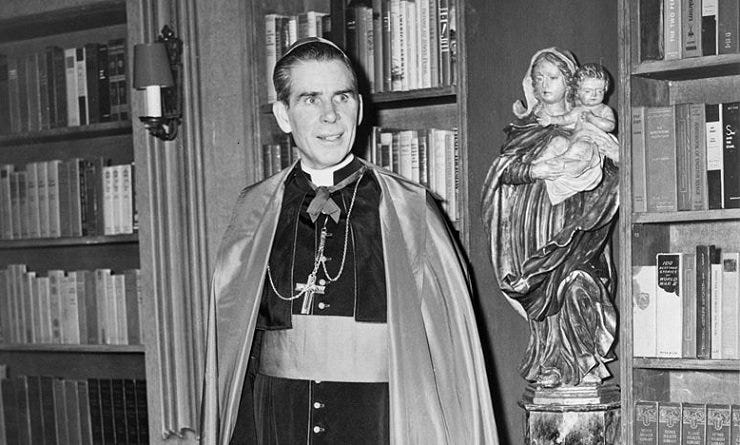
Today, the Catholic Church declares Archbishop Fulton J. Sheen “Blessed.” For those of us in the Diocese of Peoria, where Sheen grew up, discovered his vocation, and was ordained a priest, this is a day of extraordinary joy. But his Beatification is much more than a celebration of a remarkable life from decades ago. It carries a life-changing message for all of us right now.
Fulton Sheen lived through a world that knew darkness. Ordained a priest in 1919, in the aftermath of the First World War and a devastating global pandemic, he witnessed the Great Depression, the rise of fascism and communism, another world war, the Holocaust, the atomic age, the Cold War and enormous cultural upheaval. Sheen knew the anxieties of his age, yet he never surrendered to despair. That may be among the most important things he can teach us today.
Sheen could look directly at what was wrong with the world without losing sight of what was right with God. He could speak about sin without abandoning the sinner, confront evil without becoming consumed by it, and recognize the brokenness of the human heart while believing in its capacity for conversion, holiness and love. His was not an easy optimism that pretended everything would somehow work itself out. His was Christian hope, rooted in the conviction that Jesus Christ had entered into the deepest darkness of human existence and conquered it. For Sheen, the Cross changed everything.
That is why his voice is so timely now. Our circumstances are different from Sheen’s, but the human heart is not. We still know fear, loneliness, division, uncertainty, suffering and loss.
We live in a culture capable of connecting people across continents in an instant, yet many feel profoundly isolated. We have access to more information than any generation in history, yet struggle to know what is true. We speak constantly about one another and increasingly struggle to speak with one another. It can be tempting to believe that our divisions are too deep, our problems too complicated and our wounds too great to heal.
Sheen would challenge that conclusion. He understood that the deepest crisis confronting humanity was not technological, economic or political. It was spiritual. The great battle takes place within the human heart: between love and selfishness, truth and falsehood, hope and despair, God and the illusion that we can save ourselves.
That conviction shaped his ministry. When radio was the revolutionary medium of the day, Sheen entered millions of American homes through “The Catholic Hour.” Later, when television transformed American culture, he stood before a blackboard on “Life is Worth Living.” and spoke to tens of millions of people. The title itself was a proclamation of hope: Life is Worth Living.
Not because life is easy, suffering can be avoided or evil ignored, but because life comes from God. We are created by God, loved by God, and called by God. Our dignity does not depend upon our usefulness, success, health, popularity or power. It rests in something far deeper: we belong to Him.
That message remains urgent. We see young people struggling to find identity and purpose, families under enormous pressures, and communities wrestling with addiction, violence, isolation, anxiety and despair. We see a public culture in which disagreement too easily becomes contempt, and another person can quickly become an enemy rather than a neighbor. Christian hope does not permit us to look away from these realities, but neither does it permit us to despair.
Sheen famously reminded his listeners that “evil may have its hour, but God will have His day.” That was the conviction by which he lived. He knew that Christianity’s answer to darkness is to denounce it and bring light into it. The response to hatred is love; to isolation, communion; to falsehood, truth; and to despair, hope. The response to a world that has forgotten God is an invitation to encounter Jesus Christ.
Sheen himself returned to that encounter every day. For decades, he made a daily Holy Hour before the Blessed Sacrament. Despite the demands of preaching, writing, broadcasting, missionary work, and episcopal ministry, he understood that he could not give Christ to the world unless he first spent time with Christ himself.
That offers an important lesson for our age. We may think the problems confronting the world require louder voices, stronger arguments, or better strategies. Sheen reminds us that the renewal of the world begins somewhere much quieter: in the conversion of the human heart. It begins when we kneel before God and continues when we rise and love our neighbor.
This is why Sheen’s beatification is more than an honor bestowed upon a great Catholic communicator of the past. The Church places the Blessed before us so that we might imitate them. Fulton Sheen did not retreat from the world because it was troubled. He entered more deeply into it, using every means available to proclaim Jesus Christ and to remind people that darkness never has the final word.
Our age needs that witness again. The challenges before us are real. The wounds in our families, communities, Church and world are real. But so are grace, mercy, redemption and hope.
Today, as the Church calls Fulton Sheen “Blessed,” perhaps the best way we can honor him is by taking up the mission he lived. We can choose hope over despair, communion over isolation, love over contempt and faith over fear. We can believe, as Sheen did, that no darkness is greater than the light of Christ and no human life is beyond the reach of His grace.
Fulton Sheen spent his life proclaiming that truth. On this historic day, his message is as necessary as ever: Life is still worth living.