British Prime Minister Andy Burnham announced Thursday that the government will seek to end a ban on Catholics and Jews advising the British monarch on appointments to the established (state) church.
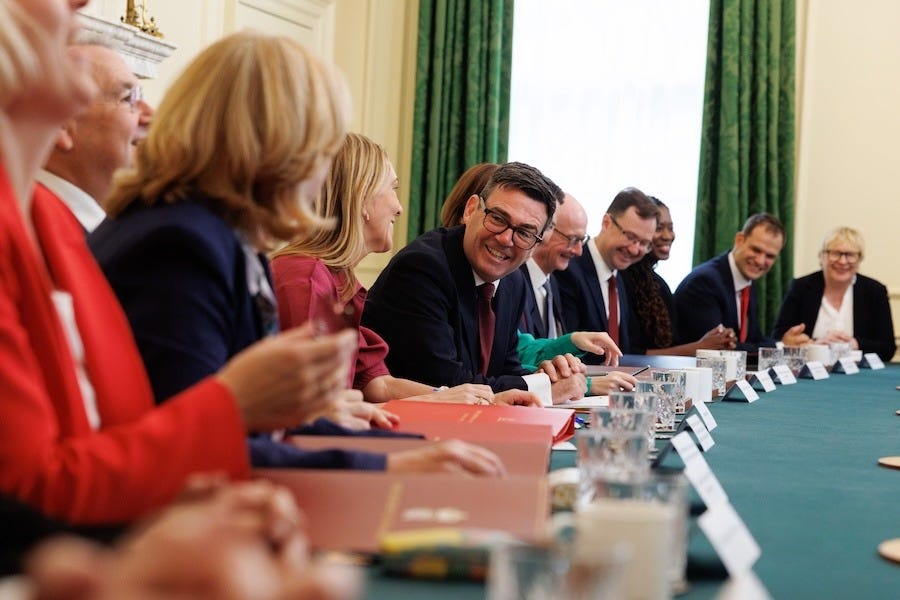
Burnham, the first lifelong Catholic to serve as prime minister, said Sept. 10 that he had transferred his constitutional responsibility to advise King Charles III on ecclesiastical appointments to the Lord Chancellor, Alex Norris.
Burnham was obliged to take the step because the Roman Catholic Relief Act 1829 says that no Catholic may advise the monarch on appointments to offices in the Church of England and Church of Scotland. The Jews Relief Act 1858 has a similar prohibition relating to members of the Jewish faith.
Burnham said it was “unacceptable for there to be a legislative bar against people of any faith performing all the functions of my office.”
“The government will therefore introduce a bill at the earliest possible opportunity to correct this antiquated and archaic anomaly,” he said.
The National Secular Society, which seeks the complete separation of Church and state, noted that Burnham’s announcement came after it wrote to Cabinet Office minister Louise Haigh in August calling for an end to the “discriminatory provisions.”
The religious restrictions only apply to Catholics and Jews. They did not apply to Rishi Sunak, a Hindu who served as prime minister from 2022 to 2024, or Keir Starmer, an atheist who held the office from 2024 to July 2026.
The prime minister’s involvement in ecclesiastical appointments is a peculiarity of the British constitutional system rooted in the Reformation.
After King Henry VIII’s break with Rome, the Act of Supremacy 1534 declared him supreme head of the Church of England. Related legislation affirmed the monarch’s power over episcopal appointments, without the requirement of papal assent.
The Church of England emerged as an established church during the English Reformation, while the Scottish Parliament established the Reformed faith in Scotland in 1560. Unlike the Church of England, the Church of Scotland is not led by bishops but by elders and ministers.
The Act of Settlement 1701 barred the monarch from being or marrying a Catholic, insisting that they be in communion with the Church of England.
The relief acts of 1829 and 1858 lifted certain restrictions on Catholic and Jewish participation in public life. But they continued to prohibit members of either faith from advising on established church appointments. The ban applies not only to prime ministers, but also to their advisers.
According to a Sept. 10 briefing by the House of Commons Library, the ban on involvement in Church of Scotland appointments may no longer be relevant as its nominations today are made independently of the monarch.
Until 2007, when an Anglican diocese fell vacant, a Church of England body called the Crown Nominations Commission selected two candidates, usually in order of preference, and sent them to the prime minister. The prime minister would select one of the names and advise the monarch to appoint the candidate. The prime minister could also reject both candidates and ask for more names, though this is believed to have rarely happened.
But in 2007, the then-Prime Minister Gordon Brown significantly reduced the prime minister’s role in the appointments process. Only one name is now presented to the prime minister, which is then forwarded to the monarch. The Crown Nominations Commission keeps a second name in reserve, in case the first is rejected.
Benjamin Disraeli was the U.K.’s first and so far only Jewish prime minister, holding the office in 1868 and again from 1874 to 1880. But he was baptized into the Church of England at the age of 12, an act that later enabled him to advise the Crown on ecclesiastical appointments.
Two recent U.K. prime ministers have been linked to Catholicism. Tony Blair was an Anglican when he held the office from 1997 to 2007, but was later received into the Catholic Church.
Boris Johnson was baptized a Catholic as a child, but confirmed in the Church of England. He was viewed as an Anglican when he became prime minister in 2019, but married in a Catholic ceremony in 2021, a year and a half before he left office.
The wedding at Westminster Cathedral prompted debate about whether Johnson had transferred his responsibility to advise the monarch on appointments to the Lord Chancellor, as Burnham has done.

So they went from the Monarch making the decision, to the Prime Minister making the decision and submitting it to the Monarch, to the Crown Nominations Committee making the decision and submits it to the Prime Minister who then submits to the Monarch.
Democracy leads to bureacracy should be a useful lesson not to follow for the Catholic Church.
The direct line from the cause of St. John Henry Newman starting the Oxford Movement and writing his “Tracts” to this news is rather startling!
It’s the same thing he sensed from the beginning, but now, almost exactly 2 centuries later, having come into a rather strange and baroque form!