USCCB to consider building sale amid big picture rethink
"Times have changed, but our physical structure has not."
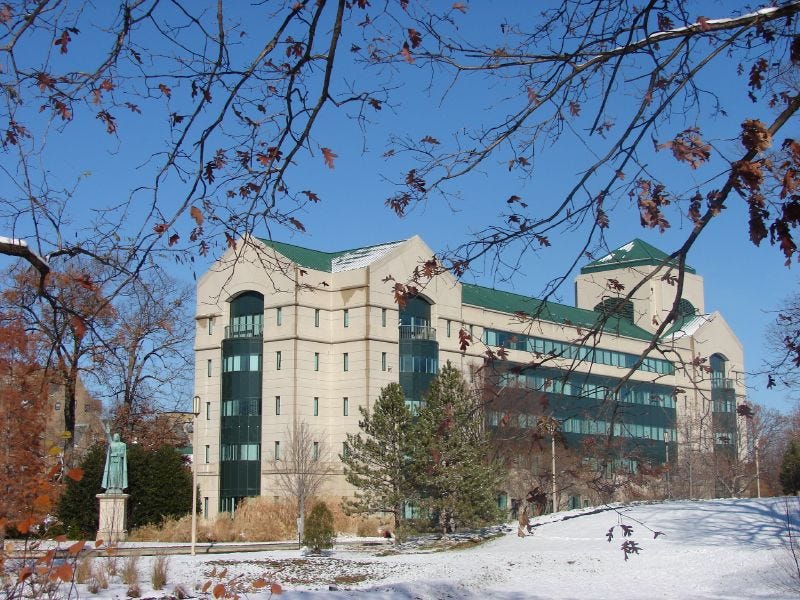
The U.S. bishops’ conference is at the start of a restructuring process that could see its Washington, D.C. headquarters sold or leased, as the conference faces ongoing financial challenges and a recent round of layoffs.
A task force of bishops was charged last month with leading a process to review the USCCB’s priorities and operations, in order to make concrete decisions about asset and resource allocation in future budget cycles.
While conference leaders say that USCCB finances are healthy, the task force approaches its work after a significant loss of federal funds, and personnel cuts across several departments in recent years.
At the USCCB’s plenary meeting in Baltimore last month, outgoing treasurer Archbishop James Checchio told bishops that the conference was facing “a challenge.”
“Succinctly,” Checchio said, “times have changed, but our physical structure has not, and the way we do business largely remains the same.”
“For perspective: Since the restructuring of the communications, justice and peace and now MRS, now in 2024 the cost to maintain our underutilized headquarter building in DC was roughly $4.4 million, which includes insurance, but not capital projects,” the archbishop added.
“Restructuring” of the departments Checchio mentioned has meant dozens of layoffs in recent years, at least 50 of which occurred this year, amid a federal cessation of refugee resettlement funds administered by the conference.
Changes at the bishops’ conference led former president Archbishop Timothy Broglio to appoint last month a task force of bishops, assigned to work with several committees on addressing interlocking questions about finance, personnel, real estate, and mission.
According to Archbishop Bernard Hebda, who succeeded Checchio in November as treasurer, “the task force is charged with discerning the most effective and responsible way to utilize the available real estate and other resources of the conference to facilitate the continuation of its mission in the years to come.”
The group will “work in tandem with the Committee on Priorities and Plans and the Budget and Finance Committee,” Hebda explained. “We met in Baltimore for the first time in conjunction with the November plenary assembly.”
And the work comes amid a period of change already underway at the bishops’ conference, Hebda said.
“In recent years, Covid changed the way the conference operates, allowing more remote work to be done. In addition, the communications office was restructured as well as the Offices of Justice and Peace and the Campaign for Human Development, along with the recent changes with [Migration and Refugee Services],” the archbishop told The Pillar.
“Given these changes over the past years, the structure of the conference and use of the building has already changed dramatically,” Hebda added.
In light of those changes, Checchio said during his November speech that the work of the task force is to envision what the conference will look like going forward.
“What do we want the conference to look like?” Checchio asked bishops in November, explaining the task force mission. “What do we want it to do?”
Answering those big picture questions, Checchio said, will help to set a pathway for bishops to make decisions on financial issues.
And that work, Checchio said, will need to be done quickly. “We have a year to figure it out,” he told bishops in November.
According to Hebda, this “figuring out” was a reference to the task force aim of developing recommendations for restructuring at the conference ahead of the November 2026 plenary assembly, when bishops will vote on the next USCCB budget cycle.
While Hebda insisted that the conference is financially healthy, Checchio explained in November the 2026 budget passed by bishops last month “included a $1.3 million draw from our long-term investments,” and made use of Covid-era Employee Retention [payroll] Tax Credit funds to balance the ledger.
“This is just a one-year solution and not long term,” Checchio told bishops.
But a major challenge, Checchio said in November, is the bishops’ five-story Washington, DC headquarters building, built by the conference in the late 1980s, and occupied by the conference since 1989.
The building, with almost 200,000 square feet of floor area, is occupied only to about 50%, Checchio said, and maintenance, routine upkeep, and insurance for the building constitute a major USCCB expense — some $4.4 million annually, Checchio told bishops.
Meeting that expense annually, without some change to the conference fiscal projections, would require the bishops to dive into their investment portfolios to keep the budget balanced.
“If we … continue to just use half or less than half of the USCCB headquarters for our operations, we can fund our operations and balance our budget by taking a 4% annual draw from our unrestricted long-term investments,” the archbishop told bishops in November.
Conference officials later told The Pillar that such a draw would most likely come from annual investment returns of the long-term conference portfolio, which typically exceed 4% annually, but that those returns are usually reinvested for long-term capital or emergency conference needs. And if market returns did not exceed the 4% needed in a particular year, the draw would impact investment principal.
“The question obviously arises: Is that a wise use of our revenues, to fund a building? Historically, the long-term investments have only been used when necessary and to the extent they are needed,” Checchio explained.
For his part, Hebda told The Pillar that “all options are being considered” with regard to the building’s future — including possible sale or lease — “with the assistance of experts from this field.”
“The ultimate decision will rest on what is programmatically and financially in the best long-term interest of furthering the conference’s mission,” he added.
In response to The Pillar’s questions regarding migration and refugee program compensation, the archbishop acknowledged that the 2025 layoffs effected by federal migration program cuts impacted the building question — federal grants administered by the USCCB allowed the conference to recoup some occupancy and infrastructure costs.
But of the $4.4 million in annual building maintenance and insurance costs, Hebda estimated that only about $500,000 was coming from federal grant allocations.
In that sense, the upkeep problem preceded the grant-related layoffs.
But as the task force considers potentially major solutions — which could eventually include more reductions in personnel — some staffers told The Pillar that Checchio’s November speech was the first internal indication that a major reorganization — or a physical move — was being considered.
That, coupled with layoffs, could cause morale concerns within the conference, some said, ahead of a change in executive leadership next November, when conference general secretary Fr. Michael Fuller will reach his term limit, and new staff leadership will be appointed internally.
Hebda, though, emphasized that a big picture discernment should not be taken as a sign of crisis for the bishops’ conference.
“We’re not at a crisis point,” the archbishop told The Pillar, “but rather at an opportune juncture for examining what the bishops want the conference to be and do.”
“The bishops of the United States have long been conscious of the need to be good stewards of their finances. As a result of wise and ethical investing and prudent planning, the USCCB finances are in very good shape. Nevertheless, any healthy organization will periodically review its resources and working methods with an eye toward better fulfilling its mission,” Hebda told The Pillar.
“I’m glad that the Conference is in a financial position that will allow any evaluation to take place calmly and deliberately, with appropriate consultation. While finances will surely play a role in this determination, the discussion is fundamentally more pastoral/theological than economic.”


Is the Pillar article talking about how there was no monetary motivation for the USCCB to support mass immigration going to be updated?
Excellent article. A couple of spelling errors:
1) Checchio's first quote, "succinctly" is missing its third c.
2) Two paragraphs down from that, "Restructuring" has a superfluous g.
I don't mean to be nitpicky, just things I noticed. Thanks for the great reporting and Merry Christmas!