Vatican says ‘nein’ to lay homilies in Germany
The German bishops made the request in March.
The Vatican’s liturgy department announced Tuesday that it had rejected the German bishops’ request to authorize lay preaching at Masses.
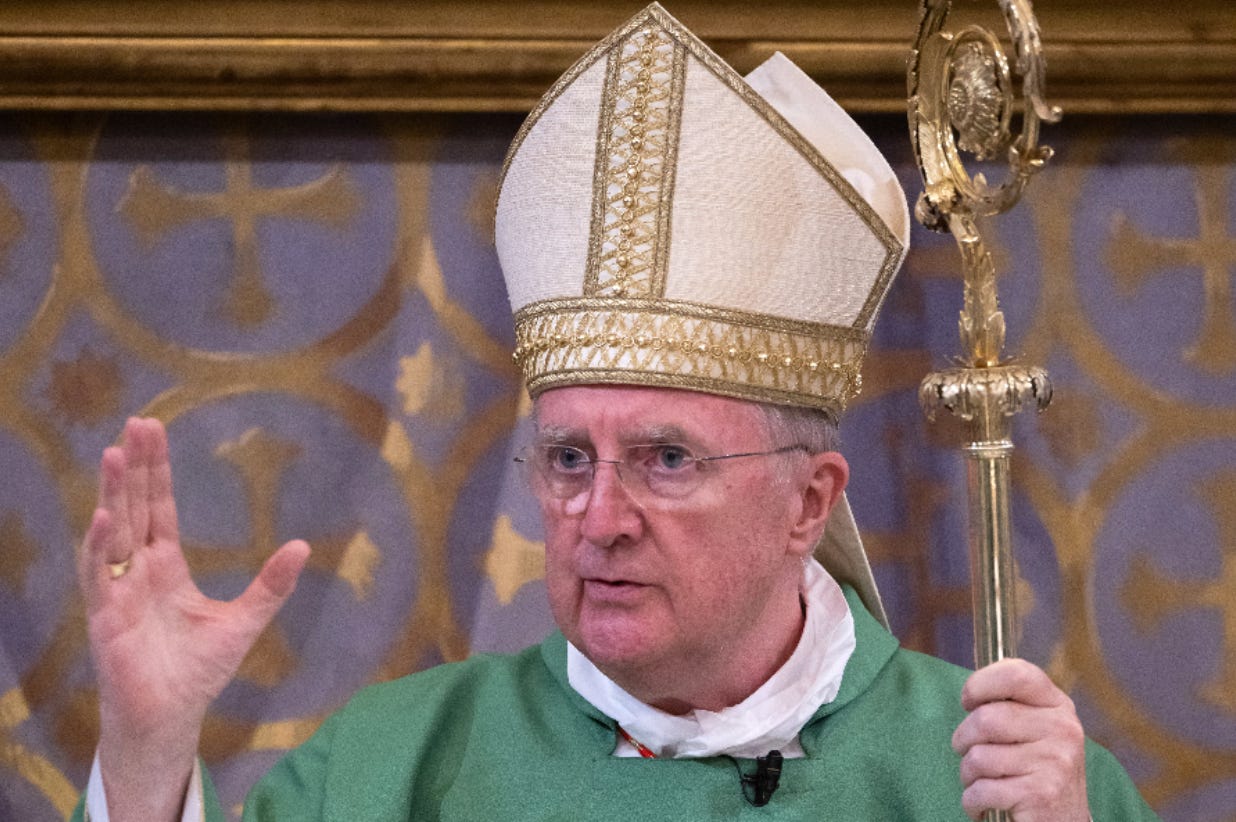
The Dicastery for Divine Worship said June 23 that it had informed German bishops’ conference chairman Bishop Heiner Wilmer, S.C.J., in a June 17 letter, of the refusal of his request for an indult to allow “in exceptional circumstances, a duly commissioned lay member of the faithful to preach in place of the homily during the celebration of the Eucharist.”
It said that “while expressing appreciation for the pastoral concerns that inspired the request, the Dicastery reaffirms that the current discipline cannot be dispensed from by means of an indult, since the reservation of the homily to a priest or deacon is not a merely disciplinary norm but derives from the very nature of the liturgy.”
The German bishops’ conference later published the DDW’s five-page letter rejecting the request, signed by the dicastery’s prefect, Cardinal Arthur Roche, and secretary, Archbishop Vittorio Francesco Viola, O.F.M.
The letter said: “This norm has been repeatedly confirmed by the Magisterium, especially in the instruction Redemptionis Sacramentum (nos. 64-66), which expressly excludes the possibility that lay faithful may give the homily during the celebration of Mass, even under another designation.”
In what was widely seen as a criticism of long-standing practices in several European countries such as Germany and the Netherlands, the 2004 Vatican Instruction Redemptionis Sacramentum said that “any previous norm that may have admitted non-ordained faithful to give the homily during the eucharistic celebration is to be considered abrogated by the norm of canon 767 §1. This practice is reprobated, so that it cannot be permitted to attain the force of custom.”
It added: “The prohibition of the admission of laypersons to preach within the Mass applies also to seminarians, students of theological disciplines, and those who have assumed the function of those known as ‘pastoral assistants’; nor is there to be any exception for any other kind of layperson, or group, or community, or association.”
In recent decades, the Church has repeatedly ruled out the possibility of lay preaching at Masses.
Canon 767 §1 of the Code of Canon Law says that the homily “is part of the liturgy itself and is reserved to a priest or deacon.”
No. 66 of the General Instruction of the Roman Missal says “the homily should ordinarily be given by the priest celebrant himself. He may entrust it to a concelebrating priest or occasionally, according to circumstances, to the deacon, but never to a lay person.”
The Vatican’s 2015 Homiletic Directory said: “Well-trained lay leaders can also give solid instruction and moving exhortation, and opportunities for such presentations should be provided in other contexts; but it is the intrinsically liturgical nature of the homily that demands that it be given only by those ordained to lead the Church’s worship.”
The DDW underlined June 23 that “the homily forms an integral part of the Liturgy of the Word, is intrinsically linked to the proclamation of the Gospel, and constitutes an exercise of the munus docendi [duty to teach] entrusted to ordained ministers through the Sacrament of Holy Orders.”
It added: “The proclamation of the Word within the liturgical celebration is inseparable from the mission received sacramentally and from the unity that binds together Word and Sacrament in the Eucharistic celebration.”
The letter to the German bishops explained that “since the reservation of the homily to the ordained minister belongs to the sacramental and liturgical structure of the Eucharistic celebration itself, no dispensation by indult can be granted from the norm established in can. 767 §1, even in the presence of serious pastoral considerations.”
It went on: “Criteria such as better theological preparation or communicative abilities on the part of lay faithful, however valuable they may be in themselves, cannot justify entrusting the homily to them … Nor is this merely a question of theological competence. For the priest, the preparation and delivery of the homily form an integral part of his priestly ministry and spirituality and cannot be separated from them.”
The request to permit lay homilies originated in a resolution approved by participants in Germany’s controversial “synodal way” on March 10, 2023.
The document called on Germany’s bishops to “draw up a particular norm and obtain permission for this from the Holy See, according to which the homily can also be taken over in Eucharistic celebrations on Sundays and feast days by theologically and spiritually qualified faithful commissioned by the bishop.”
The resolution noted that it was already a “long-standing practice” in German dioceses for “persons who have qualified themselves through studies in theology and have been sent by the bishop into the ministry of proclaiming the Gospel” to preach at Masses.
It suggested the practice could be expanded to include religious education teachers, “trained people for leading liturgies of the word,” and “spiritual leaders of associations.”
Wilmer, who was elected German bishops’ conference chairman in February, said the bishops had discussed the synodal way resolution in detail at their Feb. 23-26 plenary meeting in Würzburg and adopted a regulation that would govern the practice.
Wilmer personally submitted the request for an indult to Vatican officials March 30.
The DDW said June 23 that its letter to the German bishops also stressed “the importance of promoting the ongoing formation of ordained ministers so that the homily may fully express its pastoral and spiritual effectiveness.”
The letter also noted that the German bishops had suggested a linguistic distinction could be drawn between preaching at Masses by an ordained minister and by a lay person, if the first practice was known as a Homilie (German for “homily”) and the second as a Predigt (“preaching”).
But the letter said “the proposed distinction between a ‘homily,’ reserved to the ordained minister, and a possible ‘sermon,’ entrusted to a lay faithful person, does not appear admissible, since the proposed place, immediately after the Gospel, and the function exercised essentially coincide with those of the homily itself.”
The letter added that the present situation in Germany did not constitute a “genuine pastoral necessity” that would justify a departure from liturgical norms.
“When a priest is present to celebrate the Eucharist, he is thereby also present to exercise the ministry of the homily, which belongs to him by virtue of his ordination. Situations in which the celebrant is impeded, for example because of a temporary physical limitation, constitute merely occasional and time-limited circumstances and cannot be regarded as the basis for a permanent pastoral necessity,” it said.
It added: “Where no priest is available, no celebration of the Eucharist takes place; rather, according to the norms of the Church, provision is made for celebrations of the Word of God, within which suitable forms of proclamation or interpretation of Sacred Scripture may be entrusted to lay faithful, without any special indult being required.”
The DDW’s June 23 statement concluded by noting that current Church discipline allows for various forms of lay preaching outside the Mass.
It said: “The Church’s current discipline already provides for numerous forms of proclaiming the Word and preaching that may be entrusted to lay members of the faithful outside the homily and outside the celebration of the Eucharist, in accordance with canon law and the proper nature of these different forms of proclaiming the Gospel.”

It’s not as if they weren’t having lay preachers at Mass in Germany already. This was just an attempt to have an established practice ‘blessed’ by Rome. All this decision means is that the next time a lay person gets up to preach a homily during Mass, she (more likely) or he will proudly be labeled a ‘rebel.’
Good article, succinct and sufficient, thank you.