
Viola moves from Vatican liturgy office to St. Peter’s Basilica
Pope Leo XIV named Archbishop Vittorio Viola Saturday as the new archpriest of St. Peter’s Basilica.
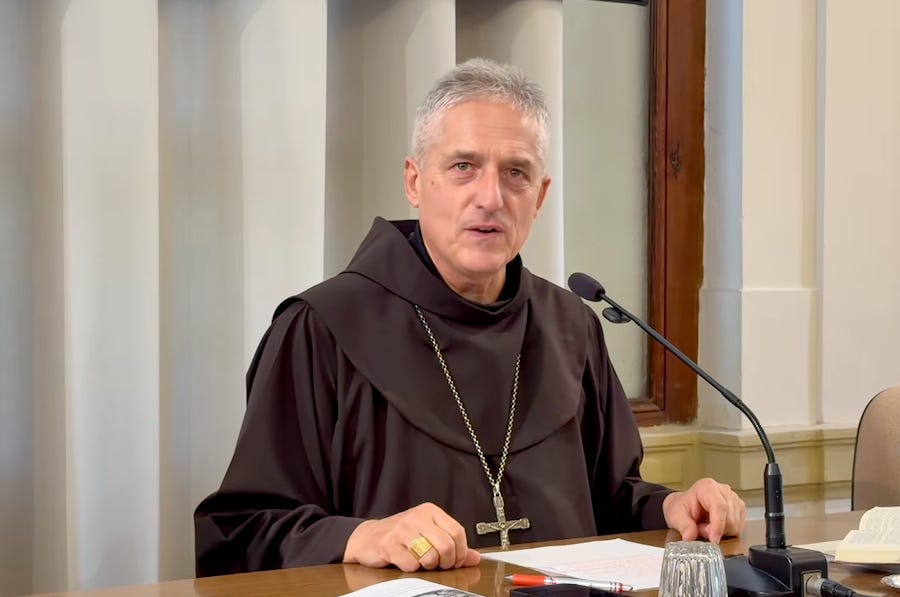
Viola, until now secretary of the Vatican Dicastery for Divine Worship and the Discipline of the Sacraments, succeeds Cardinal Mauro Gambetti, who was appointed Archbishop of Chieti-Vasto, Italy, Oct. 3.
Viola, 61, was also entrusted with the two other offices associated with the archpriest of St. Basilica, that of vicar general of His Holiness for Vatican City and president of the Fabric of St. Peter, the body responsible for the basilica’s conservation and maintenance.
St. Peter’s Basilica has a long association with the Franciscan Family. Since the 18th century, Conventual Franciscans have served as the basilica’s official confessors. Gambetti is a Conventual Franciscan, while Viola belongs to the Order of Friars Minor.
Leo XIV immediately filled the vacancy created by Viola’s transfer to St. Peter’s Basilica Oct. 10, naming Bishop Aurelio García Macías as secretary of the Dicastery for Divine Worship. The Spanish-born bishop was previously the dicastery’s under-secretary.
Cardinal Arthur Roche, a 76-year-old Englishman, has served as the dicastery’s prefect since 2021.
Vittorio Francesco Viola was born in Biella, northern Italy, on Oct. 4, 1965, the feast of St. Francis of Assisi. He professed his solemn vows as a member of the Order of Friars Minor in 1991 and was ordained to the priesthood in 1993 at the Papal Basilica of St. Mary of the Angels in Assisi by Bishop Luca Brandolini.
Brandolini was a close collaborator of Archbishop Annibale Bugnini, the controversial architect of the post-Vatican Council II liturgical reforms. Bugnini served as secretary of the Congregation for Divine Worship from 1969 to 1976, when he was appointed apostolic pro-nuncio to Iran.
Viola studied at the influential Pontifical Liturgical Institute of Sant’Anselmo in Rome, gaining a doctorate in 2000. His doctoral dissertation was on priesthood and episcopacy in the ancient Gelasian Sacramentary.
He was custodian of the friary and the Papal Basilica of St Mary of the Angels at the Porziuncola from 1999 to 2005 and guardian of the friary at the Basilica of St Clare in Assisi from 2005 to 2014.
Viola also served as head of Caritas for the Diocese of Assisi from 2008 to 2014. He reportedly came to the attention of Pope Francis in 2013, when he helped to organize a lunch with the poor during the Argentine pope’s first visit to Assisi.
Pope Francis named Viola as Bishop of Tortona, northern Italy, in 2014. Viola chose the episcopal motto In tuis te invenio sacramentis (“I discover you in your sacraments”), attributed to St. Ambrose. He is said to wear Bugnini’s episcopal ring.
Viola was named secretary of the Congregation for Divine Worship — the role Bugnini once held — in 2021 and granted the personal title of archbishop. The appointment occurred shortly before Pope Francis issued the apostolic letter Traditionis custodes, imposing significant restrictions on celebrations of the Traditional Latin Mass worldwide. Viola was later associated with the enforcement of the restrictions.
The archbishop has given several talks in Italian dioceses on Pope Francis’ 2022 apostolic letter on liturgical formation, Desiderio desideravi, including an address to the priests and deacons of Rome.
Some commentators have interpreted Viola’s appointment as part of a gradual generational shift at the Vatican, with figures who were shaped by the experience of Vatican Council II giving way to leaders less defined by the conciliar debates. They have characterized Viola as direct and straightforward, but with the kind of low profile reputedly favored by Pope Leo XIV.
Others have argued that Viola’s primary task is to restore order to the basilica after a tumultuous tenure by Gambetti that saw repeated breaches of security and the expansion of commercial activities that some viewed as inconsistent with its spiritual mission.
Others still have suggested that Viola’s appointment is bad news for Catholics attached to the Traditional Latin Mass, as the archbishop now occupies a central Vatican role that has traditionally been held by a cardinal.
During Gambetti’s tenure, private Masses were banned in the upper part of the basilica, while Traditional Latin Masses were restricted to the Clementine Chapel in the Vatican Grottoes. The measures, introduced in 2021, generated significant criticism, as they withdrew a centuries-long permission for visiting priests to say a Mass at the Church’s most famous basilica, and for visiting groups of pilgrims to have their own group liturgical celebration at its side altars.
Instead, visiting priests were told they must concelebrate Mass at the altar of the Chair of St. Peter during one of the basilica’s scheduled daily Masses.
The number of Masses celebrated each morning in the basilica reportedly dropped from up to 75 to fewer than 10.
“[L]eaders less defined by the conciliar debates.”
The man wears Bugnini’s ring. Less defined? He has chosen to make the debate central to his identity.
Is this demotion by promotion? Nobody gets fired at the Vatican, but they do get moved to jobs that look fancy but are places they can be controlled.