
At least a dozen French bishops have spoken out following an eruption of violence on the country’s streets Oct. 17.
Not surprisingly, they unanimously condemned the violence, but the length and content of their interventions varied significantly.
Several sought to distinguish between the actions of rioters and what they suggested were the legitimate concerns of peaceful young protesters. Many also evoked Pope Leo XIV’s Sept. 25-28 visit to France, suggesting it offered a powerful counter-image to the scenes of looting and destruction.
A number of bishops also stressed their solidarity with law enforcement officials who struggled to contain the disorder, as well as the owners of the roughly 3,000 damaged or looted businesses.
What’s the background to the nationwide unrest that the French media calls “les violences du 17 octobre”? And what exactly are the bishops saying?
What’s the background?
Student protests are an established feature of French public life. The most famous occurred in May 1968, triggering widespread civil unrest and a general strike that plunged France into crisis. The protests became a symbol of revolutionary cultural and political change across the Western world, and marked a generation of Catholic thinkers, including the future Pope Benedict XVI.
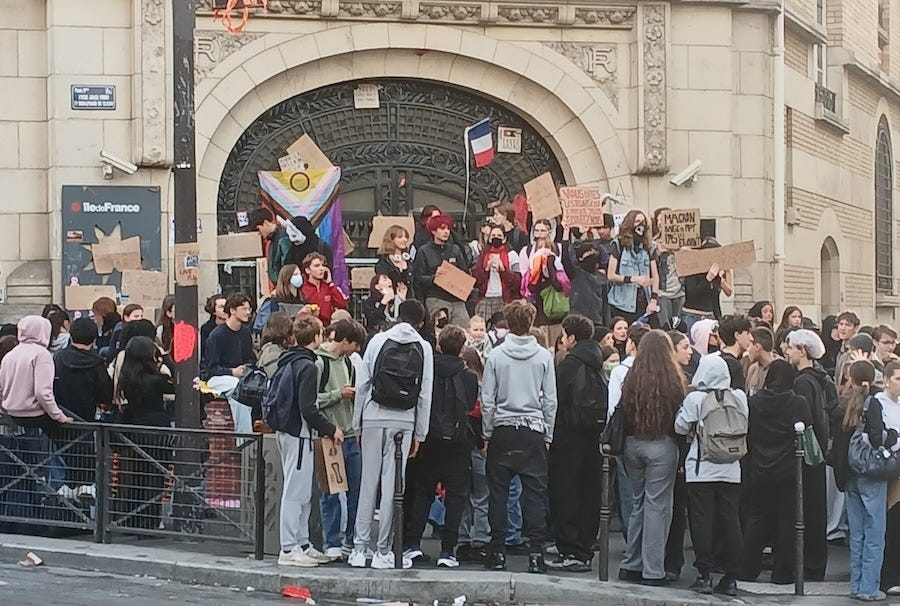
In September 2026, demonstrations broke out across France at lycées — institutions roughly equivalent to U.S. high schools that educate students between the ages of 15 and 18. The students said they were protesting against teacher shortages, crowded classrooms, rundown buildings, and overloaded timetables. The protests spread to universities.
Police responded forcefully to the demonstrations, deploying tear gas, launching baton charges, and making more than 5,000 arrests by early October, according to Amnesty International. The protests featured blockades of lycée entrances and occupations of school buildings, as well as vandalism and arson.
The mouvement lycéen et étudiant (high school and university student movement) emerged at a politically sensitive time. French President Emmanuel Macron’s second and final term is scheduled to end in May 2027. Among the frontrunners to succeed him is Marine Le Pen, the candidate of the National Rally, a political party widely described as far-right, though it presents itself as a mainstream defender of French sovereignty.
Various French bishops commented on the rise of the student movement, stressing the importance of dialogue with young people, while criticizing those who resorted to violence.
Student organizations, major French trade unions, and other activist groups called for a nationwide day of mobilization on Oct. 17, billed as a protest against the rising cost of living, fuel prices, and deteriorating public services. Their appeals were amplified on social media, drawing more than 500,000 people onto the streets to take part in 110 marches, according to the French Interior Ministry.
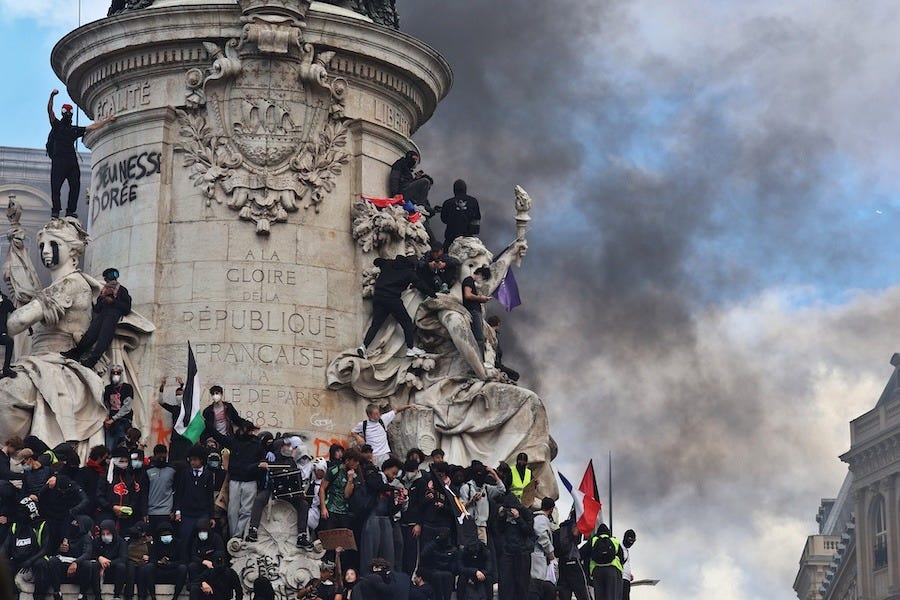
As tensions mounted, thousands of black-clad and masked figures rioted in cities across France, notably in Bordeaux, Lille, Limoges, Lyon, Marseille, Paris, Strasbourg, and Rouen.
Cardinal Jean-Marc Aveline reported that “churches were broken into” in his Archdiocese of Marseille, while protesters placed objects including Palestinian flags on statues of France’s patron St. Joan of Arc.
The unrest was described by some observers as among the worst in France since May 1968 and another potential turning point for French society. The violence poured fresh fuel onto already fiery debates about political polarization, disenfranchised youth, immigration, and France’s long-term trajectory.
What are the bishops saying?
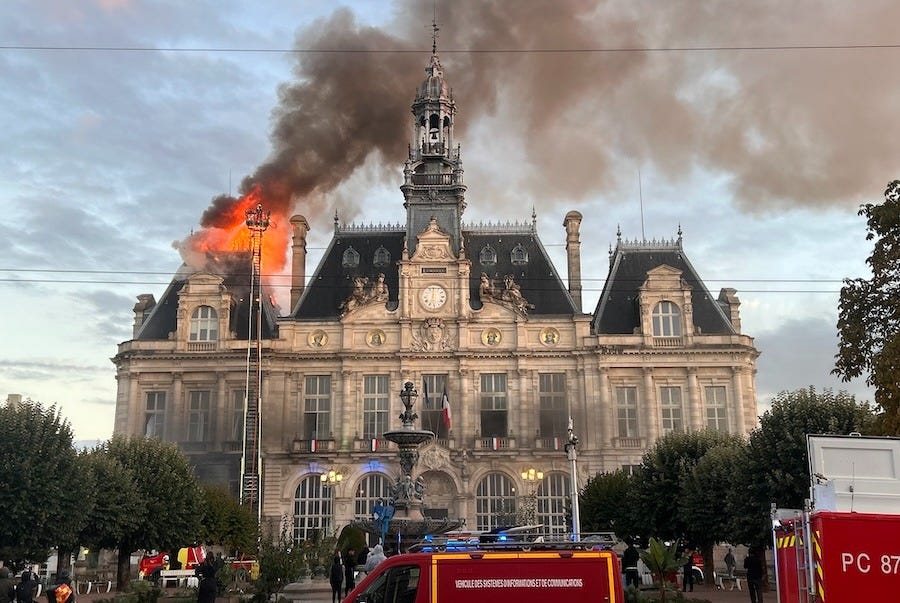
Bishop Benoît Aubert of Limoges expressed “deep sadness” Oct. 17 at the destruction of Limoges Town Hall in an arson attack.
“This place is an integral part of our city’s history and the lives of its residents. Seeing it damaged in this way is deeply distressing,” he said.
“I wish to assure the mayor, elected officials, and all municipal employees of my support and that of the diocesan Church. I express my gratitude to the firefighters and to all those who are working to protect people and preserve this heritage to which the people of Limoges are so deeply attached.”
“In this time of trial, I invite the Catholics of the diocese to join me in prayer. May Christ help us to live in brotherhood and to be peacemakers.”
Archbishop Olivier de Germay of Lyon announced Oct. 17 that the archdiocese had accepted a request from the local prefecture to postpone a planned peace march organized with Muslim, Jewish, and other Christian groups because of violence perpetrated on the sidelines of the day’s demonstrations.
On Oct. 18, the archbishop said: “The violence that took place in Lyon Oct. 17 goes far beyond the bounds of a demonstration in which legitimate grievances may be expressed. The city has been the scene of clashes, hatred, destruction, and looting, all of which are unacceptable.”
“Our thoughts and prayers are with shopkeepers, law enforcement officers and all those who have fallen victim to these excesses, including those who wished to demonstrate peacefully.”
“I do not ignore the fact that this violence is a sign of a society in deep distress, but I want to state emphatically once again that it is a dead end and can only lead to further injustice and division. It is not by turning against one another, but by working together, that we will be able to meet the challenges facing our society.”
“Let us pray for peace and be peacemakers.”
Cardinal Jean-Marc Aveline, speaking in his capacity as Archbishop of Marseille, said Oct. 18: “Yesterday, our city, like many others in France, was the scene of unacceptable violence: on the fringes of the planned demonstrations, stores were looted, churches were broken into, City Hall was stormed and vandalized, a police station was ransacked, and law enforcement officers were attacked.”
“Together with the entire Church of Marseille, I wish to express my support and solidarity with those who were injured and with the business owners who fell victim to this vandalism. I call on everyone not to get caught up in the spiral of this violence: our city and our country deserve better than this. Together with all believers, we pray for an end to these disturbances and for peace to return.”
Bishop François Touvet of Fréjus-Toulon said Oct. 18 that the violence had left him “sad and worried.”
“The urban violence that took place on Saturday in Toulon and the Var region, as elsewhere in France, and again yesterday in Paris, was a distressing spectacle,” he wrote.
“While it is legitimate to express concerns and anger, this cannot be done through violence. While the use of force against violence may be legitimate, violence itself is not: it is a dead end, and we must spare young people from it. The cowardly enemies of peace operate with their faces concealed. We must give fraternity a face.”
“We cannot tolerate such violence depriving demonstrators of their legitimate freedom of expression. I offer law enforcement officers and firefighters my full support and encouragement. I am thinking of those who have been injured and all those affected by the looting of their businesses or the burning of their cars, as well as everyone left feeling helpless, overwhelmed by anxiety and disheartened.”
Touvet cited Pope Leo XIV’s appeal for peace and fraternity in his Sept. 25 address at the Élysée Palace, the official residence of French President Emmanuel Macron.
“At a time when our country is engulfed in violence and bloodshed, I invite Christians to work for peace wherever they live and work. And I ask everyone to pray that responsibility, dialogue and respect for others may prevail,” he said.
“Together, we must choose peace and reject division. Division leads to disaster; peace charts a path of hope.”
Archbishop Laurent Ulrich of Paris lamented Oct. 19 that the French capital had been disfigured by violence over the preceding two days.
“The scenes of these extremely violent clashes and acts of looting remain very vivid in our minds, overshadowing the legitimate expression of the concerns of so many of our fellow citizens — foremost among them young people, who are worried about their future and eager to take on the responsibilities of adulthood in the best possible way — and rendering those concerns invisible and inaudible,” he said.
“We find it hard to believe that the same city which welcomed Pope Leo XIV with joy and harmony could, less than a month later, become the scene of the violence we have witnessed.”
“The consequences of what we have seen are grave and far-reaching: people have been injured, including many police officers and firefighters; shopkeepers have seen the fruits of a lifetime’s work snatched from their hands; journalists have been subjected to attacks; and residents of Paris — families and elderly people — have been afraid to leave their homes.”
“I wish to express my support and offer my prayers, which are the support and prayers of Paris’ Catholics, to all those who have experienced the past two days as a traumatic ordeal. I also wish to call on our fellow citizens to rise to the occasion: under no circumstances, and under no pretext, can indiscriminate violence — which injures, steals, and sets fires — ever be a legitimate response.”
“At this time, it is our duty as Catholics, through our commitment and self-giving, to be instruments of consolation, builders of peace and mutual understanding. We must not lose heart, but instead bear witness to our hope and work to build a just and fraternal world among our brothers and sisters.”
“It is also our responsibility, today and in the days ahead, to redouble our efforts in prayer for our country, so that reason may prevail and social peace may be preserved. Such peace safeguards and rebuilds the bonds between people — bonds that everyone needs in order to live happily together.”
Bishop Jean-Pierre Vuillemin of Le Mans said Oct. 19: “During these difficult times, I extend my deepest sympathy, support, and prayers to law enforcement, to business owners whose stores were vandalized or looted, to municipal employees, to residents, and to all the victims of the violence that took place on Saturday, Oct. 17, in our département and throughout France.”
Archbishop Dominique Lebrun of Rouen issued a statement Oct. 19 titled “We believe in God and in young people.” It offered an unequivocal condemnation of the violence, as well as a poetic evocation of the forces eroding French society.
He wrote: “After repeatedly promising the moon,
After repeatedly failing to keep those promises,
After changing government officials time and again without changing anything,
After diluting moral responsibility behind laws and regulations,
After abusing freedom with contempt for others and, ultimately, for oneself,
After undermining the family and the fundamental values of education,
After ceasing to believe in respect for life,
How can those experiencing failure, disillusionment, and unjust poverty be expected to believe in dialogue and in the goodwill of their government and all those in authority?”
Nevertheless, the archbishop said, the Catholic Church had chosen to assume its responsibilities.
He wrote: “We believe in God and in young people, whom Jesus loves and saves. We refuse to resign ourselves to despair. We will continue our educational mission with enthusiasm in our schools, our parishes and our movements, particularly those aimed at young people, such as the Scouts. We will continue to organize youth camps during the upcoming All Saints’ school holidays.”
“We will continue to offer the Gospel to anyone seeking truth, justice and love.”
Lebrun recalled Pope Leo XIV’s visit to France, saying it had “provided an opportunity for a magnificent gathering in peace.” He added: “It is possible!”
Bishop Benoît Bertrand of Pontoise issued a statement Oct. 19 titled “Violence will never shape the future of young people!”
He wrote: “The scenes of looting, chaos and devastation that unfolded on Saturday, Oct. 17, cannot leave us silent. Violence will never shape the future of young people. I firmly condemn the acts of violence committed across France. I reiterate my support for all those who express their convictions peacefully.”
“Last Thursday, I met with 35 students from state-run secondary schools. They shared with me their concerns and questions about an uncertain future. I understand their concerns and share them. We must not allow this climate of hostility to prevent us from addressing the real questions these young people are raising. These questions are profound and serious. They call for reflection over the long term.”
“This is what the bishops of France will undertake at their plenary assembly in Lourdes, beginning in November. In doing so, we wish to contribute to the wider efforts of society as a whole to find answers.”
“I also wish to express my support for law enforcement officers and emergency services personnel who protect the public, as well as for all the victims, whoever they may be. Nothing can be built through violence and divisions driven by partisan interests.”
“Our country needs to rediscover the path of respectful and honest dialogue. I appeal here to the Christians of the diocese to be, in this context, peacemakers and builders of harmony. I also invite them to pray for all the young people of France.”
The presidency of the French bishops’ conference lamented Oct. 19 the “unacceptable violence” that erupted in cities across the country.
“On the fringes of the planned and authorized demonstrations, serious unrest broke out: law enforcement officers were attacked and injured, stores were looted, public property was vandalized, and buildings representing state institutions were ransacked,” said the message signed by bishops’ conference president Cardinal Aveline, and vice presidents Archbishop Vincent Jordy of Tours and Bishop Bertrand.
“These scenes of rioting have plunged the country into shock, fear, and despair, raising many questions about the root causes of this crisis.”
“We wish to express our support and solidarity with all those who have been injured, as well as with the many business owners who have fallen victim to this vandalism. We call on everyone not to be drawn into the spiral of this deadly violence: our country deserves better than that.”
“Together with all believers, we pray that these disturbances will cease, that just demands will be heard and addressed, and that, through dialogue and respect for justice, peace may return.”
I love that discernment story - thanks for sharing that! I took some time away from my diocese to discern religious life a few years ago. And, I can definitely relate to those once- or twice-in-a-lifetime moments when God makes one's path (and cross) abundantly clear, even if that path means going back home to the obvious choice that you've now come to appreciate in a completely different way.
Interesting that the mildest statement came from the Bishop of Limoges. Their city hall wasn't just damaged, it was destroyed by arson. I fear for landmark buildings of any kind in this rioting.