The Vatican’s Secretary for Relations with States is expected to embark next week on a highly sensitive foreign trip.
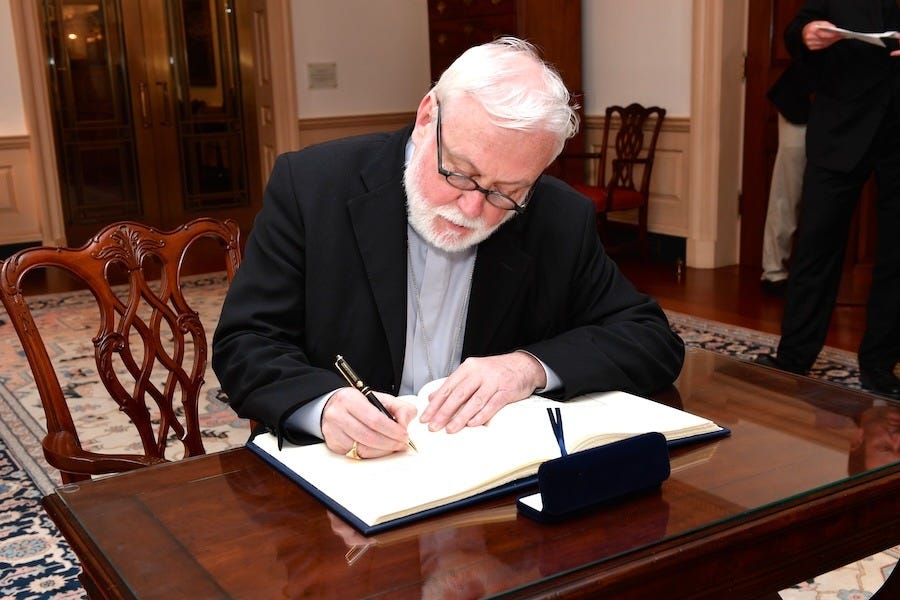
Archbishop Paul Richard Gallagher, often described as the Vatican’s “foreign minister,” is scheduled to travel to Russia Aug. 24-28, according to Russian Foreign Ministry spokeswoman Maria Zakharova.
The planned trip is the English archbishop’s first to Russia since the full-scale invasion of Ukraine in 2022. He is likely to find a country much changed since his last visit in November 2021.
Russia today is reeling from long-range Ukrainian drone strikes on its military infrastructure, energy facilities, and logistics hubs. The nation has suffered an estimated 1.4 million military casualties in Ukraine, an unprecedented array of sanctions, gas shortages, surging food costs, and a dramatic deterioration of commercial and diplomatic ties with much of the Western world.
The Trump administration’s initiatives to end the war continue, but there is no end in sight to the death and destruction. Many observers fear that Europe’s bloodiest conflict since the Second World War could rage for years to come.
The war, which pits two majority Eastern Orthodox nations against each other, has cemented a major realignment within the Orthodox world, further separating the Russian Orthodox Church from the churches close to the Ecumenical Patriarchate of Constantinople. The conflict has also created severe turbulence in relations between the Vatican and the Moscow Patriarchate.
What do we know about Gallagher’s scheduled trip? And why might it be happening now?
What do we know?
Archbishop Gallagher’s intention to make a new trip to Russia first emerged in early August. The Russian state-owned news agency TASS reported Aug. 6 that a Vatican source had said the visit would take place at the end of the month.
The report noted that Gallagher had visited Ukraine July 17-20, as Pope Leo XIV’s representative to a celebration of the 35th anniversary of the restoration of the Latin Catholic Church’s structures in the country.
Gallagher’s visit was preceded by a July 13-16 trip to Ukraine by Vatican peace envoy Cardinal Matteo Zuppi, which included a meeting with Russian prisoners of war held at a facility in the Lviv region.
The TASS report said that Zuppi, the Archbishop of Bologna, Italy, was preparing for a new trip to Moscow in September. Although TASS did not spell it out, it clearly established a link between Gallagher and Zuppi’s visits to Ukraine and Russia.
Gallagher and Zuppi arguably represent the two complementary faces of the Vatican’s mission to end or ameliorate the Ukraine war. Gallagher embodies the Holy See’s diplomatic and institutional approach, while Zuppi stands for its more informal, humanitarian-focused outreach.
On Aug. 19, TASS quoted the Catholic Church in Russia as saying that Gallagher’s visit would take place in the week of Aug. 24. It recalled that during his previous trip the archbishop had met with Russia’s Prime Minister Mikhail Mishustin and Foreign Minister Sergey Lavrov. It also noted that Gallagher and Lavrov had discussed the Ukraine war in an April 2025 phone call.
Also on Aug. 19, TASS reported on positive comments about Gallagher’s upcoming trip by Grigory Karasin, the chairman of Russia’s Federation Council Committee on Foreign Affairs.
Karasin said that Russian officials awaited “specific, interesting proposals” from Gallagher, or pertinent “assessments of the current situation.”
“We hope that the visit will lead to positive shifts or, at the very least, create a backdrop for common sense to make further progress,” he said.
On Aug. 20, TASS shared a crucial new detail: Gallagher is scheduled to hold talks Aug. 25 with Lavrov, the country’s foreign minister since 2004.
It quoted Foreign Ministry spokeswoman Maria Zakharova as saying that the meeting would “include an exchange of views on the current state and prospects of bilateral cooperation between Russia and the Vatican, as well as interaction at multilateral forums.” The parties would also address “international issues of mutual interest,” likely to include Ukraine and possibly Iran.
Finally, TASS noted that President Vladimir Putin currently had no plans to meet with Gallagher.
The Vatican has not yet confirmed Gallagher’s trip, but that is not unusual. The Vatican Secretariat of State often only formally announces diplomatic trips, via social media, once they have already begun.
Why now?
Ivan Soltanovsky, the Russian ambassador to the Holy See, offered a possible insight into the timing of Gallagher’s visit in a recent interview with EWTN News.
Soltanovsky said: “We see the future visit of Paul Gallagher as the opportunity to deliver directly on the part of our higher officials the position on many issues.”
In other words, officials see face-to-face meetings in Moscow as a good format for conveying to the Holy See the Russian state’s point of view on major international issues.
Another reason why Russian officials might be open to the Vatican at this particular time might be their appreciation for Pope Leo XIV’s outspoken advocacy for peace. They likely approved specifically of his firm stance against the war on Iran, a close ally of Russia.
Ivan Soltanovsky, the Russian ambassador to the Holy See, underlined the country’s respect for Leo XIV in the interview.
“He has a big outlook, a great outlook. He has vision and an understanding of today’s problems,” Soltanovsky said.
The Iran war may have convinced Russian officials that the world’s first U.S.-born pope will not simply follow Washington on foreign policy, while at the same time serving as a potentially important channel to Western powers.
One open question is which other Gallagher will meet other senior figures besides Lavrov. Prime Minister Mikhail Mishustin seems a likely candidate, given he met with the archbishop in 2021. Any encounter with Putin or the president’s close adviser Yuri Ushakov would be noteworthy, but nothing currently suggests such meetings will take place.
If the Russian authorities regard Gallagher’s visit as a success, it will bode well for Cardinal Zuppi’s next visit to the country, which still seems to be at the planning stage, though it could happen as early as September.
There is hope in Ukraine that Zuppi will be able to visit Ukrainian prisoners of war held in Russia, following his meeting with Russian prisoners in Ukraine. But it will no doubt be tricky to secure the Russian authorities’ approval, given widespread allegations that Ukrainian POWs are subject to systematic torture and ill-treatment. Perhaps this will be one of the items that Gallagher raises during his visit.
Russian officials would likely prefer that Zuppi follows the format of his last visit to Moscow in 2024, when he met with Foreign Minister Lavrov, children’s rights commissioner Maria Lvova-Belova, and Russian Orthodox leader Patriarch Kirill.
Ultimately, the Russian authorities must have calculated that it is in their interests to welcome the Vatican’s Secretary for Relations with State to Moscow now. They have not invited Gallagher to hear the Holy See’s case for ending the war. Instead, they want to make their own case to a soft power that they believe carries some influence with their adversaries.
