What awaits the new nuncio to Germany?
Archbishop Hubertus van Megen touched down in Berlin Monday for a challenging new assignment.
Archbishop Hubertus van Megen touched down in Berlin Monday to begin his challenging new assignment as the apostolic nuncio to Germany.
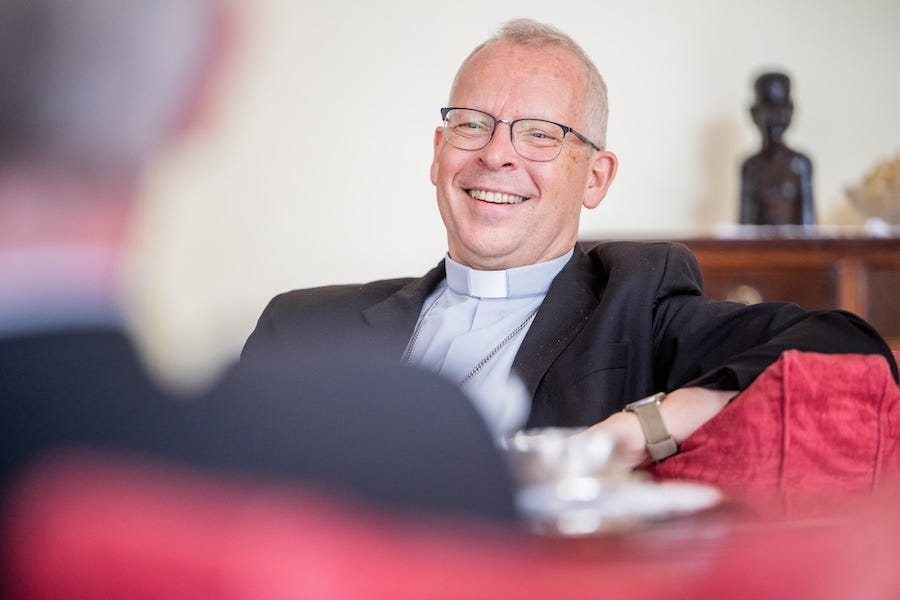
The 64-year-old Dutchman was greeted at the airport June 15 by a delegation representing the German government, the bishops’ conference, and the diplomatic corps.
Van Megen, who previously served as the nuncio to Kenya, will formally assume the new post when he presents his credentials to German President Frank-Walter Steinmeier.
He succeeds the Croatian Archbishop Nikola Eterović, who was nuncio to Germany from September 2013 to April 2026, a turbulent period in relations between the German bishops and the Vatican.
Who is van Megen? And what challenges await him at the nunciature in Berlin?

Who is the new nuncio?
Hubertus Matheus Maria van Megen was born in Eygelshoven, a village near the border between the Netherlands and Germany, on Oct. 4, 1961.
“Germany was very close to my village,” he recalled recently. “Even as children, we would cross the border to get into Germany. To play or to go shopping with my parents. Or to go even to church there at times.”
Through his grandparents, van Megen’s family has roots in Aachen and Düsseldorf in Germany and in Eupen, in Belgium’s German-speaking region.
Van Megen, who is known to friends as Bert, is fluent in German, a skill he says he picked up from the radio, television, and the streets of Germany, rather than through formal study.
But while the archbishop is culturally familiar with Germany, he recognizes that his knowledge of the country is nevertheless limited.
“I have never lived in Germany. I have never experienced the Church from the inside out in that sense. This will be a new challenge,” he said in an interview with Vatican Radio.
Van Megen appears to be the first Dutchman to serve as apostolic nuncio to Germany. If that is the case, it’s interesting to consider why the Holy See has chosen this option now.
Historically, the Vatican has tended to opt for nuncios who were neither German nor from immediately neighboring countries. In practice, this has largely meant Italians.
But perhaps now — and this is speculative — the Holy See is looking for someone who already has a strong affinity with the country, yet isn’t linked to the German Catholic establishment. Why? Because van Megen is arriving at a delicate moment in Germany-Vatican relations, but won’t need years to familiarize himself with his host country.
Although van Megen grew up on Germany’s doorstep, he wasn’t shaped by German ecclesiastical culture. He was ordained a priest of the Dutch Diocese of Roermond in 1987, worked locally as a chaplain, and entered the Holy See’s diplomatic service in 1994.
After postings in Sudan, Brazil, Israel, Slovakia, the UN in Geneva, and Malawi, van Megen was appointed apostolic nuncio to Sudan in 2014 and raised to the rank of archbishop. He was named nuncio to Eritrea the same year.
In 2019, he was transferred to Kenya. As he left Khartoum for his new assignment, the Sudanese capital was gripped by tension, with tanks on the street and sporadic shooting. He had expected a modest reception in the Kenyan capital, Nairobi. Instead, he was greeted by a choir and a large contingent of bishops — a joyous scene that was caught on camera.
Van Megen recently recalled that the large-scale welcome raised eyebrows in Kenyan government circles. One official jokingly noted that van Megen hadn’t yet presented his credentials to the president, “and here you came in like a pope.”
Later in 2019, van Megen was also named nuncio to South Sudan, the world’s youngest nation.
The archbishop has said that, after more than a decade in Africa, he will deeply miss the continent.
“I’ve always enjoyed being in Africa — perhaps because the continent is so full of color, so full of life, so full of children, so full of energy — in a way that we in Europe can hardly imagine anymore,” he told Vatican Radio.
He has characterized the Church in Germany as being “old and gray” — adding, with a touch of self-deprecation, that he is old and gray too.
Van Megen’s experience of a growing Church in the Global South may be another reason for his selection. Pope Leo XIV clearly wants to encourage a new missionary dynamism in the Church of Europe, partly by drawing in leaders from outside the continent. In November 2025, for example, he named an Indian-born Carmelite priest as Germany’s first non-European Catholic bishop.
Describing his approach as nuncio, van Megen said his task was not just to understand local theological outlooks, but to grasp the emotions that lay behind them.
“It’s about how people experience the Church and, above all, God — in their spiritual lives and in their daily lives,” he said.
“And I think I need to accompany them in that, and above all, I need to understand it first. Not so much rationally, but with my heart.”
“I think that if I can manage that, if I can walk alongside people in that — including within the Church in Germany — then I will have already fulfilled a large part of my mission.”

What are the challenges?
The post of nuncio to Germany is considered one of the most senior Vatican diplomatic appointments. It is also one of the most challenging, because of the tense relations between German Catholic leaders and Rome.
The background is likely familiar to many readers. In 2019, the German bishops and the lay Central Committee of German Catholics launched the “synodal way,” an initiative intended to introduce sweeping changes to Catholic teaching and practice in the wake of a harrowing clerical abuse scandal.
The synodal way culminated in 2023 with 150 pages of resolutions that included appeals for women deacons, a re-examination of priestly celibacy, lay preaching at Masses, a larger lay role in selecting bishops, and a revision of the Catechism of the Catholic Church regarding homosexuality.
Along the way, organizers breezed past multiple “stop signs” from the Vatican. Perhaps most significantly, they defied Rome by drawing up plans for a permanent synodal body, composed of bishops and select laity, that would have substantial decision-making powers over the Church in Germany.
The Vatican and the German bishops averted a major showdown by launching a series of talks that resulted, in 2024, with a concession from the bishops that no permanent synodal body would be established without Rome’s approval.
In March 2026, bishops’ conference chairman Bishop Heiner Wilmer handed the new body’s statutes in to the Vatican for consideration. The institution’s first meeting is already planned for November 2026, but Wilmer has cautioned that Rome may not follow the German timetable.
This is the point at which van Megen is entering the picture. Can he help guide the Vatican and the German bishops to a mutually satisfactory solution concerning the new body? What if there is too little common ground and Rome nixes the plan, or just lets the statutes gather dust on a musty Vatican shelf?
While the synodal body is arguably the biggest issue, it’s far from the only one. What will van Megen do about the German Church’s blessing guidelines, which remain in place despite the Vatican’s explicit rejection?
What will he make of the recent document from Germany’s largest Catholic women’s association, calling for abortions in Catholic hospitals? The kfd is subject to the oversight of the German bishops’ conference. Will van Megen press the conference to intervene?
How will he tackle the deep fissures within the German bishops’ conference, where a minority resists the synodal way agenda while the majority seeks to advance it to the maximum extent possible?
When advising on the appointment of new bishops, will he seek to bolster the minority, strengthen the majority, or try to forge a missing center?
Given these difficulties, you might forgive van Megen for booking an immediate return flight to Nairobi. But he insists he’s relishing the new role.
“I’m also looking forward to German culture, German music, German literature, German food, and, of course, the German language,” he told Vatican Radio.
So even if the next few years prove strenuous, van Megen will have the consolations of Brecht, Beethoven, and bratwurst.

