
A Catholic archbishop in Syria has confirmed that he is safe after armed men bound, blindfolded, and gagged him Sunday while ransacking his office.
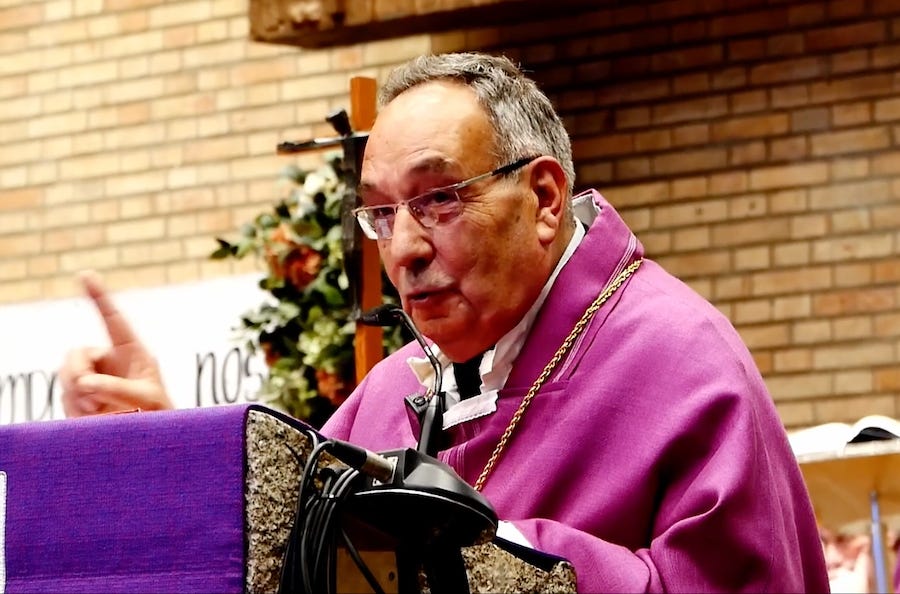
Archbishop Jean-Abdo Arbach told the pontifical foundation Aid to the Church in Need Nov. 17 that he was grateful for the prayers and messages of support he had received since the incident.
The 74-year-old thanked God that he had emerged unharmed after his assailants stole personal belongings, including an image of the Virgin Mary. According to some accounts, they also took his pectoral cross.
Arbach explained that he could not comment further on the episode because it is currently under investigation by Syrian authorities.
What’s the background? What are people saying about the incident? And what’s likely to happen next?
What’s the background?
Syria’s 13-year civil war culminated with the fall of the Assad regime in 2024. But the country of around 26 million people bordering Iraq, Israel, Jordan, Lebanon, and Turkey remains volatile.
This is partly because Bashar al-Assad was overthrown by forces led by Hayat Tahrir al-Sham, a Sunni Islamist group headed by Ahmed al-Sharaa, who now serves as Syria’s transitional president.
Syria hasn’t had a census in decades, but the majority of the population is Sunni Muslim. The country is also home to significant religious minorities with deep historical roots. These include Shia Muslims, Christians, and the Druze, as well as the Alawites, who are concentrated in the country’s coastal and urban areas.
Syria is home to some of the world’s oldest Christian communities. Before the civil war, the Greek Orthodox Church was believed to be the country’s largest, followed by the Melkite Greek Catholic Church, Armenian Apostolic Church, and the Syriac Orthodox Church.
The Melkite Greek Catholic Church is one of the 23 Eastern Catholic Churches in full communion with the pope. The name “Melkite” derives from the Syriac word for “king” and, by extension, “imperial.” The term was originally used by non-Chalcedonian Christians for Christians who followed the Byzantine emperor in accepting the Council of Chalcedon in 451.
The Melkite Church traces its roots to the 1st-century Patriarchate of Antioch. It emerged in its present form when Patriarch Cyril VI Tanas embraced communion with Rome in the 18th century.
Archbishop Arbach has led the Melkite Greek Catholic Archeparchy of Homs, in central-western Syria, since 2012. Homs is the third-largest city after Damascus and Aleppo. One of its most famous sights is the Church of St. Mary of the Holy Belt, a Syriac Orthodox cathedral housing a relic identified as part of the Virgin Mary’s girdle.
While most Catholics in Syria are Melkites, there are also Maronite Catholic, Syriac Catholic, Armenian Catholic, Chaldean Catholic, and Latin Catholic communities.
Although 2024 marked a new era in Syria, 2025 was also marred by bloodshed, as the interim government struggled to impose its authority throughout the country.
In March 2025, around 1,400 people, mainly civilians, were killed in Alawite parts of the country, according to a U.K. Parliament research briefing.
In June 2025, a suicide attack at a Greek Orthodox church in Damascus killed 25 people and injured 63.
In July 2025, there were deadly clashes between Druze and Bedouin groups in the southern Sweida province.
In short, insecurity is pervasive and felt especially among Syria’s religious and ethnic minorities.
What are people saying?
The Nov. 15 attack on Archbishop Arbach has sent ripples of fear through the local Christian community.
The Patriarchs and Heads of Churches in Syria deplored the incident in a Nov. 17 statement, accompanied by a dimly lit image of what appeared to be the archbishop with plastic tape covering his eyes, mouth, and much of his face.
After describing recent episodes of torture and kidnapping, they said that the violence had led to the “targeting” of Arbach, who was “bound, blindfolded, and gagged, while his office was ransacked.”
“The recurrence of these incidents, without any response or tangible results on the part of the authorities, confronts us, and public opinion alike, with a grave question regarding the future of Christians in this country,” they said.
They added that Christians should not be treated “as easy targets for attack or as scapegoats.”
Regina Lynch, executive president of Aid to the Church in Need, also lamented the attack.
“We were deeply shocked to hear of the attack on Archbishop Arbach, a courageous shepherd who has remained close to his people throughout so many years of war and suffering,” she said.
“We thank God that he is safe and assure him of our prayers and solidarity. Our thoughts are also with all those who continue to live in fear and insecurity in Syria. We sincerely hope that the country will finally find the peace and stability its people so desperately need.”
Gerard Russell, a Middle East analyst and former diplomat, told The Pillar in a Nov. 18 email that it was hard to determine the motive for the attack beyond robbery.
“In Iraq there was a lot of criminality post-2003 and minorities would bear the brunt of it, especially if they were not numerous and not accustomed to fighting back,” he said.
“I think if you were looking here at an organized campaign then you’d see bombing of churches and so forth, as we also saw in Baghdad. My guess — just a guess — is these were thieves. I would expect extremists to smash a cross, not steal it, for example.”
Russell, the author of “Heirs to Forgotten Kingdoms,” a study of endangered religions in the Middle East, said the incident indicated a lack of respect for religions other than Islam.
He described it as “a shocking event and a rather rare one in the region so it will no doubt be very disturbing for Christians in Homs.”
He said: “They won’t take much consolation from the thought that it was done for money. It suggests that people don’t fear retribution from the state and don’t feel shame — or expect to be shamed — at attacking a senior Christian religious figure. A very bad sign.”
What’s next?
The attack on Archbishop Arbach presents an immediate challenge to Syria’s transitional president, Ahmed al-Sharaa. Will he take the necessary steps to ensure the security of the country’s religious minority leaders? Or will he allow a sense of impunity to develop further among the nation’s armed groups?
The attack also presents a serious challenge to the country’s Christian community. It raises the uncomfortable question of whether there is still a place for Christians in post-civil war Syria.
Christian families suffer the hardships endured by the wider population: poverty, unemployment, overcrowded accommodation, hunger, power cuts, water shortages, and unaffordable medicines. If they must also fear being targeted for their faith, many will consider if they might be better off abroad.
Their bishops will appeal to them to remain in a country sometimes described as a “cradle of Christianity,” knowing that each departure progressively weakens the Church. But it is hard to reassure the flock when even the shepherds do not appear safe.