What does the end of the Orbán era mean for the Church?
The Orbán government invested heavily in relations with the local Church and Rome during its 16 years in power.
Local Catholic bishops and Vatican officials were likely watching closely as Hungarians went to the polls earlier this month in a pivotal election.
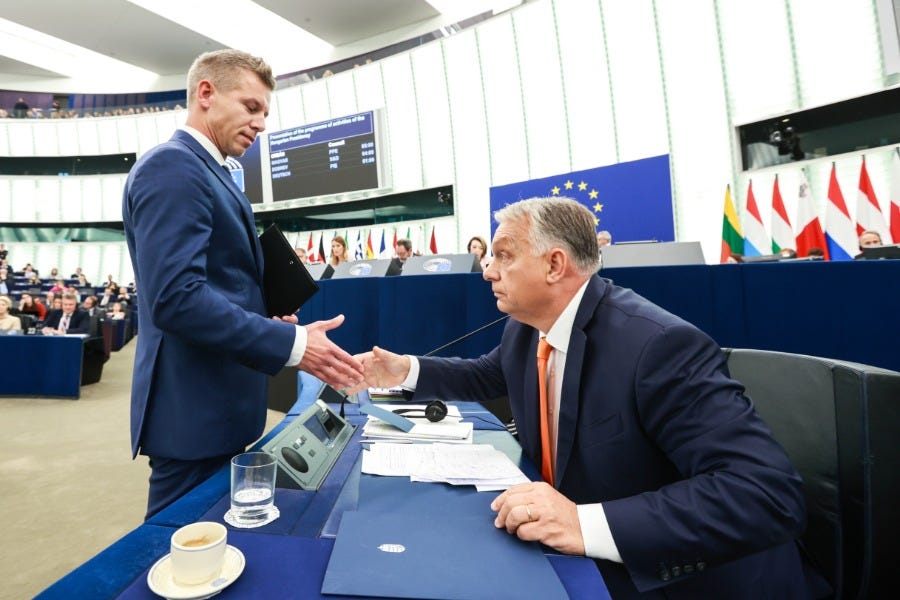
The parliamentary election, held April 12, was widely regarded as a referendum on the government of Viktor Orbán, which had invested heavily in relations with the local Church and Rome during its 16 years in power, while radically reshaping Hungary’s institutions.
Despite the advantages of incumbency, Orbán’s Fidesz party lost in a landslide to the Tisza party, led by the energetic 45-year-old Péter Magyar.
Tisza won 141 seats, well above the 100 needed for a majority, while Fidesz gained only 52, a loss of 83 seats from the 2022 election.
The Catholic-educated Magyar framed his victory not just as a change of governing party but as a regime change.
“The regime has fallen, and the Hungarian people have voted for a change of system,” he said the day after the ballot.
What does the election result mean for Church-state relations in Hungary? To answer that, we first need to look at the wider context and Magyar’s personal background.
What’s the context?
Hungary is a landlocked country of more than 9.5 million people bordering Austria, Slovakia, Ukraine, Romania, Serbia, Croatia, and Slovenia.
The country’s 2022 census concluded that only 29% of Hungarians were Catholic, but the optional nature of the religious affiliation question may have led to an undercount of those who consider themselves Catholic but did not respond.
As in other Central European countries, Hungary has experienced a steady long-term decline in Mass attendance, as well as a vocations crisis that has left priests bearing increasingly heavy pastoral burdens.
Hungary was part of the Soviet Bloc from 1949 to 1989 — an experience that still weighs heavily on the country. A young Viktor Orbán was one of the founding members of Fidesz, formed in 1988 as an anti-communist party.
In the 1990s, the party began a rightward shift. Orbán’s personal outlook also changed. Initially regarded as indifferent to religion, he began to identify more closely with Calvinism, the second-largest Christian community in Hungary after Catholicism.
Orbán first became prime minister in 1998, heading a conservative coalition government. From 2002, he led the opposition, before returning to power in 2010.
The Orbán administration took a notable interest in Church-state relations, pouring money into church renovations, transferring oversight of state institutions to the Church, courting Catholic intellectuals abroad, and creating Hungary Helps, an agency supporting persecuted Christians.
Styling Hungary as an “illiberal democracy,” the administration amended the constitution to define marriage as between a man and a woman, prohibited the dissemination of LGBT materials to under-18s, and banned gender studies in universities. It also sought to boost the country’s flagging birth rate and reduce abortions.
Although the administration’s anti-immigration policies were at odds with Pope Francis’ advocacy for migrants, Hungary and the Vatican nevertheless grew closer in the Orbán era. Hungary was one of the few countries that received two visits from the Argentine pope, in 2021 and 2023.
Orbán met with Pope Francis at least five times. Francis also regularly received Katalin Novák, Hungary’s first female president, whom he appeared to hold in high esteem.
Hungary-Vatican relations remained solid following Pope Francis’ death and the election of Pope Leo XIV. During a Vatican visit in October 2025, Orbán met with Pope Leo, as well as Vatican Secretary of State Cardinal Pietro Parolin and Secretary for Relations with States Archbishop Paul Richard Gallagher.
The discussions highlighted “the strong bilateral relations” between Hungary and the Holy See. They also touched on the Ukraine war, where the two parties arguably shared common ground, both stressing the need for peace and supporting continued communication with Russia.
Who is Péter Magyar?
Péter Magyar was born in 1981 into a wealthy, well-connected conservative family in Budapest. “Magyar” is the Hungarian term for the Hungarian people.
Although it is unclear whether Magyar had a strong religious upbringing, his lawyer parents sent him to a prestigious Budapest high school run by the Piarist religious order. He went on to study law at Pázmány Péter Catholic University in the capital in the early 2000s. Despite this educational background, he is not considered to be a practicing Catholic today.
Magyar joined a local chapter of the Fidesz party while it was in opposition and began to rise through its ranks. In 2006, he married fellow lawyer and Fidesz associate Judit Varga. They had three children before divorcing in 2023.
Magyar’s break with Fidesz was triggered by the disclosure that President Novák had granted a pardon in 2023 to a man convicted of covering up abuse in a state-run children’s home. The pardon was co-signed by Varga, who was by then serving as the country’s justice minister.
When both women resigned as a result of the scandal, Magyar believed they were made to take the fall for decision-makers higher up in Hungary’s governing apparatus. (The Hungarian presidency is a largely ceremonial role, with the prime minister wielding executive power.)
The controversial pardon was reportedly granted following a request by the presiding bishop of the Reformed Church of Hungary, which is Orbán’s denomination. This element of the story triggered debate about the closeness of Church-state ties.
Magyar began to accuse the Orbán administration publicly of corruption and cronyism, alleging that “a few families own half the country.” At a mass rally in Budapest in 2024, he announced he was joining the opposition Tisza party. The party’s name blends the Hungarian words tisztelet (respect) and szabadság (freedom), and also refers to the country’s Tisza river.
Magyar summed up his challenge to entrenched Fidesz rule with the motto “Do not be afraid” (“Ne féljetek!” in Hungarian), in an echo of Pope John Paul II, as well as Matthew 14:27.
As an opposition leader, Magyar was circumspect about religious matters. But his actions suggested he might be motivated by an underlying faith. He attended Pope Francis’ funeral in April 2025. In May 2025, he undertook a 10-day walk from St. Stephen’s Basilica in Budapest to a statue of the Hungarian monarch St. Ladislaus in Oradea, Romania. The journey was aimed at galvanizing political support, but had an undertone of pilgrimage.
According to the New York Times, Magyar wore a wristband with a small wooden cross on the parliamentary election campaign trail, alongside his characteristic open-necked white shirts, jeans, and Ray-Bans.
As the political temperature rose ahead of the 2026 election, Hungary’s bishops made clear that they did not want to be drawn into the campaign.
In October 2025, the bishops’ conference’s permanent council said: “We regret to note that, in the context of this heated election campaign, public discourse has become extremely coarse, often featuring baseless attempts to stir up emotions and slander.”
“We wish to emphasize to our clergy, all believers, and society at large that we are not a political organization and do not wish to participate in the campaign.”
“Our mission is to serve the salvation of souls. Our task is to work with dedication for the physical and spiritual well-being and progress of our country and our people, for families, for those in need, for the education of youth, for justice, and for peace.”
Individual priests and bishops were, however, caught up in the electoral battle, with some appearing at Fidesz campaign events. Their presence pointed to the intricate links formed between Church and state during the party’s long stint in power.
There is currently no publicly available data indicating how Catholics voted in the parliamentary election. As the campaign didn’t focus on specifically Catholic issues, it’s possible they voted broadly in line with the wider population.
What does the election mean for the Church?
Tisza’s election manifesto addressed the sensitive topic of Church-state relations. It offered a critique of the tightly interwoven relationships between Fidesz politicians and Church leaders.
“The independent voice of churches and the civil world has been replaced by subservience instead of cooperation. This was comfortable for some, but it meant a serious loss for the communities and for society as a whole,” it argued.
The manifesto promised that under a Tisza government, “churches and civil organizations will not be subordinates, but equal partners of the state.”
“We will create an environment in which the state and the churches mutually respect each other’s boundaries, and their cooperation serves the benefit of the community,” it said.
The manifesto also promised to maintain existing funding mechanisms, including the option to donate 1% of personal income tax to a registered religious community.
The text was seemingly aimed at reassuring Christian voters that, while Tisza intended to take a new approach to Church-state relations, it would respect well-established arrangements.
The Hungarian bishops’ conference congratulated the Tisza party on its victory, though nothing can be read into this courtesy.
Magyar will not become prime minister formally until the Hungarian Parliament reconvenes, on May 12 at the latest. For the next few weeks, Church-state ties are therefore in a kind of limbo.
Meanwhile, Magyar is being depicted in contradictory ways by the media. Some portray him as a pro-European Union liberal, while others insist he’s a conservative Hungarian nationalist. He skilfully avoided defining himself too sharply on the most controversial issues during his campaign. This arguably enabled Hungarian voters, and outside observers, to project their hopes and wishes onto him.
But as soon as he takes the oath of office, Magyar will begin to make defining decisions. It may soon become clear where his views align with Church teaching and where they diverge (perhaps on bioethical issues).
Summarizing the obstacles facing Magyar, the Hungarian Christian news site Szemlélek wrote: “Although the Tisza party could form a government on its own, it is backed by a true ‘grand coalition’ of diverse ideologies among its voters.”
“In this regard, there is a strong parallel with the 1989-90 regime change. During the final days of socialism, only two parties truly existed: ‘them’ and ‘us.’ There were the pillars of the system and its opponents — the latter including figures like István Csurka (later of the far-right MIÉP) and György Konrád (of the liberal SZDSZ).”
“Today, the spectrum behind Péter Magyar ranges from Marxists to disillusioned Fidesz supporters, and from practicing liberals to lifestyle conservatives and the devoutly religious. It will clearly be incredibly difficult to satisfy such a diverse crowd.”
Meanwhile, the Hungarian Church itself could be approaching a leadership transition. Cardinal Péter Erdő, the Archbishop of Esztergom-Budapest, will turn 75 next year, the age at which diocesan bishops are expected to tender their resignations to the pope.
Erdő, who has led the archdiocese since 2002 and was a prominent figure at the 2025 conclave, reportedly underwent multiple surgeries in February this year. As he continues to recuperate, he issued a short audio message offering Easter greetings.
Erdő’s health struggles likely add to the sense of uncertainty among Hungary’s bishops as they absorb the end of the Orbán era and prepare for the epoch of Péter Magyar.

