What happened at Jerusalem’s Church of the Holy Sepulchre?
Israeli police blocked Cardinal Pizzaballa from entering the Church of the Holy Sepulchre on Sunday.
Israeli police generated headlines around the world when they blocked Cardinal Pierbattista Pizzaballa from entering Jerusalem’s Church of the Holy Sepulchre on Sunday.
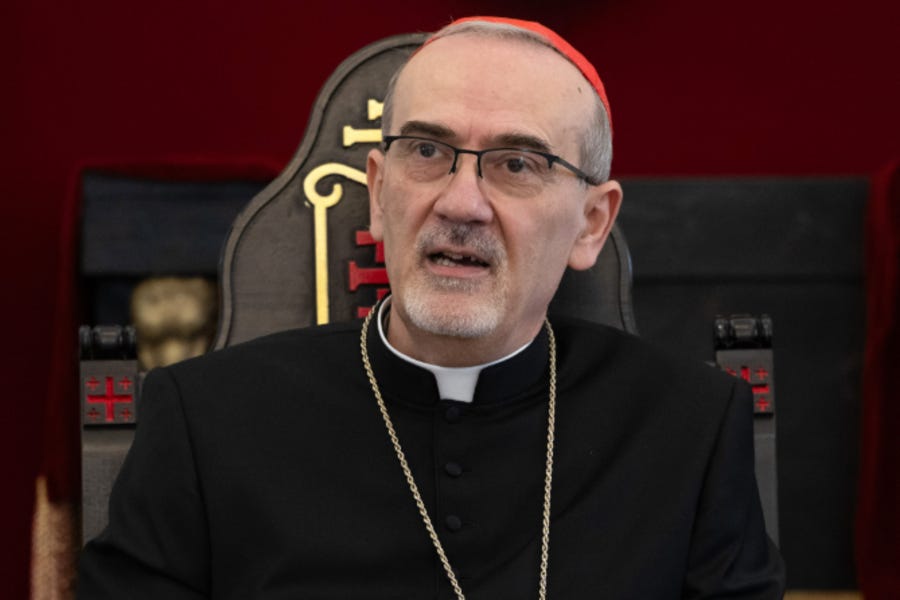
But 24 hours later, after a flurry of diplomatic activity, the Latin Patriarch of Jerusalem announced the situation had been resolved.
So what exactly happened? Here’s the background, followed by a rough chronology of events.
The background
On Feb. 28, the U.S. and Israel launched military operations against Iran in which the country’s Supreme Leader Ali Khamenei was killed. Anticipating Iranian attacks, Israel immediately declared a state of emergency, imposing nationwide civilian security restrictions, including limits on public gatherings.
The wartime measures upended the traditional Lenten program of the Latin Patriarchate of Jerusalem, which oversees the pastoral care of Latin Catholics in Israel, Palestine, Jordan, and Cyprus. The restrictions made it impossible to hold full-scale celebrations at the Church of the Holy Sepulchre, which is traditionally believed to be the site of Christ’s death, burial, and Resurrection.
The restrictions also affected the adherents of Islam and Judaism in Jerusalem. Access to the Al-Aqsa Mosque compound was limited throughout the fasting month of Ramadan. Entry to the Western Wall (popularly known as “the Wailing Wall”) was also curtailed.
On March 16, Iranian missile fragments fell on a rooftop near the Church of the Holy Sepulchre, one of hundreds of such incidents across Israel.
On March 22, Cardinal Pizzaballa, the leader of Latin Catholics in the Holy Land, announced that the annual Palm Sunday procession from the Mount of Olives to the Old City of Jerusalem would not take place because of the security measures.
The Chrism Mass, a celebration typically held in Holy Week, where the bishop blesses holy oils for use in his diocese, would be postponed.
“The churches of the diocese remain open,” Pizzaballa wrote. “Parish priests and priests, in the forms and ways that are possible, shall do everything they can to encourage prayer and the faithful’s participation in the celebrations of the Paschal Mystery.”
It’s important to note that the Church of the Holy Sepulchre is not a church of the Latin Patriarchate of Jerusalem, in the strictest sense. It’s a site with three main custodians: the Greek Orthodox Patriarchate of Jerusalem, the Armenian Apostolic Church, and the Catholic Church. The delicate shared custodianship arrangement is regulated by an 1852 agreement known as the Status Quo.
The Catholic Church’s custodianship is entrusted to the Franciscan Custody of the Holy Land, rather than the Latin Patriarchate. The Franciscans oversee the Catholic presence at the church, under the leadership of the local major superior, Fr. Francesco Ielpo, whose title is Custos of the Holy Land.
Yet, the Church of the Holy Sepulchre is officially the cathedral of the Latin Patriarchate. This is crucial for understanding the strength of the reaction to the decision to bar Pizzaballa from the site.
Due to the difficulties in accessing the shared site, the Latin Patriarchate also maintains the Co-Cathedral of the Most Holy Name of Jesus elsewhere in Jerusalem’s Old City.
The co-cathedral can accommodate around 500 people, while the spaces allocated to Latin Catholics inside the Church of the Holy Sepulchre (the Chapel of the Apparition and the Chapel on Calvary) are much more limited.

The incident
On the morning of March 29, Palm Sunday, Cardinal Pizzaballa and Fr. Ielpo sought to celebrate Mass at the Church of the Holy Sepulchre. As the Latin Patriarch of Jerusalem and Custos of the Holy Land respectively, they evidently believed they had a right to preside at the celebration, as long as they did not violate measures restricting public gatherings to 50 people or less.
A joint press release from the Latin Patriarchate of Jerusalem and the Custody of the Holy Land said that Pizzaballa and Ielpo were approaching the church “privately and without any characteristics of a procession or ceremonial act,” when they were stopped by the Israel Police and “compelled to turn back.”
“As a result, and for the first time in centuries, the Heads of the Church were prevented from celebrating the Palm Sunday Mass at the Church of the Holy Sepulchre,” the press release lamented.
“This incident is a grave precedent, and disregards the sensibilities of billions of people around the world who, during this week, look to Jerusalem.”
The statement noted that Church leaders had complied with restrictions on public gatherings since the outbreak of the Iran war.
“Preventing the entry of the Cardinal and the Custos, who bear the highest ecclesiastical responsibility for the Catholic Church and the Holy Places, constitutes a manifestly unreasonable and grossly disproportionate measure,” it said.
“This hasty and fundamentally flawed decision, tainted by improper considerations, represents an extreme departure from basic principles of reasonableness, freedom of worship, and respect for the Status Quo.”
The response
As the statement spread around the world, government leaders began to speak out.
Among the first to respond were Italy’s Foreign Minister Antonio Tajani and Prime Minister Giorgia Meloni, perhaps in part because Cardinal Pizzaballa and Fr. Ielpo are Italian nationals.
Tajani said he had instructed Italy’s ambassador to Israel to protest against the decision. Meloni described the move as “an affront not only to believers, but to any community that recognizes religious freedom.”
In France, which has traditionally considered itself a protector of Middle Eastern Christians, President Emmanuel Macron expressed his “full support” for Pizzaballa. He said the incident came amid an “alarming increase in violations of the status of the Holy Sites in Jerusalem.”
Mike Huckabee, the U.S. ambassador to Israel, defined the event as “an unfortunate overreach” that was “already having major repercussions around the world.”
“For the Patriarch to be barred from entry to the Church on Palm Sunday for a private ceremony is difficult to understand or justify,” he commented.
Israeli Prime Minister Benjamin Netanyahu responded to the backlash by announcing that he had ordered that Pizzaballa “be granted full and immediate access” to the Church of the Holy Sepulchre.
Netanyahu said that in recent days, Iran had “repeatedly targeted the holy sites of all three monotheistic religions in Jerusalem with ballistic missiles.”
As a result, Israeli authorities had “asked members of all faiths to temporarily abstain from worshipping at the Christian, Muslim and Jewish holy sites in Jerusalem’s Old City.”
Pizzaballa was asked not to celebrate Mass at the Church of the Holy Sepulchre “out of special concern for his safety,” Netanyahu said.
He added: “Even though I understand this concern, as soon as I learned about the incident with Cardinal Pizzaballa, I instructed the authorities to enable the Patriarch to hold services as he wishes.”
The resolution
In a second joint press release, the Latin Patriarchate of Jerusalem and the Custody of the Holy Land confirmed that the situation had been resolved.
“In agreement with the Israel Police, access for representatives of the Churches has been secured in order to conduct the liturgies and ceremonies and to preserve the ancient Easter traditions at the Church of the Holy Sepulchre,” it said March 30.
It said that Holy Week observances would be broadcast live to Catholics in the Holy Land and worldwide, while respecting restrictions on public gatherings.
The text singled out Israeli President Isaac Herzog for praise, thanking him for his “prompt attention and valued intervention.”
Herzog has sought to cultivate positive relations with the Vatican and the Catholic Church in Israel since his election as president in 2021. He had a private audience in September 2025 with Pope Leo XIV, after which he met with Vatican Secretary of State Cardinal Pietro Parolin and Secretary for Relations with States Archbishop Paul Gallagher.
Israel Police announced on social media March 30 that it had had a “productive meeting” with Cardinal Pizzaballa, at which “a mutual framework” for upcoming Holy Week and Easter ceremonies was agreed. An accompanying photograph showed the sometimes stony-faced Latin Patriarch beaming as he shook hands with a senior Israeli police officer.
In a March 29 interview with Italy’s TV2000, Pizzaballa characterized the Palm Sunday incident as an unfortunate event triggered by misunderstandings.
He said: “There were no clashes. Everything was handled very politely. I don’t want to push the issue; we want to use this situation to try to clarify in the coming days what to do while respecting everyone’s safety, but also respecting the right to pray.”
He added: “This morning’s events are significant, but we must consider the broader context. There are people far worse off than us, who cannot celebrate for very different reasons. Once again, we are celebrating a subdued Easter.”

