
Delegates at Ireland’s national synodal assembly voted Saturday to prioritize catechesis, healing, and youth ministry, while offering less support for proposals to create new national bodies and address the role of women in the Church.
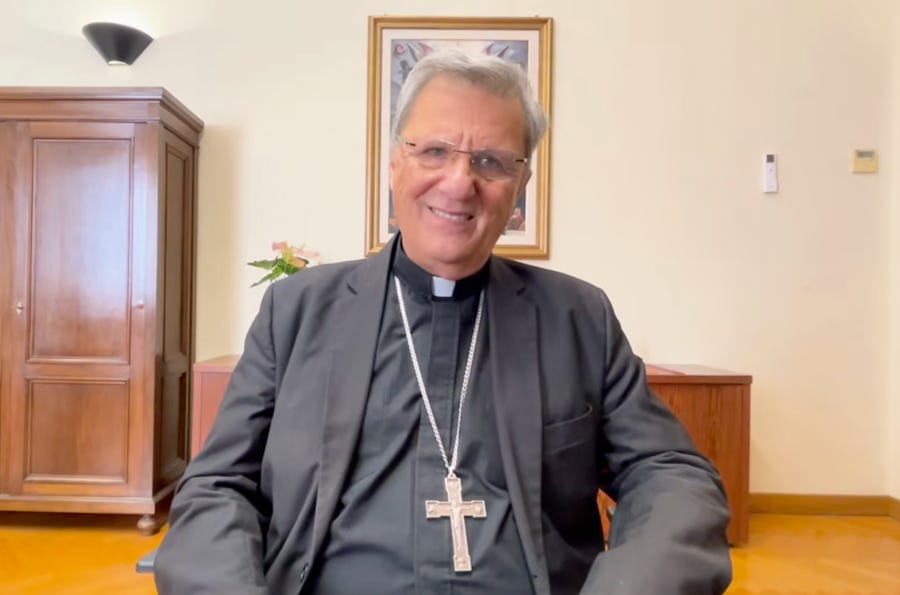
Caption: Cardinal Mario Grech, the secretary general of the Synod of Bishops, delivers a pre-recorded message to participants in Ireland’s national synodal assembly on Oct. 17, 2026. Credit: Screenshot from the @irishsynodalpathway3254 YouTube channel.
More than 300 delegates from across Ireland gathered Oct. 17 at Gormanston, County Meath, to consider 35 proposals that emerged from a national synodal process launched in March 2021.
What’s the background to the national synodal assembly? What happened at the gathering? And what’s likely to happen next?
What’s the background?
Ireland’s bishops announced in March 2021 the creation of a National Synodal Pathway. They said the process would be guided by the question “What does God want from the Church in Ireland at this time?” It would lead, within five years, to the holding of a national synodal assembly.
Significantly, they took this decision before Pope Francis announced the global synodal process in October 2021. This meant that Ireland was slightly ahead of the synodal curve compared with most other European nations. But it also meant that the Irish process had to be put on the back burner while the worldwide process unfolded.
The Irish synodal pathway began to build momentum after the nationwide consultations for the global synodal process were completed.
On Sept. 18, 2026, organizers published a 72-page working document for the national synodal assembly. The document, titled “Is not this what God asks of you?”, identified what it called “five pathways for the renewal of the Catholic Church in Ireland.”
The pathways were defined as follows:
Pathway 1: The Church that Proclaims the Gospel.
Pathway 2: The Church as a Community of Belonging.
Pathway 3: The Church as a Place of Healing.
Pathway 4: The Church that Accompanies.
Pathway 5: The Church that Empowers for Ministry and Co-Responsibility.
The many proposals that emerged over the preceding five years were whittled down to 35, each of which was grouped under one of the five thematic headings.
The document explained that delegates at the national synodal assembly would be presented with each proposal and asked whether the assembly “highly recommends it,” “recommends it,” “considers that it needs further discernment,” or “does not recommend it.”
It explained that this would not be “a simple exercise in voting,” but rather “a means of expressing the discernment of the assembly after the proposals have been prayerfully considered both locally and together.”
For example, the first proposal of Pathway 1 was titled “Building communion with those who struggle to see the relevance of the Church.” The related proposition said: “This assembly recommends that dioceses and local faith communities identify local needs in order to create a program of outreach.”
What happened?
In an address welcoming participants in the assembly, Bishop Tom Deenihan of Meath said that the five-year national pathway had helped to erode misgivings about the concept of synodality.
“During that time, fears have been allayed, understandings of the process have grown, and synodality itself seems to have moved from being a sometimes controversially perceived destination to a way of being Church,” he commented.
Delegates were presented with a video message by Cardinal Mario Grech, the secretary general of the Synod of Bishops, who had attended a conference in Knock in 2024 that helped to integrate the global synodal process and the Irish synodal pathway.
Grech told assembly participants: “Do not measure the future of the Church simply by what is disappearing. Discern what the Holy Spirit is bringing to birth. Do not simply manage a diminishing ecclesial landscape. Reposition the Church for mission within it.”
When it came to voting, the following 10 proposals received the most support, measured by the combined percentage of delegates who selected either the “recommend” or “highly recommend” option.
Top 10 proposals with the most support:
1. 5.3) The ministry of catechist, both instituted and commissioned (91% combined).
2. 3.1) Healing as a priority in the future work of the synodal process (89%).
3. 1.4) The parish/local faith community as a faith formation space (88%).
4. 2.3) Pathways of belonging for young people through pilgrimages and gatherings (88%).
5. 1.8) Engaging with Irish society in discerning the common good (85%).
6. 5.2) Formation for co-responsible ministry in a synodal Church (85%).
7. 4.1) Communities of accompaniment, discipleship and belonging (85%).
8. 4.2) Review of catechetical provision and sacramental preparation (84%).
9. 1.5) Youth co-ordinators and youth advisory committees (84%).
10. 5.10) National formation and training pathway for youth and young adult ministry (84%).
The full text of the highest-ranked proposal was: “This assembly recommends the appointment of dedicated catechists at diocesan and local faith-community levels, with a specific remit for accompaniment.”
The second-ranked proposal read: “This assembly recommends that the Irish episcopal conference and the Association of Leaders of Missionaries and Religious of Ireland explicitly commit to maintaining ‘healing’ as a priority in future synodal processes.”
The 10 proposals with the lowest levels of support:
1. 2.6) National office for women (mainstreaming women’s inclusion) (18%).
2. 4.7) Women and the domestic church (40%).
3. 2.2) National commission for faith-based social infrastructure and abiding (46%).
4. 5.1) A permanent national ecclesial council (51%).
5. 3.4) The pastoral care of women at the margins (52%).
6. 5.9) Ongoing exploration of women’s ministry, including the diaconate (54%).
7. 2.4) Ministry with the Travelling People (57%).
8. 3.3) Places of encounter (57%).
9. 5.8) A national review in light of paragraph 60 of the Final Document (58%).
10. 2.5) Women visible and valued in liturgy, public prayer, and discourse (61%).
It’s worth noting that only the first three of these 10 proposals failed to gain majority support, so it would be inaccurate to say that the assembly rejected all of them.
Five of the 10 proposals that gained the least support related to women’s role in the Church. The least-supported proposal called for “a national office, at the level of the Irish episcopal conference, to be a witness to the Church’s communal commitment at parish and diocesan levels in Ireland to the full inclusion of women.”
Another proposal, which received only 54% support, called for discussions about women’s ordination to be included in broader conversations about opening ministries to women.
Delegates also seemed reluctant to endorse the creation of new national offices, commissions, or councils. Yet they were not uniformly opposed to the establishment of new structures, as can be seen from the support for “youth advisory committees” among the top 10 proposals.
What’s next?
The national synodal assembly’s working document explained that following the gathering, the Irish pathway would enter a stage known as “bishops’ discernment,” in which the bishops’ conference considers the assembly’s recommendations.
In his closing address, Archbishop Eamon Martin assured delegates that the bishops were committed to advancing the process.
He said: “The bishops’ conference will be meeting next week, and we look forward to reflecting together on today’s assembly and all that has led to it. We initiated this process. We have been walking this synodal path with you: our people, religious, clergy and also with each other as bishops who are called to be shepherds of the flock of Christ in Ireland at this time.”
Martin, the Archbishop of Armagh and Primate of All Ireland, said the bishops would likely seek to identify the next steps in the coming months, in close cooperation at the local level with diocesan and parish pastoral councils and nationally with bishops’ conference bodies.
“We need this process, because many of our parishes and even our dioceses are unsustainable in the current model and will struggle to survive,” he commented.
He added: “With regard to the particular recommendations made today, it may be that some can be activated easily and quickly. Others will require greater planning, deployment of resources, and personnel.”
The archbishop suggested that the bishops would need to agree on a timescale for developing and implementing a possible national pastoral plan.
“Of course we must begin as soon as possible. But how long will this all take? Three years? In 2029, we will mark the bicentenary of Catholic emancipation,” he noted.
“Or should we take a longer path, towards 2032, six years from now, the 16th centenary of the coming of St. Patrick and the arrival of Christianity in Ireland?”
“Or should we aim for 2033, seven years from now, when the Catholic Church will celebrate the great Extraordinary Jubilee Year of the Redemption, 2033, marking the 2,000th anniversary of the Passion, death, and resurrection of Jesus Christ?”
“Perhaps all three of these dates might become significant milestones at which to evaluate our ongoing progress along this journey.”