What Pope Leo’s consistories tell us about his style of governance
What do his choices for the meetings tell us about how he plans to use the college?
Pope Leo XIV will formally convene on Friday an extraordinary consistory of the College of Cardinals, his second meeting with the group.
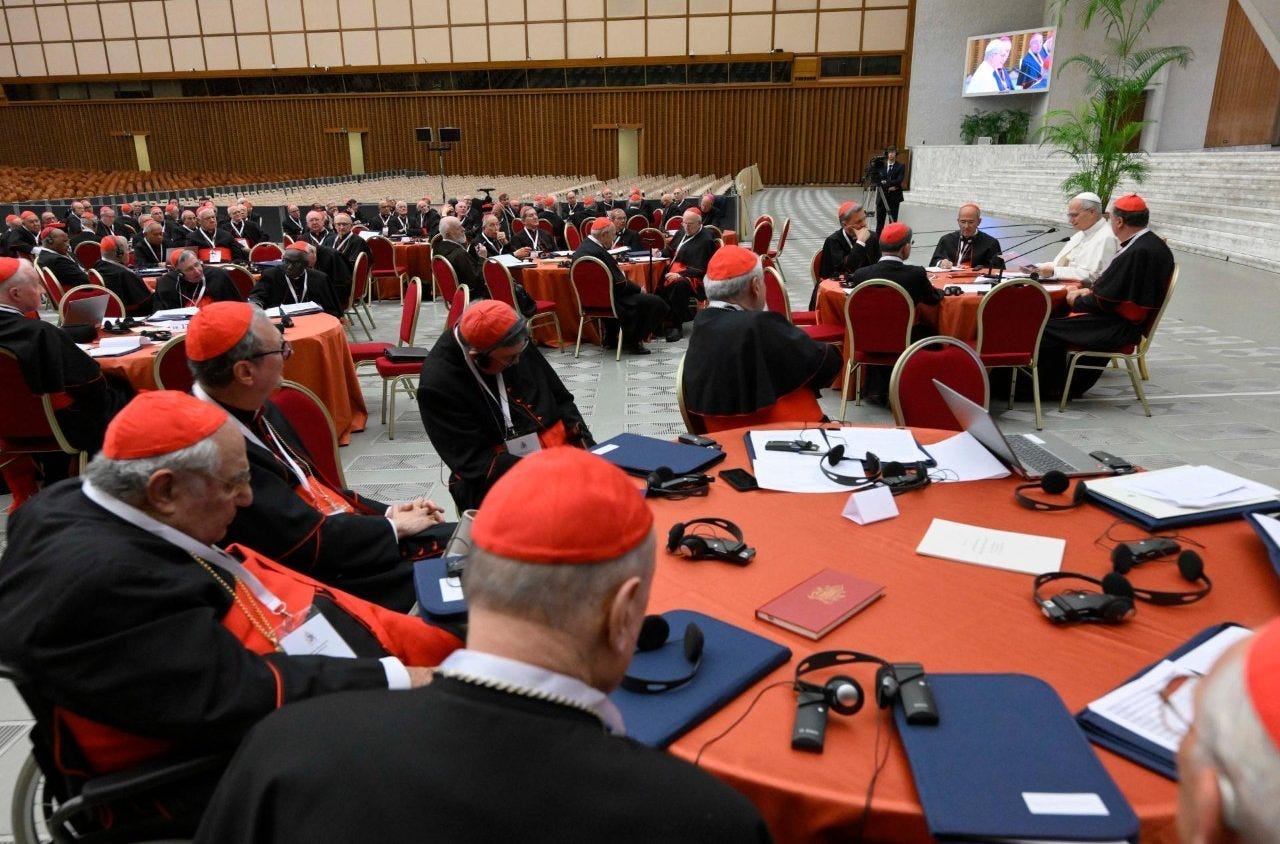
The expectation is that Leo will make an extraordinary consistory again part of the annual Roman calendar, giving the world’s cardinals a chance to meet with the pope and each other.
After years of Pope Francis choosing not to summon the college for extraordinary consistories at all, retaining only perfunctory ordinary meetings to formally elevate new cardinals, Leo has, to some extent, the chance to reinvent the wheel.
With the pope free to choose his own format for extraordinary consistories, and how and on what topics he wants to consult the college, what do his choices for the meetings tell us about how he plans to use the college?
—
The formal agenda for the two days of meetings broadly follows the format of the last consistory in January, with cardinals meeting in groups to discuss topics chosen by the pope, themed around his chosen headline topics of international affairs and evangelization.
The chosen subjects for the four working sessions — three themed around the state of the world, with two based on sections of Leo’s encyclical Magnifica humanitas, followed by a final session on the implementation of the synod — are broadly drawn, at least in the circulated agenda.
All the groups will send their feedback via email, with groups of cardinals serving as diocesan bishops presenting their summaries in the hall to the entire assembly, along with some of the other groups of non-diocesan cardinals.
The consistory’s business will conclude Saturday with a “dialogue” between the cardinals and the pope, before they adjourn to dinner.
But even this somewhat basic outline for the consistory tells us something about Leo’s expected outputs from the meetings — and, perhaps, how he wants to utilize the college itself.
For a start, the resumption of extraordinary consistories is itself significant, of course, especially in context.
Francis was sparing in summoning the world’s cardinals to discuss particular issues or themes, convening only three extraordinary consistories across his pontificate and limiting even the ordinary sessions to a minimum.
On the rare occasions the cardinals were summoned to Rome for a topical discussion — on the family and the reform of the Roman curia — some cardinals objected that, after a fractious and volatile assembly in 2014, a new format of small group discussions, narrow agendas, and strictly limited opportunities for feedback rendered the sessions meaningless.
Francis appeared to agree, effectively discontinuing them altogether. In comparison, Leo’s publicly stated intention to make the consistories annual events is a kind of monument to collegiality.
But another crucial piece of context is Leo’s having dispensed with another cardinalatial institution, the so-called C9 Council of Cardinal Advisors, created by Francis as a kind of global kitchen cabinet as he suppressed meetings of the entire college.
The balance of the Leonine changes seems to be that the pope prefers and sees the necessity of hearing from the entire college — and allowing them the chance to meet and get to know each other, both subjects of vocal frustration during the general congregations ahead of the 2025 conclave.
And, unlike Francis, Leo does not appear to be looking for, or interested in, a hand-picked representation of the larger body, either to function as a private sounding board or a kind of para-curial cabinet.
While the “small group discussion model” remains intact, it is worth noting that the final session of the consistory is an hours long open “dialogue” between the cardinals and the pope — effectively an open mic session for the college to raise whatever issues they want with Leo, suggesting again that the pope is sincerely interested in hearing the cardinals’ thoughts.
Some observers have questioned the pope’s desire to really hear from the college, though, especially in reaction to the discussion items, both for this week and the previous session in January.
Much has been made of the absence of the subject of the liturgy from the last consistory, for example, and a shadow hanging over the June session will undoubtedly be the looming threat of a schism by the leadership of the Society of St. Pius X, with their illicit episcopal consecrations set to take place in the first days of July.
Some, too, have noted that while Leo has broadly themed the discussions this week around global conflict and division versus building up the common good, rooted in sections of his recent encyclical letter, one of its more pointed and noteworthy statements — that the Church’s just war theory has become outdated — is not listed for discussion.
While observers might perceive that Leo is aiming to keep the most contentious issues off the consistory’s agenda though, another interpretation is that the pope is simply not imposing anything more than the broadest of boundaries on their conversations.
For example, during the first day’s sessions, the cardinal are asked to discuss and to give on what “sufferings, tensions and questions most strongly affect” their people and dioceses, what “signs of hope, fidelity to the Gospel and possible reconciliation” ought be given more prominence in the Church, and to consider how “tensions, divisions and conflicts affecting the world today touch the life of our Churches and our peoples.”
The second day’s sessions ask the cardinals to discuss local points of division and marginalization in the context of building up the common good.
It is a broad agenda, but by no means a lightweight set of topics — nor, indeed, could it reasonably be called prescriptive. Virtually any issue of concern to any individual cardinal could find room under one of those headings, if any feels the need to raise it.
Another question to consider is what Leo actually wants to get out of the consistory sessions. Judging by the organization and agenda, which ends with an extended open session for free dialogue with the pope, Leo’s primary aim appears to be to hear whatever wants to be said, and to hear it within the context of the entire College of Cardinals, allowing him to gauge actual consensus behind different issues and priorities and identify outlying topics which may nevertheless be of interest.
It is also worth pointing out that the absence of specific topics from the formal agenda — like the SSPX or just war theory — could signal that Leo simply isn’t interested in canvassing the global college’s opinions on granular issues, at least at this point in time.
Each pope uses the college in his own way, as best suits his style of governance — Francis did away with the general meetings in favor of hearing from the C9 on specific priorities and plans.
Leo, for now at least, may be more concerned with re-tuning the Petrine office to hear more open feedback from the global cardinals, rather than asking them to work — as a whole or via small quasi-executive committee — as a kind of policy shop for specific problems.
A knee-jerk assessment of this would be to consider it as a decrease of collaboration, but in reality (and in context) it might more appropriately be seen as a return to more established mechanisms of curial governance.
Under Francis, for example, the C9 often appeared somewhat insulated from both the rest of the College of Cardinals and from the Roman curia, and the pope himself was often seen as having a very tightly knit inner circle which, the years-long synodal process notwithstanding, often appeared impregnable and somewhat unpredictable to the rest of the hierarchy.
Just over a year into his pontificate, it seems as though Leo is most interested for the moment in helping the entire college rediscover itself and its proper role, as a whole, and hearing from the whole body, much in the way he did prior to and just after his election during the conclave last year.
That in itself is a very new — at least by immediate comparison — notion of collegiality.

