Since I left Congress, I have spent countless hours with my father lamenting the state of our country and our Church.
We both maintain a pretty active interest. In his late 80s, my father still writes a newspaper column and does a podcast about government and politics. I spend most of my time writing and speaking about issues in the Church and in politics.
At one point my father started saying – with a laugh – that he would take on the responsibility of saving our country if I would shoulder responsibility for saving the Catholic Church. I told him that, if we must, at least I knew that I was going to be successful because Jesus promised that “the gates of the netherworld shall not prevail against His Church.”
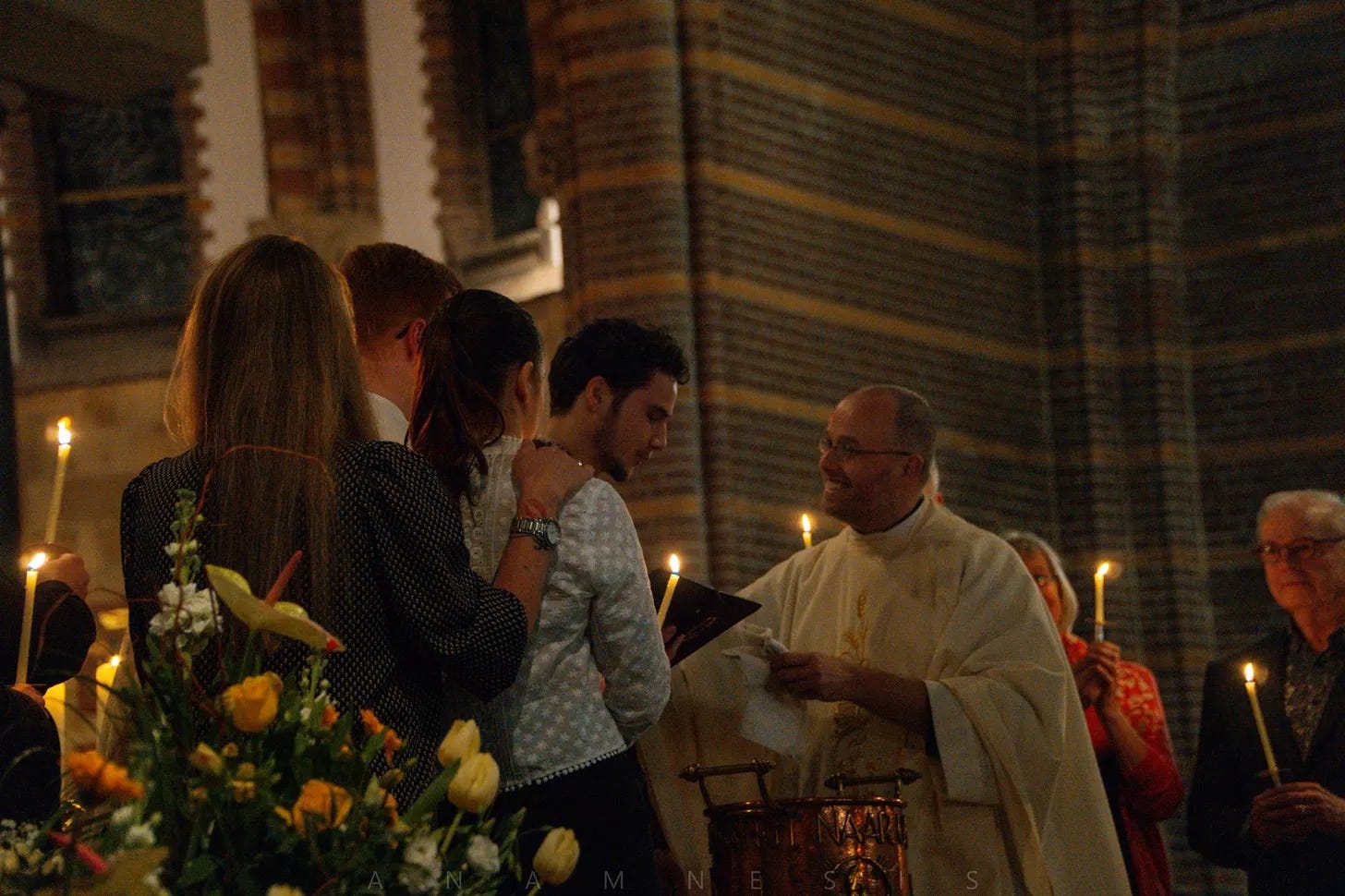
Armed with the inevitability of my success, I also told my father at Easter dinner that it looks like I am doing a much better job than he is. While few think America has taken a turn for the better recently, we have witnessed a surge of converts coming into the Church at Easter Vigil Masses across the country.
But what is really happening? And, more importantly, what should we do in response?
Major publications, including The New York Times, the Washington Post, The Atlantic, and The New York Post, have recently carried articles noting that something is going on in the Church.
A journalist at the New York Times – whose use of phrases such as “secularization is officially on pause” rather lays bare her bias – says that assertions of revival are made because this “excites people” and is “politically advantageous” for Trump and Republicans. She claims that all of this may simply be a “vibe shift” and “vibes in America can shift quickly” and be gone.
Despite my cynicism about this columnist, there may be some truth in this.
What we do know is that in the past couple of years there has been a significant increase in adults coming into the Church in America. The Pillar examined the numbers. It’s good news, but it is still below the level we saw 25 years ago. In addition, the number of infant baptisms since that time has dropped dramatically. In a Washington Post article, David Gibson, the director of Fordham University’s Center on Religion and Culture, “cautioned against mistaking an uptick in conversions for a full-blown revival.” He cites a 2025 study by the Pew Research Center that found that for every young person coming into the Catholic Church, around 12 young people had left.
We must acknowledge the reality that – barring a miracle – the Church in America is going to continue to shrink in the coming years. But while getting smaller, it could also be changing. A couple of decades ago many were baptized as infants only because it was a cultural vestige. Now they tell surveyors that they have “left” the fold, though they were never really committed. These “fallen away” Catholics are being replaced by many who are truly on fire.
Part of gauging the change they might bring to the Church requires knowing who they are and why they’re joining. When asked by the New York Times to explain who or what is responsible for the surge in new converts, Washington’s Cardinal McElroy said, “Of course we think the Holy Spirit is. But we are kind of stymied.”
As I am wont to do, I will start with my concerns.
Some of these young people are coming into the Church because of the evanescent, glimmering attractiveness of the “vibe.” Catholic online influencers are getting a lot of credit. Some of these, such as the Catholic “theo-bros,” are promoting the faith by appealing to young men’s desire for power — though, of course, there are many faithful and engaging Catholic voices online who do great work evangelizing.
Others are being drawn in by the post-liberal politics of prominent Catholics. I will never stop repeating that politics – left, right, or neither – should never drive a person’s religious faith. These shallow or shaded attractions are troubling.
But this is not the full picture. The aforementioned Washington Post story focused on St. Joseph’s Church in Manhattan’s Greenwich Village, which has seen a boom in young people attending. Attendees of a post-Mass wine social gave a variety of reasons for why they were flocking there. Some said it was a much-needed IRL (“in real life” – i.e. not online) “third space.”
Others liked that it “afforded meaningful connection and the potential to turn those connections into serious relationships.” It worked for me; I met my wife in a Catholic young adult group. Still others said that Catholicism offered beauty and tradition in an ugly and fake world. While these respondents were not necessarily all converts, these young people are showing up when many of their cohort have dropped out.
I decided to wait to finish this column until a trip to “America Week” in Rome where many Yankees gather to support various Catholic institutions in the city. The mixing of Catholicism and politics was not absent and some clergy voiced concerns about the impact of despicable online content on some young Catholic men. But there was much more of a spirit of joy about the increase in converts at Easter and a sense of hopefulness. No one there was exactly sure why this is occurring, besides the Holy Spirit. But the most thoughtful explanations were that the Church provides meaning – through deep spiritual, intellectual, and moral tradition – in a world where so many have tired of a world offering only empty pleasure.
So, how should we – the Church and each of us – respond to this moment?
First, we need to pray and act to keep this surge in conversions not just going, but growing. Let’s not just be passive while we pat ourselves on our collective Catholic back. A local priest talked about the joy of bringing 46 people into the church, but he emphasized, “Let’s get to that Pentecost number of 3,000. That’s what the Holy Spirit is leading us to. Let’s not think small, think big.”
Second, we need to make sure that we accompany these new Catholics and encourage them in understanding that faith formation is a lifelong process. I just learned that there is a formal post-Easter stage of OCIA called mystagogy. It is modeled on the form of catechesis used by the early Church Fathers to embrace and train new Christians in the practices and beliefs of the faith.
While this is officially a limited period, we need to take it seriously and continue it formally and informally. I’ve watched adults – unfortunately some friends – who joined the Church but quickly had their fire grow dim and sometimes extinguished.
It is clear to me that something is happening, even if we do not fully understand it. I have never before witnessed this type of wildfire, especially in young people. We have an opportunity to join with the Holy Spirit in growing this revival. We may be approaching the period which Pope Benedict XVI spoke about in which a smaller “purified” church of the truly faithful emerges.
I, and many others, like to pity myself about living in these times. It’s time for me to wake up and see that being part of a revival in these troubled times is a gift.

