What was the Avignon Papacy?
The city where seven successive pontiffs resided during the 14th century became an unlikely talking point this week.
As the mighty Rhône River flows down from Switzerland, through France, and out into the Mediterranean Sea, it passes through an urban area nicknamed the “City of the Popes.”
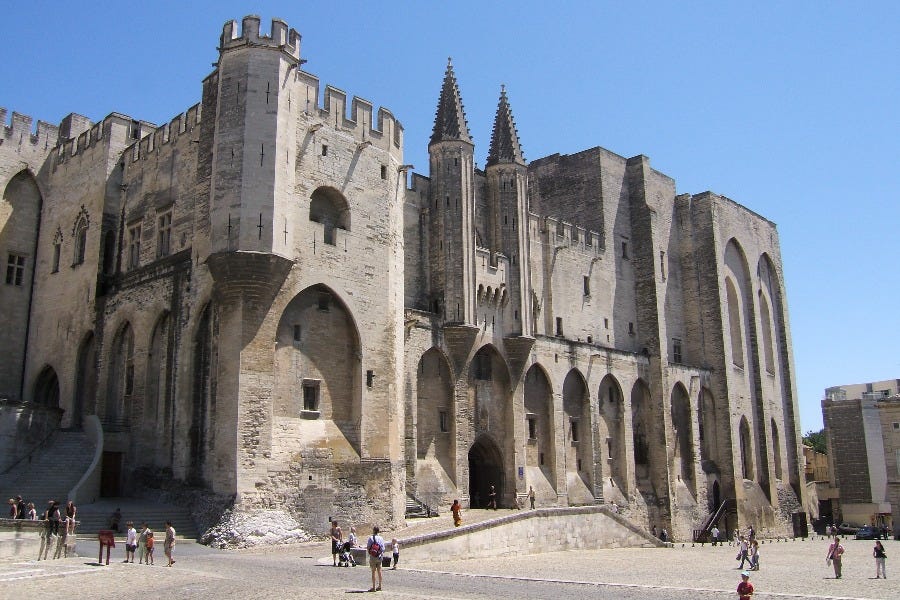
On a rocky outcrop on the river’s left bank stands a Gothic building that is one of the most important papal edifices outside of Rome. It is the Palace of the Popes, where seven successive French pontiffs resided during the 14th century.
This was the headquarters of the Avignon Papacy, a phenomenon that became an unlikely talking point this week.
It began with a report on a January meeting between Pentagon staff and the then-nuncio Cardinal Christophe Pierre.
“As tensions escalated, one U.S. official went so far as to invoke the Avignon Papacy, the period in the 1300s when the French Crown leveraged its military power to dominate the papal authority,” it said.
Subsequent reports cast doubt on whether the Avignon Papacy was actually mentioned. Nevertheless, the news cycle left Catholics around the world struggling to remember what, exactly, the Avignon Papacy was.
The beginning
The Catholic Encyclopedia says bluntly that at the start of the 14th century, Avignon was “a town of no great importance.” But that was about to change.
The trigger was the death of Pope Benedict XI in 1304 in Perugia, then located in the Papal States. The cardinals were summoned to the city to elect a successor. There were only 19 living cardinals at the time; only 15 of them made it to the conclave.
As the cardinals were divided into pro- and anti-French factions, they struggled to agree on a candidate. It took them almost a year to reach a decision. They opted for a non-cardinal: Raymond de Got, the archbishop of Bordeaux, who took the name Pope Clement V.
The cardinals asked the French pope to join them in Perugia and then travel to Rome for his coronation. He declined, ordering them instead to join him in Lyon, for a ceremony attended by Philip IV of France, known as “the Iron King” because of his inflexibility.
The event in Lyon was not exactly auspicious. As Pope Clement processed through the city, a wall collapsed, knocking him off his horse, damaging the papal tiara, and killing his brother and an elderly cardinal.
Clement V’s pontificate had an unsettled start. He moved from Bordeaux to Poitiers to Toulouse, before arriving in 1309 at a Dominican priory in Avignon, which at the time belonged to the King of Naples as Count of Provence, but lay within the borders of the Kingdom of France.
This was the start of the Avignon papacy.
The middle
Misfortune stalked Clement V even after his death in 1314. According to one account, as his body lay in state in a church, lightning struck, setting fire to his body and burning it to a crisp.
The conclave to elect his successor was agonizingly long, because by now there were three factions among the cardinals: Italian, Gascon (southwestern France), and Provençal (southeastern France). The Italians wanted to return the papacy to Rome, the Gascons to retain privileges they had acquired under Pope Clement, and the Provençal group to block the ambitions of the other two groups.
After much strife, a compromise candidate emerged in 1316: Jacques Duèze, a small, thin, and serious Frenchman who took the name John XXII.
The second Avignon pope was followed in 1334 by a third: Benedict XII, who began building the grand papal palace in the city.
Benedict XII was in turn succeeded in 1342 by Clement VI, whose reign coincided with the arrival of the Black Death, a pandemic that would kill up to 50 million people. Despite the austere times, Clement spent extravagantly, expanding the palace with a new grand chapel, and commissioning lavish frescoes with hunting and fishing scenes for the older rooms. In 1348, he bought the city of Avignon from Joanna I of Naples for 80,000 florins.
The fifth Avignon pope was Innocent VI, who ruled for a decade, from 1352 to 1362, catching some flak from St. Bridget of Sweden for his harsh treatment of the Spiritual Franciscans, a movement committed to strict poverty.
Innocent VI was followed in 1362 by Urban V, the only Avignon pope to be recognized as blessed. Urban succeeded in traveling to Rome in 1367, becoming the first pope to reach his own diocese in 60 years. But he fell ill and died on his return to Avignon.

The end
The seventh and last Avignon pope was Gregory XI, who was elected in 1370. He was the recipient of letters from St. Catherine of Siena, berating him for his hesitation in returning the papacy to Rome.
“Be manly and not fearful,” she wrote in one letter. “Answer God who is calling you to take possession of the place of the glorious shepherd, St. Peter, who you represent. Restore to Holy Church the heart of burning charity which she has lost: she is all pale because iniquitous men have drained her blood. Come, Father!”
In 1377, Gregory packed up and left for the Eternal City. He died not long after he arrived and was succeeded by an Italian pope, Urban VI. The Catholic Church then experienced the disaster known as the Western Schism, where churchmen living in Rome and Avignon simultaneously claimed to be rightful popes.
The era of the antipopes would only end in 1417, with the election of Pope Martin V as the sole, universally recognized pope.
No Frenchman has been elected pope since Gregory XI. The papal palace at Avignon was sacked during the French Revolution, used as a barracks and prison under Napoleon, and converted into a museum in 1906.


There's an excellent book, The Popes of Avignon: A Century in Exile by Mullins that provides a good history without being too long.