What’s happening to England’s dioceses?
Will English dioceses be consolidated in the coming years?
Is a drive underway to reduce the number of Catholic dioceses in England?
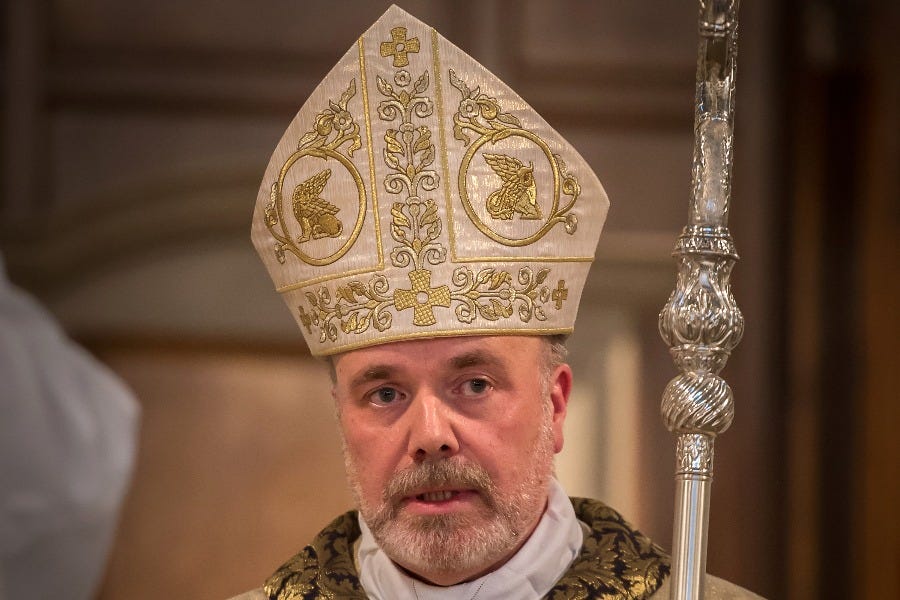
That is the question raised by a couple of recent episcopal moves by Pope Leo XIV.
On Dec. 22, 2025, the pope accepted the resignation of 76-year-old Bishop Terence Drainey of Middlesbrough. He appointed Bishop Marcus Stock, head of the neighboring Leeds diocese, as apostolic administrator of the vacant diocese.
On March 20, 2026, the pope accepted the resignation of 73-year-old Bishop Ralph Heskett, C.Ss.R., of Hallam, for health reasons. He named Stock, whose Leeds diocese also borders Hallam diocese, as apostolic administrator of the vacant diocese.
Are the Leeds, Middlesbrough, and Hallam dioceses heading for a merger? How did we reach this point? And might other English dioceses be consolidated in the coming years?
A triple merger in the cards?
On the day he was appointed administrator of Middlesbrough diocese, Bishop Stock issued a message that got swiftly to the point.
The Leeds bishop said: “It is the Holy Father’s wish that I explore with the clergy, lay faithful, and religious of our two historic sister Dioceses of Middlesbrough and Leeds how we might journey together in mission, work in close collaboration and gain from each other’s strengths in order to secure the future of the Church’s witness to Christ across the regions we serve.”
Without saying so explicitly, Stock implied that the Middlesbrough diocese might not be in line for a new bishop of its own.
If that’s true, the pope might be considering uniting Leeds and Middlesbrough under a single bishop without merging the two dioceses. This process is known as the union of two dioceses in persona episcopi (in the person of the bishop).
In the 21st century, popes have often favored this option when considering what to do with Western dioceses that have been hollowed out by demographic changes and declining Catholic practice.
Uniting dioceses in persona episcopi is generally more attractive than simply merging a weaker diocese with a stronger one, because it enables local Catholics to retain their diocesan identity, while combining resources. In any case, if the union in persona episcopi is successful, the dioceses can be merged at a later date.
Might the plan be for Leeds and Middlesbrough to skip the in persona episcopi stage and head straight to a merger? Some consultation materials on the Middlesbrough diocese’s website speak of “the amalgamation of the two dioceses.” But other materials talk of bringing the dioceses under one bishop. So the exact nature of any unification isn’t clear at this stage.
If Leeds and Middlesbrough are heading for union or merger, where does Hallam fit into the picture?
Stock has also discussed that, in a message issued on the day he was appointed as Hallam’s administrator.
He said: “The Holy Father has requested that I begin a consultation with the clergy, religious, and lay faithful of the Diocese of Hallam about a possible reunification with the Diocese of Leeds, from part of which Hallam was created in May 1980.”
The phrase “possible reunification” again suggests that an in persona episcopi union or outright merger of Leeds and Hallam is on the table.
If both Hallam and Middlesbrough are in the process of uniting with Leeds, then it is possible that in a few years, Stock will be known as the Bishop of Leeds-Hallam-Middlesbrough.
If that sounds unwieldy, consider Italy, where mergers have created entities such as the Diocese of Altamura-Gravina-Acquaviva delle Fonti and the Diocese of Assisi-Nocera Umbra-Gualdo Tadino.
How did we get here?
After centuries of persecution following the Reformation, Catholics in England and Wales welcomed the restoration of the hierarchy in 1850.
That year, Pope Pius IX issued the bull Universalis Ecclesiae, replacing the existing system of vicars-apostolic with 13 dioceses. They consisted of the Metropolitan Archdiocese of Westminster and the 12 suffragan dioceses of Beverley, Birmingham, Clifton, Hexham, Liverpool, Newport and Menevia, Northampton, Nottingham, Plymouth, Salford, Shrewsbury, and Southwark.
The Beverley diocese, which covered the county of Yorkshire, was divided in 1878 into the dioceses of Leeds and Middlesbrough. The Hallam diocese was formed in 1980 with territory taken from the dioceses of Leeds and Nottingham.
Hallam is not only the most recently created territorial diocese in England; it also has the smallest Catholic population. Those two factors alone make it a candidate for a union or merger with a larger diocese.
The Middlesbrough diocese is a century older than Hallam, but it also has a relatively small Catholic population (though it’s actually grown in recent years). That appears to make it vulnerable to reconfiguration.
What might happen next?
If the reorganization process in neighboring Ireland is anything to go by, Church authorities might not only be thinking of combining Leeds, Middlesbrough, and Hallam.
Western Ireland has seen a succession of unions in persona episcopi, and there is speculation the process could spread to other parts of the country.
If Middlesbrough and Hallam are earmarked for unions or mergers because of their small Catholic populations, what about other similarly sized dioceses?
The Diocese of Plymouth served 69,300 Catholics in 2023. That’s more than Hallam’s 65,735, but fewer than Middlesbrough’s 97,700. Plymouth is one of the original 1850 dioceses, which might make Church leaders reluctant to combine it. But in purely numerical terms, there might be an argument for joining it with either of its larger neighbors, the dioceses of Clifton or Portsmouth. Of the two, Portsmouth would be the more likely because Portsmouth and Plymouth are both in the ecclesiastical province of Southwark.
The Diocese of Lancaster, too, might be a candidate for change, with 100,600 Catholics in 2023. The diocese was created in 1924, from parts of the Archdiocese of Liverpool and the Diocese of Hexham and Newcastle. Reabsorption into either diocese would not be a surprise, given the Lancaster diocese’s Catholic population has declined steadily since the 1970s.
The Diocese of East Anglia was formed in 1976, from the Northampton diocese. It served 111,200 Catholics in 2023. A union or merger with Northampton is conceivable, though it is in some respects a lively diocese and includes the Catholic National Shrine and Basilica of Our Lady at Walsingham.
It’s important to stress that there are currently no signs of change concerning Plymouth, Lancaster, and East Anglia. These are only imagined future scenarios, based solely on numbers.
Such decisions are rarely made on numbers alone. There are plenty of dioceses with fewer than 100,000 Catholics with stable futures. History, geography, and leadership are other important factors.
Weekly Mass attendance in England is recovering after the COVID-19 crash. Adult baptisms are surging. But this is occurring after decades of decline that have left the Catholic Church in England with structures that are no longer a perfect fit. Further changes to dioceses therefore cannot be ruled out.


