What’s next? Anglican-Catholic ecumenism, past and future
How should Catholics respond to the installation of Dame Sarah Mullally as the Archbishop of Canterbury?
How should Catholics respond to the installation of Dame Sarah Mullally as the Archbishop of Canterbury, a role that makes her the first woman to lead the Church of England and the global Anglican Communion?
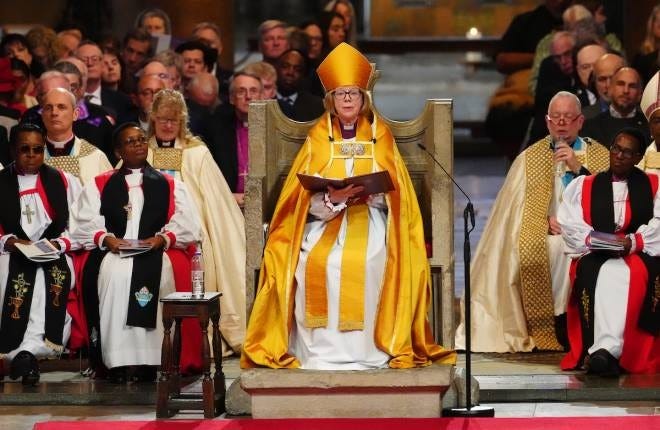
To understand the extent to which this development alters the quality of the relationship between the Anglican Communion and the Catholic Church — and so how we should react — we need to go back almost 20 years to the debates surrounding the ordination of women as bishops in the Church of England.
While the Episcopal Church in the United States began to have women as bishops in 1989, the Church of England — still today considered the ‘mother church’ of Anglicans worldwide — played the whole issue more cautiously.
The General Synod, which is the Church of England’s governing body, eventually opened the way to women as priests in 1992. But it wasn’t until 2008 that it moved to include women as bishops. That vote — I was present in the synod chamber — was amongst the most traumatic in modern Anglicanism, not least because of the robust way in which it also brought to an end any and all structural means of providing for those Anglicans who, in good conscience, could not accept these changes (namely, by having their own “flying bishops.”
The drama behind this in fact continued for several years, with a second proposal that would have finally implemented the change being narrowly defeated by just a handful of votes in 2012. It was another two years before things settled down enough for the synod to pass legislation, which in December 2014 led to the appointment of Libby Lane as the first woman to be named a bishop in the Church of England.
In the period leading up to all of this, the Catholic Church was represented in its major ecumenical relations by Cardinal Walter Kasper, then-President of the Pontifical Council for Promoting Christian Unity.
Already in 2006, Cardinal Kasper had cautioned the General Synod of the Church of England about proceeding with the ordination of women as bishops, signaling that to do so would not only disrupt the ecumenical conversation that had borne so much fruit since the 1960s, but would definitively alter the possibility of eventual reconciliation.
About every ten years, the world’s Anglican bishops descend on Canterbury for a gathering known as The Lambeth Conference. It so happened that 2008 — the year of the first synod vote — coincided with one such conference, and as an important ecumenical partner Cardinal Kasper was invited to speak to the 650 or so Anglican bishops.
In his address, he made much of the positive steps taken in relations between Anglicans and the Catholic Church since the Second Vatican Council. The council’s decree on ecumenism Unitatis redintegratio had acknowledged a special place for Anglicanism amongst the communities that emerged from the Reformation, on account of certain traditions and institutions that in part continued to exist.
Since then, as Cardinal Kasper noted, there have been several formal ecumenical dialogues — stable bodies for conversations between the Catholic Church and the Anglican Communion on points of commonality and divergence — which produced texts to promote greater understanding and harmony.
There had also been numerous ecumenical encounters, notably the meeting of Pope Paul VI and the Archbishop of Canterbury, Dr Michael Ramsey in 1966, and the visit of Pope John Paul II to England in 1982, which established personal relationships between key figures, all with the prospect of finding common ground.
More directly addressing the question of the ordination of women as bishops, Cardinal Kasper noted: “this decision to ordain women implies a turning away from the common position of all Churches of the first millennium, that is, not only the Catholic Church but also the Oriental Orthodox and the Orthodox Churches. We would see the Anglican Communion as moving a considerable distance closer to the side of the Protestant churches of the 16th century, and to a position they adopted only during the second half of the 20th century.”
In other words, with the ordination of women as bishops, the historical “tension” inherent within Anglicanism — a product of the Protestant reformation but retaining certain Catholic elements — would be (from a Catholic perspective) definitively resolved in a way that took up a more clearly Protestant approach to ecclesial life.
To the extent that dialogue between Anglicans and Catholics had relied up to then on that ambiguity, with the hope that it might be resolved in favor of Catholic teaching, such dialogue would cease to be a realistic vehicle for the visible reunion of Anglicans and Catholics.
Cardinal Kasper made this point unambiguously clearly: “While our dialogue has led to significant agreement on the understanding of ministry, the ordination of women to the episcopate effectively and definitively blocks a possible recognition of Anglican Orders by the Catholic Church.”
So, from the moment that the Church of England proceeded to the ordination of women as bishops in 2008, the effective possibility of institutional reunion between Anglicans and Catholics has been off the table. Of course, in God’s good providence nothing is truly impossible, but from every practical aspect the necessary mutual recognition of orders and sacraments no longer has a reasonable path to success.
It was in part for this reason, then, that Pope Benedict XVI reached out to unity-minded Anglicans left somewhat abandoned by their own church after 2008, in his apostolic constitution Anglicanorum coetibus.
This provided for personal ordinariates—structures equivalent to dioceses—for the ongoing life and worship of former Anglicans, now within the full communion of the Catholic Church. None of us who joined the ordinariates became Catholic simply because of the ordination of women as bishops. If you ask, we describe this as a symptom of a more fundamental issue of authority.
But as a sign of the continuity that exists between this development and the ordinariates, it’s telling to note that several of us who were present for that synod vote in 2008 (including the now-Bishop David Waller of the Personal Ordinariate of Our Lady of Walsingham) are now clergy and laity in the ordinariates.
The move, represented by Anglicanorum coetibus, from a model intended to facilitate church-to-church reunion to one more comfortable speaking church-to-group, has also opened up the possibility of parallel ecumenical dialogues between the Catholic Church, locally and universally, and other, so-called “continuing Anglicans.” This includes those groups who have left the Anglican Communion since the 1970s, and who now make up a very large proportion of those who claim an Anglican pedigree, in bodies like the Global Fellowship of Confessing Anglicans (GAFCON).
The Anglican tradition undoubtedly has much to offer the Catholic Church, especially in Anglophone countries. It has massively shaped our culture, and it has given rise to numerous heroic converts from St Edmund Campion and St John Henry Newman, to St Elizabeth Ann Seton and Fr Thomas Byles (who led prayers during the sinking of the Titanic).
As if to make this point, two days after the installation of the new Archbishop of Canterbury, the Dicastery for the Doctrine of the Faith published a new document entitled Characteristics of the Anglican Heritage as Lived in the Ordinariates Established Under the Apostolic Constitution Anglicanorum Coetibus.
This sets out the various ways in which this rich patrimony has already—in the few short years since the ordinariates’ establishment in 2011/12—begun to be lived out by former Anglicans, now happily within the full communion of the Catholic Church.
There are numerous good men and women who continue to live their Christian life from within Anglicanism. Some are bound by a sense of history to the church of their birth; others by duty to the people of the parishes. Given this new stage of ecumenical dialogue — which has been with us for a decade or more at this point — it is incumbent on Catholics to befriend them, to pray earnestly and sincerely for the reunion of all Christians, and to adopt an attitude of generosity and welcome, so that (in the immortal words of St John Henry Newman) “some means of drawing to us so many good people, who are now shivering at our gates, may be discovered.”
If you ask me, the ordinariate is it.
Father James Bradley is a Priest of the Personal Ordinariate of Our Lady of Walsingham and Assistant Professor of Canon Law at The Catholic University of America in Washington, DC.


@Dylan Campbell @Wesley Walker @Nate Marshall @J. A. Siemer @J. M. Terry check this out!
Thank you for this, Fr. Bradley! We have a priest at our parish who came into the church and became a priest toward the end of Pope Benedict's pontificate (in fact, his dispensation from celibacy was signed on one of Pope Benedict's last days as Pope... he is a husband and father.) I saw the pictures from that installation and felt great sadness which I attribute to this sense of greater disunity that you eloquently highlight here. We love our former Anglican priest and pray for unity and those who are on the fence to take the leap across the Tiber.