Pilgrims arriving at the Shrine of the Most Holy Trinity in Vallepietra approach on foot after hours of walking through the mountains, traveling in groups behind decorated banners. Inside, they touch the rock above them. When they leave, they walk backwards, unwilling to turn their backs on the image of the Holy Trinity they have come to venerate.
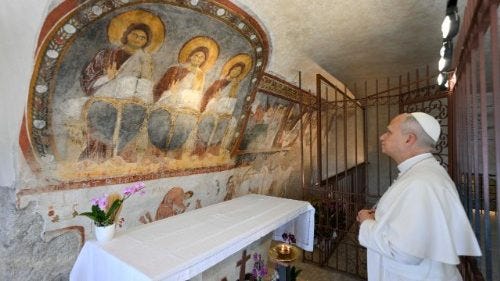
Nearby, in Subiaco, pilgrims descend into another cave, where St. Benedict of Nursia lived in solitude at the beginning of the sixth century. There, visitors kiss the knee of the saint’s statue, following the example of generations who have made the same gesture.
In a surprise move, Pope Leo XIV visited both sites July 22. His itinerary connected two very different expressions of Catholic pilgrimage: a mountain shrine shaped by centuries of local popular devotion, and the cave where a young hermit began the spiritual life that would help shape Western monasticism.
The Shrine of the Most Holy Trinity stands beneath a sheer wall of rock on Mount Autore, near the border between the Lazio and Abruzzo, and located more than 4,000 feet above sea level.
The origins of the shrine are unknown. According to one legend, a farmer was plowing on the mountain when his oxen separated from the plow and plunged into a ravine. When the frantic farmer was finally able to reach the oxen, he found them kneeling before an image of the Holy Trinity inside a cave.
Another tradition tells of two Christians fleeing persecution under Emperor Nero. On the mountain, they encountered the apostles Peter and John, while an angel brought them food and caused a freshwater spring to flow from a rock. The next day, the image of the Holy Trinity appeared and blessed the mountain.
Historians have instead suggested that Eastern monks or hermits may have established the place of worship. The shrine’s most revered image is Byzantine in nature, with the three Persons of the Trinity represented as three identical, seated figures of Christ, each holding an open book, and raising his right hand in blessing.
That fresco is the center of devotion at Vallepietra, which has spanned centuries.
After Pentecost, and in preparation for Trinity Sunday, pilgrims travel to the shrine in companies formed in towns across Lazio and Abruzzo. Some begin walking during the night, spending hours on mountain paths before reaching the shrine. Each company follows its own banner, carried at the front of the procession.
Across the centuries, pilgrims have maintained certain traditions. Some touch the cave’s rock before leaving, and walk backwards out of the door. Some carry stones as symbols of the burden of sin, and cast them away along the route. Another older custom directly relates to the Simbrivio Springs, mountain water that flows around and beneath the shrine. In this ritual, two people place their hands together in the pure water to establish a bond of spiritual friendship, commitment, and community.
On the morning of Trinity Sunday, young women from Vallepietra traditionally perform the Pianto delle Zitelle — the “Weeping of the Spinsters” — a centuries-old sacred drama recounting Christ’s Passion. The performers wear white, except for the woman portraying the Virgin Mary, who is dressed in black. The women alternate between the holy mysteries of the Passion of the Christ, and sung choral verses from the Miserere psalm.
The shrine also preserves “ex-votos,” objects left behind in gratitude for miracles or prayers answered, in an ever-growing museum. These include banners left by previous companies, traditional silver hearts, and photographs, all offering a record of the communities that have traveled there for generations.
Leo is the first pope to visit the shrine, though it does include a first-class relic of St. John Paul II.
From Vallepietra, Leo traveled to the Monastery of St. Benedict at Subiaco, known as the Sacro Speco, or Holy Cave. It has been one of the most revered sites in Benedictine spirituality for nearly one thousand years.
The monastery’s chapels, stairs, and passageways built against and directly into the side of Mount Taleo. The Sacro Speco is the small cave where St. Benedict of Nursia lived after leaving his wealthy Roman family in the early sixth century.
Wanting to follow the example of the early Desert Fathers, St. Benedict sought to live in prayerful solitude, though his reputation as a spiritual guide drew the faithful to him; eventually 13 monasteries were founded nearby.
The cave became a place of pilgrimage, and the present monastery developed around it during the Middle Ages. Its churches and chapels are covered with frescoes from several periods, including an image before which Pope Leo stopped for prayer: the oldest surviving portrait of St. Francis of Assisi.
St. Francis came to Subiaco as a pilgrim in the early 13th century. The portrait identifies him simply as “Brother Francis,” and he appears without a halo and without the stigmata.
Deeper inside the complex is the cave itself, marked by a 17th-century statue of Benedict seated in prayer. Following the custom of pilgrims before him, Leo bent to kiss the statue’s knee, and recited the Our Father with those accompanying him.

Leo then continued to the nearby Monastery of St. Scholastica, named for Benedict’s sister, where most of Subiaco’s Benedictine community now resides. He toured the monastery and ate lunch with the assembled religious community.
The pope delivered no major address during the excursion, and instead, followed the examples of generations of pilgrims before him: silent prayer before ancient images, entrance into a hermit’s cave, and the customary kiss offered to Benedict.


I really wish America had more local, folk veneration customs. Not to say it doesn’t exist…in some parts of the Midwest you can find wayside shrines in the countryside that remind you that the locals are descended from European Catholic peasants, regardless of their own piety or lack thereof. And Bl. Solanus Casey seems to be morphing into a European style patron saint of a region with genuine devotion from the faithful here in his native St. Croix Valley. I also love Ex Voto offerings…it’s so real and human.